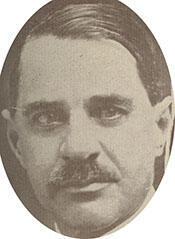
Eliakim “E. P. Walton” Persons Walton (February 17, 1812 – December 19, 1890) was an American journalist, editor, and politician who served three terms as a U.S. Representative from Vermont. He was born in Montpelier, Vermont, to Ezekiel Parker Walton and Prussia Persons. Raised in the state capital, he attended the common schools and the Washington County, Vermont, grammar school. As a young man he was apprenticed to a printer, an experience that began his lifelong association with the press and publishing. He also studied law under United States Senator Samuel Prentiss, a distant relative, and was admitted to the bar, though he chose not to engage in the active practice of law, instead devoting his career primarily to journalism and public affairs.
Walton’s early professional life was closely tied to the printing trade and newspaper work. From 1826 until 1827 he lived in Essex, New York, where he edited and printed his first newspaper, the Essex County Republican. Returning to Vermont, he became involved in the family’s publishing enterprises and emerged as a prominent figure in the state’s journalistic community. He served as editor of Walton’s Vermont Register, a widely used annual reference work, and after the retirement of his father, Eliakim Parker Walton, in 1853, he became the sole proprietor of the Vermont Watchman, a leading Montpelier newspaper, a position he held until 1868. Beyond his own publications, Walton played an important role in organizing the newspaper profession in the state. He was the organizer and first president of the Editors and Publishers’ Association, and he held the office of president of that body for more than twenty years, helping to shape journalistic standards and cooperation among Vermont editors.
Walton’s prominence in journalism and his legal training naturally led him into public life. He was first elected to the Vermont House of Representatives as a Whig in 1853, marking his formal entry into elective office. As the Whig Party dissolved and the Republican Party emerged in the 1850s, Walton aligned himself with the new Republican organization. His experience as an editor and his reputation as a public commentator on political issues positioned him as a leading Republican voice in Vermont during a period of intense national debate over slavery, union, and sectional conflict.
As a member of the Republican Party representing Vermont, Eliakim Persons Walton contributed to the legislative process during three terms in office. He was elected as a Republican to the Thirty-fifth, Thirty-sixth, and Thirty-seventh Congresses, serving in the U.S. House of Representatives from March 4, 1857, until March 3, 1863. Walton’s service in Congress occurred during a significant period in American history, encompassing the final years before the Civil War and the early phase of the conflict itself. During these years he participated in the democratic process and represented the interests of his Vermont constituents as the nation confronted secession and war. After three consecutive terms, he declined to be a candidate for reelection in 1862 and returned to his editorial and literary labors in Montpelier, resuming his influential role in Vermont’s public discourse.
Following his congressional service, Walton remained active in Republican politics and state government. In 1864 he served as a delegate to the Republican National Convention, which renominated President Abraham Lincoln during the Civil War. He was a member of the Vermont state constitutional convention in 1870, contributing to the revision and refinement of the state’s fundamental law. Walton later served in the Vermont State Senate, holding office during the sessions of 1874 and 1878. His legislative and constitutional work at the state level complemented his earlier federal service and reflected his continuing engagement with public policy and governance in Vermont.
In addition to his political and journalistic activities, Walton played a significant role in Vermont’s educational and historical institutions. From 1875 until 1887 he served as a trustee of the University of Vermont and of the Vermont State Agricultural College, helping to oversee the development of higher education in the state during a period of expansion in public and land-grant institutions. He was also a leading figure in the preservation and interpretation of Vermont’s history. From 1876 until 1890 he served as president of the Vermont Historical Society. In that capacity he edited Volume II of the Collections of the Vermont Historical Society, including the important Haldimand Negotiations papers, and he edited eight volumes of Records of the Governor and Council, contributing substantially to the documentary record of Vermont’s colonial and early statehood eras.
Walton’s personal life included two marriages. He married Sarah Sophia Howes, and following her death he married Clara P. Snell Field. He continued to reside in Montpelier for most of his later years, remaining associated with the city where he had been born and where much of his professional and political life had unfolded. Eliakim Persons Walton died on December 19, 1890, in Montpelier, Vermont. He is interred in Green Mount Cemetery in Montpelier, leaving a legacy as a prominent Vermont editor, historian, and Republican officeholder who served both his state and the nation in the mid-nineteenth century.
Congressional Record