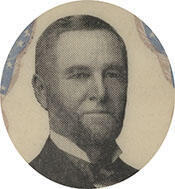
Edwin Hurd Conger (March 7, 1843 – May 18, 1907) was an American Civil War soldier, lawyer, banker, Iowa congressman, and United States diplomat who played a prominent role in both domestic politics and U.S. foreign relations at the turn of the twentieth century. He was born near Knox in Starke County, Indiana, and spent his early years in the rural Midwest. During his youth he worked on farms and in local enterprises, experiences that acquainted him with the economic and social conditions of the region he would later represent in Congress.
During the American Civil War, Conger enlisted in the Union Army, serving in the 7th Iowa Cavalry Regiment. His military service on the western frontier, including duty in territories affected by the conflict and its aftermath, helped shape his views on national unity and federal authority. After the war, he pursued higher education, attending Lombard College in Galesburg, Illinois, from which he graduated. He then studied law, was admitted to the bar, and began practicing as an attorney. In addition to his legal work, he became involved in banking, building a professional reputation that combined legal expertise with financial and commercial experience.
Conger moved to Iowa, where he established himself in the town of Dexter in Dallas County and became active in Republican Party politics. His standing as a lawyer and banker, along with his Civil War record, made him a credible candidate for public office. He served as treasurer of Dallas County, Iowa, which provided him with administrative experience and further strengthened his ties to local constituents. By the early 1880s, he had become a recognized figure in Iowa Republican circles, positioning him for higher office.
Edwin Hurd Conger served as a Representative from Iowa in the United States Congress from 1885 to 1891. In 1884, when the incumbent Republican U.S. Representative from Iowa’s 7th congressional district, John A. Kasson, declined to seek re-election, Conger won the Republican nomination to succeed him and then won the general election. Kasson’s early resignation to accept an ambassadorship, and the election of Hiram Y. Smith to serve out Kasson’s unexpired term, resulted in Conger formally succeeding Smith rather than Kasson. A member of the Republican Party, he contributed to the legislative process during three terms in office, being re-elected in 1886 and 1888. His service in Congress occurred during a significant period in American history, marked by industrial expansion, monetary debates, and evolving federal economic policy. As a member of the House of Representatives, Conger participated in the democratic process and represented the interests of his Iowa constituents.
During his tenure in the House, Conger rose to a position of influence. He served as chairman of the Committee on Coinage, Weights, and Measures from 1889 to 1890, a role that placed him at the center of important discussions over the nation’s monetary standards and the regulation of coinage and measures at a time when questions of gold, silver, and currency policy were of intense national interest. In 1890, he entered the race for a fourth term in Congress, seeking to continue his legislative career. His congressional record reflected the priorities of a Midwestern Republican of his era, attentive to agricultural, financial, and infrastructural issues affecting his district and the broader region.
After leaving Congress, Conger’s career shifted decisively toward diplomacy. Drawing on his legislative experience and party connections, he was appointed by President Benjamin Harrison as United States minister to Brazil, where he served in the 1890s during a period of political transition in that country following the fall of the Brazilian monarchy. His diplomatic service in South America enhanced his standing as an international representative of the United States and prepared him for more challenging assignments.
Conger achieved his greatest international prominence as the United States minister to China. Appointed to that post in the late 1890s, he was serving in Beijing during the Boxer Rebellion of 1900, a violent anti-foreign and anti-Christian uprising that engulfed northern China. As the United States’ minister to China during the Boxer Rebellion, Conger, his family, and other Western diplomatic legations were besieged in the foreign legation quarter of Beijing for several weeks. They endured severe hardship and danger until they were rescued by the China Relief Expedition, an international military force organized by several foreign powers, including the United States. Conger’s conduct during the siege and his subsequent role in negotiations over the Boxer Protocol made him a notable figure in the history of American diplomacy in East Asia.
In his later years, Conger continued to be associated with diplomatic and public affairs, though his most active period of service had passed. He eventually returned to the United States, where he lived in retirement from public office. Edwin Hurd Conger died on May 18, 1907, in Pasadena, California. His career, spanning military service in the Civil War, legal and banking work in the Midwest, three terms in the U.S. House of Representatives, and high-profile diplomatic posts in Brazil and China, reflected the expanding role of the United States at home and abroad in the late nineteenth and early twentieth centuries.
Congressional Record