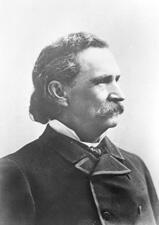
Edward Cary Walthall (April 4, 1831 – April 21, 1898) was a general in the Confederate States Army during the American Civil War and a Reconstruction-era United States senator from Mississippi. A member of the Democratic Party, he represented Mississippi in the United States Senate from 1885 to 1894 and again from 1895 until his death in 1898, contributing to the legislative process during three terms in office.
Walthall was born in Richmond, Virginia, on April 4, 1831. In 1841 he moved with his family to Mississippi, where he came of age in the antebellum South. He attended St. Thomas Hall in Holly Springs, Mississippi, where he studied law. After completing his legal studies, he was admitted to the bar in 1852 and began practicing law in Coffeeville, Mississippi. His abilities as a lawyer and advocate quickly brought him to public attention, and he entered public service as a young man.
In 1856 Walthall was elected district attorney for the tenth judicial district of Mississippi, a position he held with distinction. He was reelected to the same office in 1859, underscoring his standing in the legal and political community of the state on the eve of the Civil War. During these years he built a regional reputation as a capable lawyer and public official while deepening his ties to the Democratic Party and to Mississippi’s political leadership.
With the outbreak of the Civil War, Walthall entered the Confederate Army on April 27, 1861, as a lieutenant in the 15th Mississippi Infantry. He was promoted to lieutenant colonel on July 21, 1861, and fought with his regiment at the Battle of Mill Springs on January 19, 1862. On April 11, 1862, he was elected colonel of the 29th Mississippi Infantry and took part in the Siege of Corinth and the Confederate Heartland Offensive. Commanding a brigade in the Army of Tennessee by November 1862, he was appointed brigadier general on December 13, 1862. He led his brigade in the Tullahoma Campaign and fought at the Battle of Chickamauga on September 19–20, 1863. Walthall particularly distinguished himself at the Battle of Missionary Ridge on November 25, 1863, where he led his brigade over a ridge and held back advancing Federal troops long enough to facilitate the Confederate army’s escape; he was wounded in the foot and captured there but was quickly exchanged. He was again wounded at the Battle of Resaca on May 15, 1864.
As the war continued, Walthall rose to higher command. On June 6, 1864, he received a temporary promotion to major general and advanced to division command in Lieutenant General Alexander P. Stewart’s corps of the Army of Tennessee. He saw heavy action in the late-war campaigns, including the Battle of Franklin on November 30, 1864, where he was wounded or at least badly bruised and had two horses shot from under him, yet returned quickly to duty. In the aftermath of the Confederate defeat at Nashville, Walthall played a key role in covering the retreat of General John Bell Hood’s army. During the Carolinas Campaign, while Lieutenant General Alexander P. Stewart commanded the remnant of the Army of Tennessee under the overall command of General Joseph E. Johnston, Walthall acted as commander of the army’s III Corps from March 16, 1865, until April 9, 1865, when he returned to division command in the same corps. He and his division surrendered with Johnston at Bennett Place on April 26, 1865, and he was paroled at Greensboro, North Carolina, on May 1, 1865.
After the war, Walthall returned to civilian life and resumed the practice of law in Coffeeville, Mississippi. In 1871 he moved to Grenada, Mississippi, where he continued his legal practice. Over the next decade and a half he reestablished himself as a prominent attorney and Democratic leader in the state during the Reconstruction and post-Reconstruction periods, participating in the political realignment that restored Democratic control in Mississippi. His legal and political work during these years laid the foundation for his subsequent elevation to national office.
Walthall entered the United States Senate when he was appointed as a Democrat to fill the vacancy caused by the resignation of Senator Lucius Q. C. Lamar. He took his seat on March 9, 1885, and was subsequently elected by the Mississippi legislature to complete the unexpired term. He was reelected in 1889, serving continuously until January 24, 1894, when he resigned due to ill health. During this period his service in Congress occurred during a significant era in American history marked by Reconstruction’s aftermath, the rise of the New South, and debates over tariffs, currency, and federal power. As a member of the Senate, he participated actively in the democratic process and represented the interests of his Mississippi constituents. In the Fifty-third Congress he served as chairman of the Committee on Military Affairs, reflecting both his wartime experience and his influence in matters relating to national defense.
Despite his earlier resignation, Walthall’s standing in Mississippi remained strong, and he was again elected to the United States Senate for the term beginning March 4, 1895. He returned to Washington and served from that date until his death in office. During this final period of service he was a member of the Committee on Revolutionary Claims in the Fifty-fifth Congress, continuing his committee work on historical and military-related matters. In all, he served three terms in the Senate between 1885 and 1899, contributing to national legislation and policy during a transformative period in the post–Civil War United States.
Edward Cary Walthall died in Washington, D.C., on April 21, 1898, while still serving in the Senate. Funeral services were held in the Chamber of the United States Senate, a mark of the esteem in which he was held by his colleagues. His body was returned to Mississippi, and he was buried in Hillcrest Cemetery in Holly Springs. In recognition of his service to the state and his prominence in its history, Walthall County, Mississippi, was named in his honor. His papers are preserved in collections such as the E. C. Walthall Collection at the University of Mississippi, and his name appears in standard reference works on Civil War generals and members of Congress who died in office.
Congressional Record