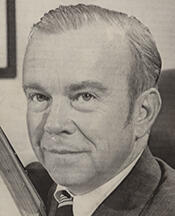
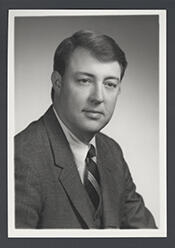
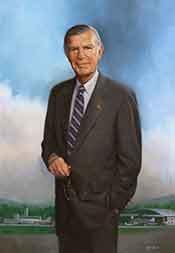
Edward Lewis Sittler Jr. (April 21, 1908 – December 26, 1978) was a Republican member of the U.S. House of Representatives from Pennsylvania. He was born in Greensburg, Westmoreland County, Pennsylvania, and moved with his parents to Uniontown, Fayette County, Pennsylvania, while still an infant. Raised in Uniontown, he came of age in the early twentieth century in a community that would remain the center of his personal, professional, and political life.
Sittler pursued higher education at Brown University in Providence, Rhode Island, from which he graduated in 1930. Shortly after completing his studies, he returned to Pennsylvania and entered private business. From 1931 to 1937 he worked as a salesman for an ice cream company, gaining experience in sales and local commerce during the difficult years of the Great Depression. His early involvement in business coincided with the beginning of his participation in local civic affairs.
In 1934, Sittler was elected to the Uniontown School Board, marking his first entry into public office. He quickly rose to a leadership role, serving as president of the board in 1936 and 1937. In 1937 he also began a new professional career as a field underwriter for the Mutual Life Insurance Company of New York, a position that reflected his growing expertise in financial and insurance matters. Through these overlapping responsibilities in education and business, he established himself as a prominent figure in Uniontown’s civic and professional life.
During World War II, Sittler entered military service. He enlisted as a private in the United States Army in February 1943 and served in the Ordnance Corps in the European Theater of Operations. Over the course of his service he advanced in rank, and at the conclusion of his active duty he was released to the Inactive Reserve as a captain in August 1946. His wartime service added a military dimension to his record of public service and leadership.
After returning from the war, Sittler resumed his engagement in local government. He was elected mayor of Uniontown and served in that office from 1948 to 1951. As mayor, he oversaw municipal affairs in the postwar period, a time of adjustment and growth for the community. His tenure as mayor further elevated his political profile within Fayette County and the surrounding region and set the stage for his candidacy for national office.
In 1950, Sittler was elected as a Republican to the 82nd United States Congress from Pennsylvania’s 23rd congressional district, defeating incumbent Democratic Congressman Anthony Cavalcante. He served a single term in the U.S. House of Representatives from January 3, 1951, to January 3, 1953. During his time in Congress he represented a largely industrial and coal-producing region of southwestern Pennsylvania. Following redistricting prior to the 1952 elections, he was compelled to run in the newly configured 26th congressional district, where he faced incumbent Democratic Congressman Thomas E. Morgan. Sittler was an unsuccessful candidate for reelection in that 1952 contest.
Following his congressional service, Sittler remained active in Republican Party affairs and local government. He served as Republican State committeeman for Fayette County, Pennsylvania, from 1960 to 1972, participating in party organization and strategy at the state level over more than a decade. In addition, he held county office as the minority Fayette County Commissioner from 1968 to 1971, continuing his long-standing involvement in public administration and local governance. Edward Lewis Sittler Jr. died on December 26, 1978, closing a career that spanned business, military service, municipal leadership, and representation in the United States Congress.
Congressional Record