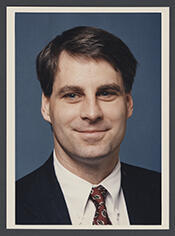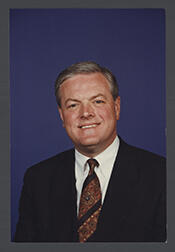
Edward Allan Pease (born May 22, 1951) is an American politician, lawyer, and higher education and corporate executive from Indiana. A member of the Republican Party, he served as a Representative from Indiana in the United States House of Representatives for two terms from January 3, 1997, to January 3, 2001, contributing to the legislative process during a significant period in American history. Throughout his career he has also been prominently involved in higher education administration, the Boy Scouts of America, and the American college fraternity movement.
Pease was born in Terre Haute, Vigo County, Indiana, on May 22, 1951. He was raised in Terre Haute and graduated from Gerstmeyer High School there in 1969. He became active in the Boy Scouts of America as a youth, ultimately achieving the rank of Eagle Scout, an affiliation that would shape much of his later civic and volunteer work. His early experiences in Scouting and community service helped establish his longstanding interest in public affairs, youth development, and leadership.
Pease pursued his higher education at Indiana University Bloomington, where he earned a Bachelor of Arts degree in 1973. He then studied law at the Indiana University–Purdue University Indianapolis (IUPUI) campus, receiving his Juris Doctor in 1977. From 1978 to 1984 he undertook post‑graduate studies at Indiana State University in Terre Haute, further strengthening his ties to the institution that would later become central to his professional life. During this period he also began building his legal and public service career, combining academic work with practical experience in government and community organizations.
Pease’s early career was closely tied to youth organizations and public service. From 1965 to 1975 he served on the staff of the Wabash Valley Council of the Boy Scouts of America in Terre Haute, eventually becoming director of the council. While still in school, from 1974 to 1975 he worked as a law clerk to the Attorney General of Indiana, gaining experience in state legal affairs. From 1975 to 1976 he served as national director of alumni affairs for the Pi Kappa Alpha fraternity in Memphis, Tennessee, beginning a long association with the fraternity that would continue for decades. After being admitted to the bar, he practiced law in Brazil, Indiana, from 1977 to 1984 and served as an attorney for the Clay County Department of Public Welfare. In 1980 he also served as City Attorney for Brazil, Indiana, providing legal counsel to the municipal government.
In addition to his legal practice, Pease entered elective office at the state level. From 1980 to 1992 he served as a member of the Indiana Senate, representing his district for twelve years. During his tenure in the Senate he participated in the legislative process on a wide range of state issues, building a reputation that later supported his election to Congress. Concurrently, he developed a significant career in higher education administration at Indiana State University in Terre Haute. From 1984 to 1993 he served as an assistant to the president of Indiana State University and later as the university’s general counsel, overseeing legal matters and advising the administration. From 1993 to 1997 he was vice president for university advancement at Indiana State University, where he was responsible for development, alumni relations, and external affairs.
Pease was elected as a Republican to the United States House of Representatives and served two terms from 1997 to 2001. Representing Indiana in the House during a period marked by budget debates, foreign policy adjustments after the Cold War, and domestic policy disputes, he participated in the democratic process and represented the interests of his constituents. His tenure in Congress was defined by several notable accomplishments, including increasing Indiana’s share of federal transportation funding and supporting increased investment in the United States military. He played a key role in saving the historic downtown Federal Building in Terre Haute, Indiana, preserving an important civic landmark. Pease served on the House Judiciary Committee, which in 1998 introduced the articles of impeachment against President Bill Clinton, placing him at the center of one of the most consequential constitutional and political episodes of the era. His time in Congress was also marked by personal misfortunes: he discovered a dead body outside his apartment building, was mugged at an Arlington, Virginia, subway station, and had his apartment burglarized. His successor, Brian Kerns—who had served as Pease’s chief of staff—later speculated that these incidents may have contributed to Pease’s decision to retire from office at the conclusion of his second term.
After leaving Congress in 2001, Pease transitioned to the private sector while maintaining his involvement in public affairs. He became senior vice president of government relations for Rolls‑Royce plc North America, where he was responsible for representing the company’s interests before federal and state governments and advising on public policy matters affecting the aerospace and defense industries. He later continued his association with Rolls‑Royce as a consultant, drawing on his legislative experience and legal background. In higher education governance, his longstanding relationship with Indiana State University culminated in his selection in 2018 as chairman of the university’s board of trustees, giving him a leading role in overseeing the institution’s strategic direction and governance.
Throughout his adult life, Pease has remained deeply involved with the Boy Scouts of America and the fraternity community. An Eagle Scout, he has been honored with the Distinguished Eagle Scout Award, the Silver Buffalo Award, the Silver Antelope Award, and the Silver Beaver Award, among the highest recognitions in Scouting for service to youth and the organization. He served as chairman of the National Order of the Arrow Committee, the Boy Scouts’ national honor society, a position in which he was later succeeded by Bradley Haddock. In the fraternity world, Pease has been an active supporter of the American college fraternity movement and of Pi Kappa Alpha in particular. He has served Pi Kappa Alpha as international president (1988–1990), Foundation president, Supreme Council vice president, Midwest regional president, and founding chapter advisor to the Theta Omicron chapter at Indiana State University. As chapter advisor, he helped establish Theta Omicron in 1979 as the first and only dry fraternity house on the Indiana State campus, emphasizing morals and integrity; the chapter went on to dominate intramural athletics at the university, winning the Intramural Cup every year since its founding, and has received more Smythe Awards—given to the top 10 percent of Pi Kappa Alpha chapters—than any other chapter in the fraternity’s history. Pease also served two terms as president of the North American Interfraternity Conference and received its highest honor, the Gold Medal. In 2015 he was selected as the Boy Scouts of America National Alumnus of the Year, and in 2016 he received Pi Kappa Alpha’s Loyalty Award at the fraternity’s convention, further recognizing his decades of leadership and service.
Congressional Record