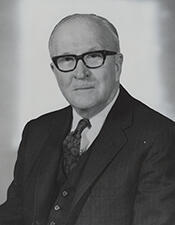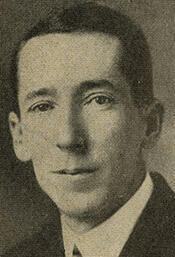
Edward Oscar McCowen (June 29, 1877 – November 4, 1953) was a three-term Republican member of the U.S. House of Representatives from Ohio, serving from 1943 to 1949. His congressional tenure spanned the final years of World War II and the early postwar period, during which he participated in the legislative process and represented the interests of his Ohio constituents in the House of Representatives.
McCowen was born on June 29, 1877, in Bloom Township, Ohio. He attended the public schools of South Webster, Ohio, where he received his early education. Demonstrating an early commitment to learning and public service, he pursued higher education while maintaining strong ties to his home region in southern Ohio.
McCowen’s formal education was extensive and spanned several decades. He graduated from Ohio Northern University at Ada, Ohio, in 1908. He later continued his studies at Ohio State University in Columbus, Ohio, where he graduated in 1917. Committed to further academic advancement even in midlife, he earned a degree from the Graduate School of the University of Cincinnati in Cincinnati, Ohio, in 1939. This sustained pursuit of education informed his long professional career in the field of public schooling and administration.
Before entering national politics, McCowen built a distinguished career as an educator. He served successively as a high-school teacher, principal, and superintendent, reflecting a steady progression through the ranks of educational leadership. From 1914 to 1942 he was superintendent of the Scioto County public schools, a position in which he oversaw the administration and development of public education in the county for nearly three decades. In addition to his administrative duties, he contributed to higher education governance as a trustee of Rio Grande College in Rio Grande, Ohio.
Alongside his educational work, McCowen was active in Republican Party politics at the local and state levels. He served as a precinct committeeman and was a delegate to the Ohio Republican State conventions in 1935 and again in 1946. These roles reflected his growing influence within the party and helped lay the groundwork for his eventual election to Congress.
McCowen was elected as a Republican to the Seventy-eighth, Seventy-ninth, and Eightieth Congresses, serving from January 3, 1943, to January 3, 1949. During his three terms in the U.S. House of Representatives, he contributed to the legislative process at a time marked by global conflict, wartime mobilization, and the transition to a peacetime economy. As a member of the House, he participated in the democratic process and represented the interests of his Ohio district, aligning with the Republican Party on national policy questions of the era. He was an unsuccessful candidate for reelection in 1948 to the Eighty-first Congress, which brought his congressional service to a close at the start of 1949.
After leaving Congress, McCowen returned to Wheelersburg, Ohio. He remained engaged in political affairs and continued his activity in Republican politics, maintaining his involvement in public life even after his formal legislative career had ended. He lived in Wheelersburg until his death there on November 4, 1953. Edward Oscar McCowen was interred in South Webster Cemetery in South Webster, Ohio, near the community where he had been educated and where his long career in public service had begun.
Congressional Record