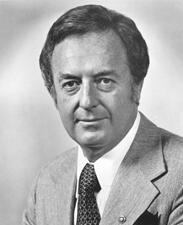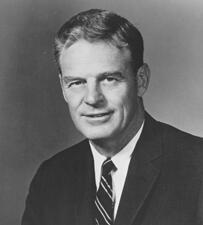
Edward John Gurney Jr. (January 12, 1914 – May 14, 1996) was an American politician, attorney, and U.S. Army officer who represented the state of Florida in the United States Congress, first in the U.S. House of Representatives from 1963 to 1969 and then in the U.S. Senate from 1969 to 1974. A member of the Republican Party, Gurney was the second Republican elected to Congress from Florida in the 20th century and, in 1968, became the first Republican Senator from Florida since Reconstruction. His congressional service spanned a significant period in American history, during which he participated in the legislative process and represented the interests of his Florida constituents.
Gurney was born in Portland, Maine, on January 12, 1914, and attended public schools there. He graduated from Colby College in Waterville, Maine, in 1935 and went on to study law at Harvard Law School, from which he graduated in 1938. Admitted to the New York bar the following year, he began practicing law in New York City. After the United States entered World War II, Gurney enlisted as a private in the United States Army. He was commissioned as an officer, served in the European Theater of Operations, and by the time of his discharge in 1946 had attained the rank of lieutenant colonel. Following his military service, he pursued further legal studies at Duke University, earning a degree from Duke Law School in 1948.
After completing his studies at Duke, Gurney moved to Winter Park in Orange County, central Florida, where he established a law practice. He later partnered with attorney Lou Frey, who would go on to succeed him in the U.S. House of Representatives. Gurney quickly became active in local government. In 1952 he was elected city commissioner of Winter Park. He subsequently served as city attorney for the nearby community of Maitland and culminated his local public service as mayor of Winter Park from 1961 to 1962. These roles helped build his reputation as a rising Republican figure in a state that had long been dominated by the Democratic Party.
In 1962, Gurney was elected to the U.S. House of Representatives, becoming the second Republican elected from Florida in the 20th century. He represented a central Florida district and was re-elected in 1964 and 1966, serving in the House from 1963 to 1969. During this period he gained recognition for employing what observers described as modern campaign techniques, including sophisticated advertising and media strategies that contributed to the broader modernization of Florida politics. His record in the House included opposition to major civil rights legislation enacted in 1964 and 1965, opposition to foreign aid measures, and criticism of President Lyndon B. Johnson’s War on Poverty, which he characterized as an “expensive boondoggle.”
In 1968, Gurney successfully sought statewide office and was elected to the United States Senate to succeed retiring Democratic Senator George Smathers. His election coincided with Richard Nixon’s victory in the presidential race and benefited from the national Republican “Southern Strategy,” which sought to attract conservative white voters in the South. Gurney defeated former Democratic governor LeRoy Collins with 55.9 percent of the vote to Collins’s 44.1 percent, drawing support from many backers of third-party presidential candidate George C. Wallace as part of a coalition of emerging Florida Republicans and conservative white Democrats. As a senator from 1969 to 1974, he was an important figure in the state’s Republican ascendancy. In 1973, he was appointed to the Senate Select Committee on Presidential Campaign Activities, commonly known as the Senate Watergate Committee, led by Senator Sam J. Ervin of North Carolina. On that panel, Gurney was regarded as the Nixon administration’s strongest supporter, in contrast to the more critical stance of ranking Republican member Howard Baker of Tennessee.
Gurney’s Senate career unfolded amid intense intraparty competition within the Florida Republican Party. He was a rival of Representative William C. “Bill” Cramer, who in 1954 had been the first Republican elected to Congress from Florida in the 20th century. Both men were considered potential candidates for a Senate seat in 1968 until Cramer deferred to Gurney, expecting Gurney’s support for the other Florida Senate seat that Senator Spessard Holland was anticipated to vacate in 1970. In the 1968 Republican primary, Gurney defeated Herman Goldner, a moderate former mayor of St. Petersburg and Cramer’s former law partner, who was underfunded and distrusted by many conservative Republicans. Gurney carried all but four counties in the general election against Collins. When Holland announced his retirement, Cramer, encouraged by President Nixon, entered the 1970 Senate race, but Gurney and Governor Claude R. Kirk Jr. instead backed Judge G. Harrold Carswell, a former nominee to the U.S. Supreme Court whose nomination had been rejected amid criticism of his mediocrity and past racism. Although Cramer easily defeated Carswell in the primary, the contest deepened divisions within the party, and Cramer ultimately lost the general election to Democrat Lawton Chiles. In the aftermath, Governor Kirk selected Gurney’s Orlando law firm as counsel to the Florida Turnpike Authority at a $100,000 annual retainer, while Cramer’s firm received no state legal work.
Gurney’s Senate tenure was overshadowed in its final years by a major federal investigation. In 1974 he was indicted in an influence-peddling scandal in which federal prosecutors alleged that he and several political aides had collected payoffs from Florida builders in exchange for assistance in securing federal housing contracts. On March 19, 1974, William F. Pelski, director of the Federal Housing Administration insuring office in Coral Gables, Florida, pleaded guilty to conspiring to defraud the government by making loan commitments to contributors to Gurney and was sentenced to 18 months’ imprisonment. Gurney resigned his Senate seat effective December 31, 1974, and was tried on seven counts of bribery and related offenses. He was acquitted on five counts, and the jury was unable to reach a verdict on the remaining two. In a second trial on those two counts, he was acquitted. Although ultimately cleared of all charges, his political standing was severely damaged, and he did not seek re-election. In the 1974 Senate race to succeed him, Republican nominee Jack Eckerd was defeated by Democrat Richard Stone.
After leaving the Senate, Gurney attempted a political comeback. In 1978 he ran for a seat in the U.S. House of Representatives but was defeated by Democrat Bill Nelson. Following this loss, he retired from electoral politics and returned to the practice of law in Winter Park, Florida, resuming his legal career on a full-time basis. His earlier service in Congress—from 1963 to 1969 in the House and from 1969 to 1974 in the Senate—had made him a central figure in the emergence of the modern Republican Party in Florida, and he remained a notable, if controversial, figure in the state’s political history. During his public life he also received recognition from civic organizations; on November 2, 1968, he was initiated as an honorary brother of the Alpha Phi chapter of Alpha Kappa Psi, a professional business fraternity, at the University of Florida.
Gurney’s personal life was marked by both family devotion and tragedy. He married Natalie, whom he met while in law school, and the couple had three children: a son, Edward, and two daughters, Jill and Sarah. Their son, Edward Gurney III, died by suicide in 1968, and Natalie suffered a stroke in 1971 that left her bedridden for years until her death in 1978. After her passing, Gurney married Leeds Dye of Winter Park. Edward John Gurney Jr. died in Winter Park, Florida, on May 14, 1996. He was survived by his second wife, Leeds, and his two daughters, Jill and Sarah.
Congressional Record