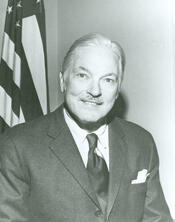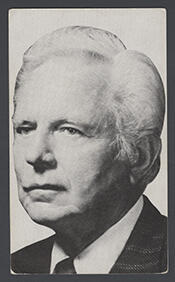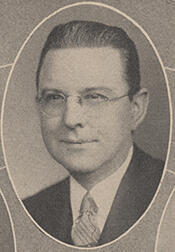
Edward Joseph Gardner (August 7, 1898 – December 7, 1950) was an American businessman, World War I veteran, and Democratic politician who served one term as a member of the United States House of Representatives from Ohio’s third congressional district from 1945 to 1947. Over the course of his career he was active in municipal, state, and national government, while maintaining a long-standing profession as a public accountant.
Gardner was born on August 7, 1898, in Hamilton, Butler County, Ohio, the son of Edward Gardner and his wife Mary. His father had emigrated from Ireland as a child, and his mother was born in Ohio, placing Gardner in a family rooted both in immigrant and native-born American traditions. He was raised in Hamilton and attended local parochial schools, receiving a Catholic education that formed the basis of his early intellectual and moral development.
After completing his primary and secondary schooling, Gardner pursued higher education in business and finance. He graduated from the College of Commerce and Finance of St. Xavier University in Cincinnati in 1920. Seeking further training in business administration and accounting, he undertook graduate work at the Wharton School of Business of the University of Pennsylvania in Philadelphia and at the University of Cincinnati. This combination of formal education in commerce and advanced study in business disciplines prepared him for a professional career in accounting and financial management.
During the First World War, Gardner served in the United States Army. In 1918 he entered military service as a private, joining the large cohort of young Americans mobilized in the final year of the conflict. His wartime experience as a soldier preceded and informed his later public statements and legislative interests concerning veterans and returning servicemen.
Following his military service, Gardner embarked on a career in business and accounting. He first worked in Philadelphia, Pennsylvania, as district controller of a food distributing company, a position he held for four years. In 1924 he returned to his hometown of Hamilton, Ohio, where he established himself as a public accountant. He practiced as a public accountant in Hamilton from 1924 until his death in 1950, building a professional reputation that ran parallel to his growing involvement in public office.
Gardner entered local politics in the 1920s. In 1926 he was elected to the Hamilton city council, where he served as president of the council and vice mayor for two years. His municipal service provided him with experience in local governance and public administration. He advanced to state office when he was elected a member of the Ohio House of Representatives in 1937, serving a two-year term, and was again elected to the Ohio House in 1941 for another two-year term. In the state legislature he participated in the lawmaking process during the late Depression and early World War II years, representing his district as a member of the Democratic Party.
In 1944, Gardner was elected as a Democrat to the Seventy-ninth Congress, representing Ohio’s third congressional district in the United States House of Representatives. His term in Congress ran from January 3, 1945, to January 3, 1947. His service in Congress occurred during a significant period in American history, spanning the final months of World War II and the immediate postwar transition. During his campaign, Gardner emphasized his commitment to returning servicemen, telling fellow Democrats that he would work “honestly and ceaselessly” for their employment. He argued that “we must make a positive determination that there shall be jobs and wages, that there should be security from unemployment, thereby setting a market for production.” In line with these views, during his term he supported a temporary extension of wartime price controls, continuation of the draft, and the right to strike, reflecting his concern with economic stability, labor rights, and the orderly demobilization of the wartime economy. As a member of the House of Representatives, he participated in the democratic process and represented the interests of his Ohio constituents during this critical period.
Gardner sought reelection in 1946 but was defeated. The political climate in Ohio and nationally had shifted, and President Harry S. Truman’s unpopularity at the time overshadowed the campaigns of many Democratic candidates, including Gardner. The Republican resurgence in the 1946 midterm elections contributed to his loss, ending his congressional service after one term in office.
After leaving Congress in January 1947, Gardner returned to Hamilton and resumed his profession as a public accountant. He continued in that capacity until his death, remaining engaged in the civic and economic life of his community even after his national political career had concluded. Edward Joseph Gardner died in Hamilton, Ohio, on December 7, 1950. He was interred in St. Mary’s Cemetery in Hamilton, closing a life that combined military service, professional achievement in accounting, and public service at the municipal, state, and federal levels.
Congressional Record