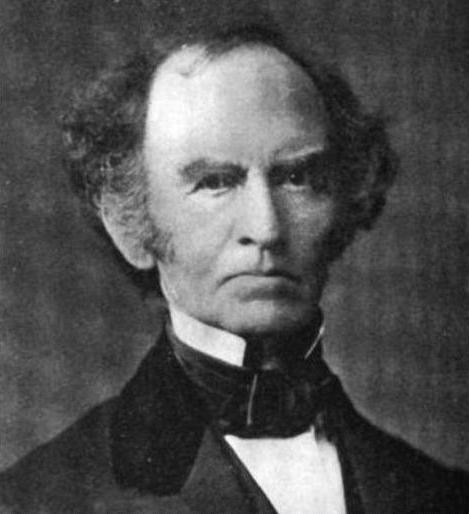
Edward Dickinson (January 1, 1803 – June 16, 1874) was an American lawyer, legislator, and Whig member of the United States House of Representatives from Massachusetts. He is also known as the father of the poet Emily Dickinson; their family home in Amherst, now the Emily Dickinson Museum, is dedicated to her life and work. Born in Amherst, Hampshire County, Massachusetts, he was the eldest son of Hon. Samuel Fowler Dickinson, a lawyer and civic leader, and Lucretia (Gunn) Dickinson. He grew up in Amherst, where he attended the local public schools and Amherst Academy, an important regional preparatory school of the early nineteenth century.
Dickinson pursued higher education at Yale College, from which he graduated in 1823. After Yale, he studied law at the Northampton Law School in Northampton, Massachusetts, a prominent training ground for attorneys in the region. He was admitted to the bar in 1826 and that same year commenced the practice of law in Amherst, establishing himself as a leading attorney in the town. On May 6, 1828, he married Emily Norcross (1804–1882), of Monson, Massachusetts. The couple had three children: William Austin Dickinson, who became a lawyer and civic figure in Amherst; Emily Elizabeth Dickinson, who would gain posthumous fame as one of America’s most important poets; and Lavinia Norcross Dickinson, who played a crucial role in preserving and publishing her sister Emily’s work.
Alongside his legal practice, Dickinson was deeply involved in the affairs of Amherst College, an institution with which his family had longstanding ties. He served as treasurer of Amherst College from 1835 until 1873, overseeing its finances during a period of growth and consolidation. In recognition of his service and standing, Amherst College conferred upon him an honorary Doctor of Laws (LL.D.) degree in 1863. His work for the college, combined with his legal and political activities, made him one of the central civic figures in Amherst throughout the mid-nineteenth century.
Dickinson’s political career began at the state level. A member of the Whig Party, he was elected to the Massachusetts House of Representatives, serving from 1838 to 1839. He later advanced to the Massachusetts Senate, where he served from 1842 to 1843. His influence in state government continued when he became a member of the Massachusetts Governor’s Council in 1846 and 1847, participating in the executive advisory body that reviewed legislation, appointments, and other matters of state administration. Through these roles, he gained a reputation as a careful, conservative, and business-minded legislator.
At the national level, Dickinson was elected as a Whig to the United States House of Representatives, serving one term in the Thirty-third Congress from 1853 to 1855, representing Massachusetts. His service in Congress occurred during a significant period in American history marked by intensifying sectional tensions over slavery and westward expansion. As a member of the Whig Party representing Massachusetts, he contributed to the legislative process and participated in the democratic governance of the nation, representing the interests of his constituents. He was elected in substantial part to secure for the town of Amherst and the surrounding region the advantages of the proposed Massachusetts Central Railroad, reflecting his long-standing interest in internal improvements and economic development. After his congressional term, he declined candidacy for the Republican nomination for Lieutenant Governor of Massachusetts in 1861, choosing instead to remain focused on his legal practice, college responsibilities, and local affairs.
Dickinson returned to state office late in life. In 1873 he again served in the Massachusetts House of Representatives, this time as a member of the 1874 Massachusetts legislature’s session that began in January of that year. On the morning of June 16, 1874, while in Boston during the legislative session, he delivered a careful speech in the House on his connection with the Hoosac Tunnel, a major railroad and engineering project in western Massachusetts that had long been a subject of political and financial controversy. Later that day he suffered an apoplexy (stroke) at his hotel and died before evening. Edward Dickinson was buried in West Cemetery in Amherst, Massachusetts, not far from the family home that would later become the Emily Dickinson Museum, linking his own long public career with the literary legacy of his daughter.
Congressional Record