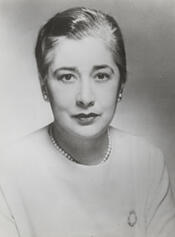
Edna Flannery Kelly (August 20, 1906 – December 14, 1997) was an American politician who served ten terms as a Democratic member of the United States House of Representatives from New York from 1949 to 1969. She was born in East Hampton, New York, the daughter of William E. Kelly, who served as postmaster and clerk of Kings County. Raised in New York, she came of age during a period of rapid urban growth and political change that would later shape her interest in public service and social policy.
Kelly pursued higher education at Hunter College in New York City, graduating in 1928. Her college education, relatively uncommon for women of her generation, provided a foundation for her later work on issues affecting women, families, and working people. After college she became increasingly active in Democratic Party politics in Brooklyn, building a reputation as an effective organizer and advocate. Her political involvement and growing influence within the party led to her selection as a delegate to multiple national conventions.
By the late 1940s, Kelly had become a significant figure in Democratic politics. She served as a delegate to the Democratic National Conventions of 1948, 1952, 1956, 1960, and 1968, participating in the selection of presidential nominees and in the shaping of the party platform. At the 1956 Democratic National Convention she spoke on behalf of the nomination of New York Governor W. Averell Harriman, emphasizing his anti-communist credentials, and she formally seconded his nomination. In addition to her convention roles, she served as a member of the Democratic National Committee from 1956 until 1968, reflecting her prominence within the party at both the state and national levels.
Kelly entered Congress through a special election. She was elected on November 8, 1949, to fill the vacancy caused by the death of Representative Andrew L. Somers, and she served continuously in the House of Representatives from November 8, 1949, until January 3, 1969. A member of the Democratic Party, she represented New York during a significant period in American history, spanning the post–World War II era, the early Cold War, the civil rights movement, and the beginning of the Vietnam War. Over the course of her 19-year career in the House, she participated actively in the legislative process and represented the interests of her constituents through ten consecutive terms in office.
Throughout her congressional service, Kelly was particularly recognized for her expertise in foreign affairs. She served on the House Committee on Foreign Affairs and rose to become the third-ranking member of that committee by the time of her retirement. She chaired the Subcommittee on Europe, where she played a central role in shaping U.S. policy toward postwar Europe. During her tenure she was responsible for measures that addressed the resettlement of displaced persons after World War II and facilitated refuge for people fleeing Russia and Eastern Europe. She also contributed to the creation of the United States Arms Control and Disarmament Agency, reflecting her engagement with issues of international security and arms control during the height of the Cold War.
Kelly was also a leading advocate for women’s rights and social policy in the House. Contemporary news accounts noted her focus on “women’s and social issues,” particularly her efforts to draw attention to inequities in pay, credit, and tax policy, including what she regarded as inadequate deductions for child care. Her work in these areas contributed to broader reforms embodied in the Internal Revenue Code of 1954. In 1951 she introduced what is often credited as the first “equal pay for equal work” bill in Congress, a landmark initiative that helped inaugurate a new era in the legislative fight for women’s economic equality. She remained committed to this cause throughout her career and was present at the White House on June 10, 1963, when President John F. Kennedy signed the Equal Pay Act into law.
Following a round of redistricting in the late 1960s, Kelly’s long tenure in Congress came to an end. Faced with new district lines and shifting political alliances, she chose in 1968 to challenge Emanuel Celler, the Dean of the House of Representatives, in the Democratic primary rather than run in the redrawn 12th District, where local party leader Stanley Steingut backed Shirley Chisholm. Kelly lost the primary to Celler, and Chisholm ultimately succeeded to the seat that encompassed much of Kelly’s former constituency. Several years later, in 1972, Celler himself was narrowly defeated in a Democratic primary by Elizabeth Holtzman, underscoring the generational and demographic changes then reshaping New York politics.
In her personal life, Kelly was married to Edward L. Kelly, a New York City Court Justice from Brooklyn. Their marriage ended tragically when he was killed in an automobile accident in 1942, several years before she entered Congress. She was the mother of two children and, in later years, the grandmother of eight grandchildren and great-grandmother of 17 great-grandchildren. After leaving public office, she lived away from the political spotlight but remained a figure of historical interest for her pioneering work on foreign affairs and women’s economic rights.
Edna Flannery Kelly died in Alexandria, Virginia, on December 14, 1997, at the age of 91. The cause of death was cancer and a series of strokes. Her long career in the House of Representatives, her leadership on foreign policy, and her early and sustained advocacy for equal pay and improved treatment of women and families in federal law secured her a place among the notable women who have served in the United States Congress.
Congressional Record