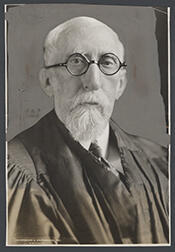
Edmund Waddill Jr. (May 22, 1855 – April 9, 1931) was a Virginia lawyer, Republican politician, and federal judge who served as a United States Representative from Virginia’s 3rd congressional district and later as both a United States district judge and a judge of the United States Court of Appeals for the Fourth Circuit. He served as a Representative from Virginia in the United States Congress from 1889 to 1891, contributing to the legislative process during one term in office and representing the interests of his constituents during a significant period in American history.
Waddill was born in Charles City County, Virginia, on May 22, 1855. He was educated by private tutors and attended Norwood Academy, receiving the type of classical and preparatory instruction common to aspiring professionals in post–Civil War Virginia. Early in his working life, he gained experience in local government and the court system by serving as a deputy clerk of the courts of Charles City, New Kent, Hanover, and Henrico counties, as well as of the circuit court of Richmond, Virginia. He later studied law at the University of Virginia and completed his legal training by reading law in 1877, a customary method of legal education at the time.
Admitted to the Virginia bar in 1877, Waddill began his legal career in private practice in Hanover County, where he practiced from 1877 to 1878. He then moved to Richmond and continued in private practice there and in surrounding Henrico County from 1878 to 1880. In 1880, the Virginia General Assembly selected him as Judge of the County Court of Henrico County. He held that judicial post for three years, serving until 1883, when he resigned to accept appointment as United States Attorney for the Eastern District of Virginia. As United States Attorney, he served from 1883 to 1885, after which he returned to private practice and entered elective politics.
Waddill was elected as a Republican to the Virginia House of Delegates, a part-time legislative body, and served from 1885 until 1889, building his reputation as a leading Republican figure in the state. He ran unsuccessfully as the Republican candidate for election to the Fiftieth United States Congress in 1886. Undeterred, he later successfully contested the election of Democrat George D. Wise to the United States House of Representatives for the Fifty-first Congress. As a result of that contest, Waddill was seated as a United States Representative from Virginia’s 3rd congressional district and served from April 12, 1890, to March 3, 1891. Although his service in the House fell within the 1889–1891 congressional term, he was not a candidate for renomination in 1890. After leaving Congress, he resumed the practice of law in Richmond from 1891 to 1898 and remained active in national Republican politics, serving as a delegate to the Republican National Conventions in 1892 and 1896.
On March 10, 1898, President William McKinley nominated Waddill to a seat on the United States District Court for the Eastern District of Virginia, vacated by Judge Robert William Hughes. The United States Senate confirmed his nomination on March 22, 1898, and he received his commission the same day. As a United States district judge, Waddill presided over a wide range of federal cases, but one of his most notable matters arose from the women’s suffrage movement. On November 14, 1917, a group of suffragists known as the “Silent Sentinels,” who had been sentenced to the Occoquon Workhouse in Lorton, Virginia, for protesting outside the White House, endured what became known as the “Night of Terror,” during which they were subjected to beatings and harsh treatment by prison guards; suffragist Lucy Burns was forced to stand all night with her arms shackled to the ceiling of her cell. Three days later, Judge Waddill issued a writ of habeas corpus seeking to secure the release of the women jailed near Alexandria, Virginia, and approximately ten days thereafter he ordered them freed. His service on the district court continued until June 9, 1921, when it terminated upon his elevation to the court of appeals.
Waddill was nominated by President Warren G. Harding on May 26, 1921, to a seat on the United States Court of Appeals for the Fourth Circuit, succeeding Judge Jeter Connelly Pritchard. The Senate confirmed his nomination on June 2, 1921, and he received his commission the same day. As an appellate judge, he participated in shaping federal law across the Fourth Circuit, which encompassed several southern and mid-Atlantic states. From 1925 to 1930, he also served as a member of the Conference of Senior Circuit Judges, now known as the Judicial Conference of the United States, contributing to the administration and governance of the federal judiciary at the national level.
Edmund Waddill Jr.’s service on the United States Court of Appeals for the Fourth Circuit continued until his death in Richmond, Virginia, on April 9, 1931. He was interred in Hollywood Cemetery in Richmond, a resting place for many of Virginia’s political and judicial figures. His family maintained a role in Republican politics in Virginia; his son-in-law, Menalcus Lankford, helped revitalize the Republican Party in the Tidewater region and later served two terms in the United States House of Representatives, representing Virginia’s 2nd congressional district.
Congressional Record