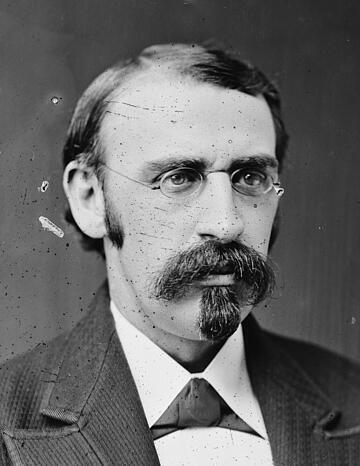
Edmund William McGregor Mackey (March 8, 1846 – January 27, 1884) was a lawyer, state representative, and United States Representative from South Carolina who emerged as a prominent leader in the Republican Party during and after Reconstruction. He was born in Charleston, South Carolina, where he was raised in a politically and socially engaged family. His father, Dr. Albert Gallatin Mackey, was a noted physician, author, and Masonic scholar who became the primary founder of Scottish Rite Freemasonry in the United States, a background that placed Edmund Mackey in an environment of public affairs and organizational leadership from an early age.
Mackey came of age during the American Civil War and entered public life in its aftermath, when South Carolina and the rest of the former Confederacy were undergoing profound political and social transformation. An active Republican in the Reconstruction era, he quickly became involved in efforts to reshape the state’s political order. In 1868 he was nominated to be a delegate from Charleston to the South Carolina constitutional convention, which was convened under federal Reconstruction policies to draft a new state constitution. That same year he was admitted to the bar and began practicing law in Charleston. Alongside his legal practice, he held local offices, serving as sheriff and as an alderman, roles that placed him at the center of municipal governance during a period of intense political contestation.
Building on his local prominence, Mackey was elected as a Republican to the South Carolina House of Representatives in 1872. His legislative service in Columbia coincided with the high tide of Republican influence in the state, when newly enfranchised African American voters and white Republicans sought to consolidate political and civil rights gains. In 1874 he campaigned for the United States House of Representatives from South Carolina’s Second Congressional District as an Independent Republican and was elected to Congress. His service in the House of Representatives, which formed part of his broader tenure in Congress from 1875 to 1885 as recorded in congressional accounts, occurred during a significant period in American history marked by the waning of Reconstruction and the resurgence of Democratic control in the South. However, his initial congressional tenure was cut short when the Forty-fourth Congress declared his seat vacant on July 19, 1876, amid ongoing partisan disputes.
Mackey returned to state politics in the turbulent election year of 1876, winning election again to the South Carolina House of Representatives. In the aftermath of that bitterly contested campaign, he claimed the position of Speaker of the House in a legislature divided between rival Republican and Democratic factions. Republicans, including Mackey, disputed the election of Democratic representatives from Edgefield and Laurens counties, alleging massive fraud, widespread violence, and the systematic barring of freedmen from the polls by Democratic paramilitary groups such as the Red Shirts. When the South Carolina Supreme Court ultimately decided to allow the seating of the Democratic legislators from those counties, competing state governments emerged. Mackey and the Republican legislators, insisting on the legitimacy of their claims, occupied the South Carolina State House with the support of Federal troops, symbolizing the last major effort of Reconstruction-era Republicans to maintain control of the state government.
The national political compromise that followed the disputed presidential election of 1876 brought this struggle to an end. Acting under the terms of that settlement, President Rutherford B. Hayes ordered the removal of Federal troops from South Carolina on April 10, 1877. Without federal military backing, the Republican state government collapsed, and the Democrats consolidated control. One of their early actions was to annul the election of representatives from Charleston County, including Edmund Mackey, thereby formally ending his role in the state legislature. Despite this reversal, Mackey remained active in public life and in the Republican Party. From 1878 to 1881 he served as an assistant United States attorney for South Carolina, a federal post that allowed him to continue influencing legal and political affairs in the state even as Democrats dominated its government.
Mackey also continued to seek a return to Congress. He ran as a Republican candidate for the U.S. House of Representatives from South Carolina’s Second Congressional District in 1878 but was defeated by Democrat Michael P. O’Connor. Mackey contested the result and attempted to have the Democratic-controlled House overturn the election, but his challenge was unsuccessful. His persistence was rewarded when the Republican Party regained control of the U.S. House for the Forty-seventh Congress. In that more favorable political climate, Mackey successfully contested the seat held by Democrat Samuel Dibble and was seated in Congress, thereby resuming his service as a Representative from South Carolina. He was re-elected in 1882 from the newly configured Seventh Congressional District, continuing his work as a Republican member of the House and contributing to the legislative process during what congressional records describe as three terms in office.
In his personal life, Mackey married Victoria Sumter in 1874. She was of part African American descent, a fact of social and political significance in Reconstruction-era South Carolina, where questions of race, citizenship, and political power were central to public life. The couple had two sons. Mackey’s marriage and family life unfolded against the backdrop of his contentious political career and the broader struggles over racial equality and Republican governance in the postwar South.
Edmund William McGregor Mackey died in office in Washington, D.C., on January 27, 1884, while serving in the Forty-eighth Congress as the Representative from South Carolina’s Seventh District. His death placed him among the members of the United States Congress who died in office in the nineteenth century. Remembered as a determined and often embattled Republican leader, he played a notable role in South Carolina’s Reconstruction politics, in the contested transition from Republican to Democratic rule, and in the broader national debates of his era.
Congressional Record