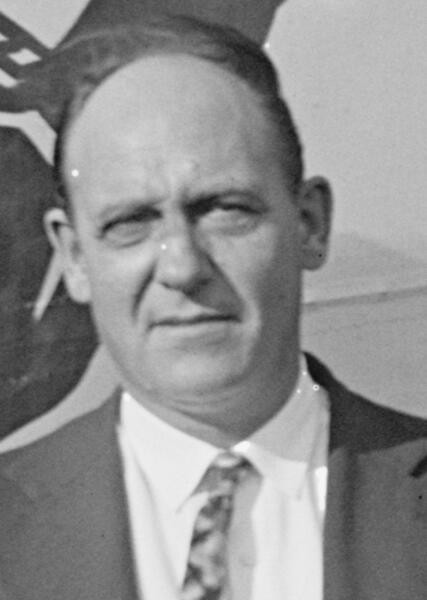
Edmund Francis Cooke (April 13, 1885 – May 13, 1967) was a Republican member of the United States House of Representatives from New York who served two terms in Congress from 1929 to 1933. He was born in Prescott, Arizona, then a small frontier town in the Arizona Territory. During his infancy, local settlers feared a rumored Yavapai Indian attack on the community; concerned that he might be killed without having been baptized, his mother summoned a neighbor, and the two women christened him without benefit of clergy. In 1887 he moved with his parents to Alden, New York, where his grandfather lived. Growing up in this rural community, he gained first-hand knowledge of the problems faced by dairy farmers, an experience that would later shape his professional and political interests. As a boy, he was noted for practicing his oratorical skills by giving speeches to the corn stalks in the fields.
Cooke received his early education in New York and, choosing the law as his profession, studied in the office of Judge Harold J. Hinman in Albany. He read law there rather than attending a formal law school, following a common path to the bar in the early twentieth century. He was admitted to the bar in 1910 and began the practice of law in Alden, New York. On June 30, 1908, he married Jennie O. Swanson of Jamestown, New York. The couple had several children: Eilene, who graduated from the University of Buffalo; John H. Cooke and Richard T. Cooke, both of whom graduated from Washington and Lee University and the University at Buffalo Law School; and Cynthia G. Cooke, who graduated from the University of Arizona and Arizona State University and later lived in Scottsdale, Arizona.
During World War I, Cooke served overseas as a secretary for the Young Men’s Christian Association (YMCA) in Europe. His work with the YMCA placed him in close contact with American servicemen and the broader war effort, and during this period he laid plans to pursue a political career upon his return home. After the war he resumed his legal practice and became increasingly active in public affairs in Erie County, drawing on his legal background and his familiarity with agricultural and rural issues.
Cooke entered elective office as a member of the New York State Assembly, representing Erie County’s 7th District. He served in the Assembly for six consecutive years, from 1923 through 1928. In the legislature he gained experience in lawmaking and constituent service, and he developed a reputation as an articulate advocate, particularly on matters affecting farmers and rural communities. His state legislative service provided the platform for his subsequent election to national office.
In 1928 Cooke was elected as a Republican to the United States House of Representatives. He served in the 71st and 72nd Congresses, holding office from March 4, 1929, to March 3, 1933, as a Representative from New York. His tenure in Congress coincided with a pivotal period in American history, encompassing the end of the 1920s economic boom and the onset of the Great Depression following the stock market crash of 1929. As a member of the House of Representatives, Edmund Francis Cooke participated in the legislative process during these challenging years, representing the interests of his constituents and contributing to debates over economic policy, relief measures, and federal responses to the crisis. A member of the Republican Party, he took part in the democratic process at the federal level throughout his two terms in office. In the 1932 election he was defeated for re-election by Democrat Alfred F. Beiter.
After leaving Congress in 1933, Cooke returned to New York and resumed the practice of law in Buffalo. Drawing on his lifelong familiarity with agricultural issues, he began what became decades of work to improve the economic position of dairy farmers in the Northeast Milk Shed, the region supplying milk to major urban markets. He was the founder and, for 25 years, the general manager and counsel of the Mutual Federation of Independent Cooperatives, an organization of dairy farmers in the northeastern United States that supplied milk and other dairy products to metropolitan New York. In this role he worked to strengthen cooperative marketing, stabilize prices, and secure fairer terms for producers in their dealings with distributors and urban markets.
In addition to his legal and agricultural advocacy, Cooke maintained close relationships with Native American communities. In recognition of his contributions to the welfare of Native Americans, he was made an adopted member of the Tuscarora Tribe. Outside his professional and public service commitments, he was known as an avid hunter and fisherman, pursuits that reflected his enduring attachment to rural life and the outdoors. Edmund Francis Cooke died in Alden, New York, on May 13, 1967, closing a life that spanned the American frontier era of his birth in territorial Arizona through the mid-twentieth century and combined legal practice, legislative service, and sustained advocacy on behalf of farmers and Native communities.
Congressional Record