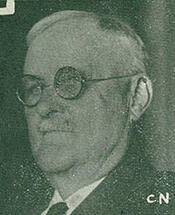
Edgar Clarence Ellis (October 2, 1854 – March 15, 1947) was a Republican U.S. Representative from Missouri who served multiple, nonconsecutive terms in the United States House of Representatives between 1905 and 1931. His congressional career, spanning the early twentieth century, placed him in the midst of significant political and economic developments in American history, during which he participated in the legislative process and represented the interests of his Missouri constituents.
Ellis was born on October 2, 1854, in Vermontville, Eaton County, Michigan. He attended local country schools in his youth, reflecting the rural educational environment of the post–Civil War Midwest. Pursuing higher education, he enrolled at Olivet College in Michigan, where he received a Bachelor of Arts degree in 1880. Seeking further academic advancement, he then attended Carleton College in Northfield, Minnesota, graduating in 1881. His early academic training, particularly in the classical disciplines, laid the groundwork for his later work as both an educator and a lawyer.
Immediately after completing his studies, Ellis embarked on a career in education. In 1881 and 1882 he served as an instructor in Latin at Carleton College, demonstrating both his mastery of classical languages and his commitment to teaching. He subsequently became superintendent of public schools in Fergus Falls, Minnesota, a position he held from 1882 to 1885. While serving as a school principal and superintendent, he began to study law, preparing for a transition from education to the legal profession. He was admitted to the bar in 1885 and commenced the practice of law in Beloit, Kansas, that same year.
During his tenure as a school principal at Fergus Falls, Ellis married Emily Hatch Roy on July 20, 1882, in Atlanta, Georgia. She was the daughter of noted abolitionists Rev. Joseph Edwin Roy and Emily Stearns Hatch Roy, linking Ellis by marriage to a family with a strong tradition of social reform and public service. The couple had three sons. Ellis’s legal career advanced as he moved to Kansas City, Missouri, in 1888, where he continued the practice of law. In 1893 he formed a partnership with Hale C. Cook under the firm name Ellis & Cook. As the practice grew, James A. Reed and Ernest Ellis later joined the firm, which became known as Ellis, Cook & Ellis, establishing Ellis as a prominent figure in the Kansas City legal community.
Ellis entered national politics as a member of the Republican Party and was first elected to the United States House of Representatives from Missouri to the Fifty-ninth Congress, serving from March 4, 1905, to March 3, 1907. He was reelected to the Sixtieth Congress, serving from March 4, 1907, to March 3, 1909. During these initial two terms, he contributed to the legislative process at a time when the country was grappling with issues of industrial regulation, economic growth, and progressive reform. He was an unsuccessful candidate for reelection in 1908 to the Sixty-first Congress and returned to Kansas City to resume his law practice. In addition to his legal work, he was appointed a member of the Missouri Waterway Commission, on which he served in 1911 and 1912, reflecting his engagement with regional infrastructure and transportation concerns.
After several years away from Congress, Ellis reentered national politics and was elected to the Sixty-seventh Congress, serving from March 4, 1921, to March 3, 1923. He again failed to secure reelection in 1922 to the Sixty-eighth Congress, but remained a significant Republican figure in Missouri. He returned once more to the House as a Representative in the Sixty-ninth Congress, serving from March 4, 1925, to March 3, 1927, and, after another unsuccessful reelection bid in 1926 to the Seventieth Congress, he was elected to the Seventy-first Congress, serving from March 4, 1929, to March 3, 1931. Across these nonconsecutive terms—altogether five terms in office—Ellis participated in the democratic process during a period that included the post–World War I adjustment and the onset of the Great Depression. He was an unsuccessful candidate for reelection in 1930 to the Seventy-second Congress, after which he retired from both law practice and active political life.
In his later years, Ellis experienced significant personal changes. His first wife, Emily Hatch Roy Ellis, died in 1931, ending a long marriage that had begun during his early career in education. In 1936 he married Mrs. Katherine Morgan of Cincinnati, Ohio, marking a new chapter in his private life following his withdrawal from public office. He spent his final years away from the political spotlight, having concluded a career that combined education, law, and repeated service in the U.S. House of Representatives.
Edgar Clarence Ellis died in St. Petersburg, Florida, on March 15, 1947. His remains were cremated, and his ashes were interred in Kansas City, Missouri, the city that had been the center of his legal and political career. His life and work, recorded in the Biographical Directory of the United States Congress, reflect the trajectory of a Midwestern lawyer-educator who rose to national office and served Missouri in Congress during some of the most transformative decades of the early twentieth century.
Congressional Record