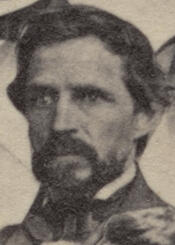
Ebenezer Dumont (November 23, 1814 – April 16, 1871) was a U.S. Representative from Indiana who served two terms in Congress from 1863 to 1867 and was a brigadier general in the Union Army during the American Civil War. He was born in Vevay, Switzerland County, Indiana, where he was raised in a politically and intellectually active family. His father, John Dumont, served in the Indiana Legislature in 1822–1823 and later ran for governor of Indiana against David Wallace, while his mother, Julia Louisa Dumont, was a noted educator and writer. This environment helped shape his early interest in public affairs and the law.
Dumont pursued classical studies at Hanover College in Indiana, receiving the education typical of young men preparing for professional and political careers in the antebellum Midwest. After completing his studies, he read law and was admitted to the bar, commencing legal practice in his native Vevay. His legal work in the small but growing river town provided him with a local reputation and a base from which to enter public life.
Dumont’s political career began early. He served as a member of the Indiana House of Representatives in 1838, marking his first formal role in state government. From 1839 to 1845 he held local office as treasurer of Vevay, managing the town’s finances during a period of economic and infrastructural development along the Ohio River. After his term as treasurer, he continued his legal practice until the outbreak of the Mexican–American War, when he entered military service.
During the Mexican–American War, Dumont served as lieutenant colonel of the 4th Indiana Infantry Regiment, gaining valuable military experience and leadership credentials. Following the war, he returned to Indiana and resumed the practice of law in Vevay. He reentered state politics as a member of the Indiana House of Representatives in 1850 and again in 1853, participating in legislative deliberations during a period of growing sectional tension in the United States.
With the onset of the Civil War, Dumont returned to military service on behalf of the Union. Indiana Governor Oliver P. Morton appointed him colonel of the 7th Indiana Volunteer Infantry. The regiment initially saw action in western Virginia and subsequently served primarily in the western theater of the war. Dumont’s performance in the field led to his promotion to brigadier general of volunteers on September 3, 1861. He served in this capacity until February 28, 1863, when he resigned his commission in order to resume his political career and seek election to Congress.
Dumont was elected as a Unionist to the Thirty-eighth Congress and was reelected as a Republican to the Thirty-ninth Congress, serving from March 4, 1863, to March 3, 1867. His tenure in the House of Representatives coincided with the critical years of the Civil War and the beginning of Reconstruction. As a member of the Republican Party and, initially, the broader Unionist coalition, he contributed to the legislative process during this significant period in American history and represented the interests of his Indiana constituents. In the Thirty-eighth Congress he served as chairman of the Committee on the District of Columbia, overseeing legislation affecting the federal capital. In the Thirty-ninth Congress he chaired the Committee on Expenditures in the Department of the Interior, exercising oversight over federal spending in that department. He was not a candidate for renomination in 1866 and concluded his congressional service at the end of his second term in 1867.
In his later years, Dumont remained a figure of public prominence. President Ulysses S. Grant appointed him Governor of Idaho Territory, recognizing his experience in both civil administration and national politics. However, he died in Indianapolis, Indiana, on April 16, 1871, before taking the oath of office or assuming the duties of the governorship. Ebenezer Dumont was interred in Crown Hill Cemetery in Indianapolis, closing a career that had encompassed local office, state legislative service, military command in two wars, and two terms in the United States Congress.
Congressional Record