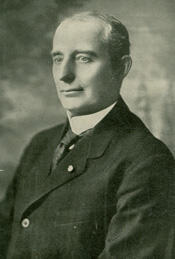
Eben Wever Martin (April 12, 1855 – May 22, 1932) was an American attorney and Republican politician from South Dakota who served as a member of the United States House of Representatives during the early twentieth century. Over the course of seven terms in Congress between 1901 and 1915, he represented South Dakota at large and later from a congressional district, contributing to the legislative process during a significant period in American history and participating in the democratic governance of his state and nation.
Martin was born on April 12, 1855, in Maquoketa, Iowa. He attended the public schools of his hometown before pursuing higher education at Cornell College in Mount Vernon, Iowa, from which he graduated in 1879. Immediately following his undergraduate studies, he enrolled at the University of Michigan Law School, where he studied in 1879 and 1880. He was admitted to the bar in 1880 and soon afterward moved west to the Dakota Territory, commencing the practice of law in Deadwood.
Establishing himself as an attorney in Deadwood, Martin quickly became involved in public affairs during the territorial period. He served in the South Dakota Territory House of Representatives in 1884 and 1885, gaining early legislative experience before statehood. In addition to his work in the territorial legislature, he was active in local education, serving as president of Deadwood’s board of education from 1886 to 1900. Through these roles he built a reputation as a civic leader and legal practitioner in the Black Hills region.
Martin’s congressional career began with his election in 1900 as a Republican to Seat B, one of South Dakota’s two at-large seats in the United States House of Representatives. He took office on March 4, 1901, and was reelected in 1902 and 1904, serving continuously from March 4, 1901, to March 3, 1907. During these early terms he represented the interests of his South Dakota constituents in the House of Representatives and participated in national legislative debates at a time of rapid economic and political change in the United States. In 1906 he sought higher office as a candidate for the United States Senate but was unsuccessful, temporarily interrupting his service in Congress.
Following the death of Representative William H. Parker, Martin returned to the national legislature. He won a special election to fill the vacancy in Seat B and reentered the House on November 3, 1908. He was subsequently reelected to three more terms, serving from November 3, 1908, to March 3, 1915. As a result of the 1910 United States census, South Dakota’s representation in the House was increased and the state was apportioned three members, leading to the creation of three separate congressional districts. In the 1912 election, Martin successfully ran for the newly created South Dakota 3rd congressional district, continuing his service in the House under the new district-based system. He chose not to be a candidate for reelection in 1914, concluding his congressional career after seven terms.
After leaving Congress in 1915, Martin resumed the practice of law, this time in Hot Springs, South Dakota. He continued his professional life there, remaining a respected figure in the state’s legal and political circles. His long career in public service, spanning territorial government, local educational leadership, and multiple terms in the U.S. House of Representatives, left a lasting imprint on South Dakota’s civic development.
Eben Wever Martin died in Hot Springs on May 22, 1932. He was buried in Evergreen Cemetery in that city. His legacy in South Dakota is reflected not only in his years of public service but also in the naming of the city of Martin, South Dakota, in his honor.
Congressional Record