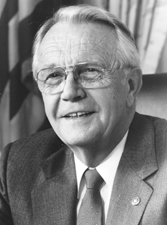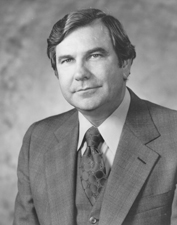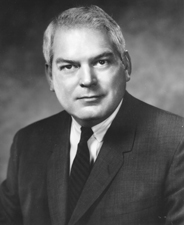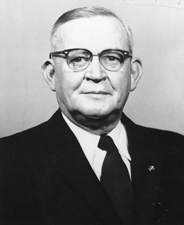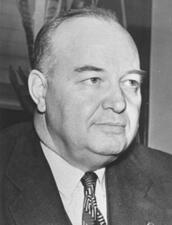
Earle Chester Clements (October 22, 1896 – March 12, 1985) was a Kentucky politician who rose from local office to become a U.S. Representative, U.S. Senator, and the 47th governor of Kentucky. A member of the Democratic Party, he represented the Commonwealth of Kentucky in both the U.S. House of Representatives and the U.S. Senate and served as a key party leader at the state and national levels for a quarter-century. For 25 years, he led a powerful faction of the Kentucky Democratic Party that stood in opposition to the faction headed by his boyhood friend, two-time governor and U.S. senator A. B. “Happy” Chandler.
Clements followed his father into local politics in his native Union County, Kentucky, where he first gained experience in county affairs and Democratic Party organization. His statewide prominence began to develop in 1935, when Thomas Rhea of Russellville, a former state treasurer and highway commissioner, asked him to serve as campaign chairman for Rhea’s gubernatorial race. Clements accepted, and when Chandler later asked him to chair his own gubernatorial campaign, Clements—already committed to Rhea—refused. Chandler went on to win the Democratic primary, and for decades afterward the two men led rival factions within the Kentucky Democratic Party. Chandler claimed that Clements bolted the party and supported Republican King Swope in the general election; Clements denied this, though he acknowledged that he gave Chandler’s campaign only minimal support, marking the beginning of a long and consequential political rift.
In 1941, Clements was elected to the Kentucky Senate, representing Union, Webster, and Henderson counties. By 1944 he had risen to the post of majority leader and played a central role in drafting the state budget. He successfully campaigned for a larger budget than that proposed by Republican Governor Simeon Willis, securing substantial increases in educational appropriations far above what Willis had recommended. His high-profile confrontation with Willis made him popular and prominent within the Democratic Party and helped him organize a campaign that forced the withdrawal of Representative B. M. Vincent from the 1944 Democratic primary for Kentucky’s Second Congressional District. With Vincent out, Clements became the party’s nominee without opposition, defeated Republican Otis White of Morgantown in the general election, and was re-elected to the U.S. House of Representatives in 1946.
As a New Deal Democrat in the House, Clements supported an expanded federal role in economic and social policy. He voted to increase funding for the Rural Electrification Administration and advocated for the 1945 National School Lunch Act. He backed expansion of agricultural research and reorganization of the Farm Security Administration, endorsed conservation and wildlife programs, and supported additional funding for federal parks. He favored civil rights legislation, including proposals to ban lynching and poll taxes, and he notably did not sign the 1956 Southern Manifesto, despite the fact that school segregation remained legally required in Kentucky prior to the Supreme Court’s decision in Brown v. Board of Education (1954). He opposed the 1947 Taft–Hartley Act and voted to disband the House Un-American Activities Committee. His service on the Select House Committee on Food Shortages brought him into close working contact with President Harry S. Truman and further elevated his standing in national Democratic circles.
In 1947, Clements returned to state office when he was elected governor of Kentucky, succeeding the term-limited Simeon Willis. He had first defeated Harry Lee Waterfield, Chandler’s preferred candidate, in the Democratic primary, thereby deepening the intra-party rivalry. As governor from 1947 to 1950, Clements raised taxes and used the resulting revenue to expand and improve the state park system and to construct and maintain more roads, significantly advancing Kentucky’s transportation infrastructure. He also pursued improvements in public education, including increased funding and administrative reforms, and achieved some progress toward desegregation in the state’s educational system. His administration was marked by an assertive use of state resources to modernize Kentucky and by continued leadership of the anti-Chandler faction within the Democratic Party.
Clements’ gubernatorial tenure intersected directly with his rise to the U.S. Senate. When Senator Alben Barkley resigned his seat to become vice president in 1949, Governor Clements appointed Highway Commissioner Garrett L. Withers to fill the vacancy until the next regular election. Clements then ran for the full six-year Senate term in 1950 and defeated Republican Charles I. Dawson by a vote of 300,276 (54 percent) to 256,876 (45 percent). To maximize his seniority in the Senate, a carefully timed sequence of resignations and appointments followed: on November 27, 1950, Withers resigned as senator, Clements resigned as governor, and Lieutenant Governor Lawrence Wetherby, who succeeded Clements as governor, appointed Clements to the Senate seat. In the Senate, where he served from 1950 until 1957, Clements became a central figure in Democratic leadership. He was appointed Democratic Party whip in 1953, serving under Majority Leader Lyndon B. Johnson, and he served as executive director and chairman of the Senate Democratic Reelection Committee during multiple election cycles, including 1952, 1954, 1957, and 1959. He advocated closer coordination between the Reelection Committee and the Democratic National Committee and helped institutionalize year-round campaign operations and transition services for freshman senators, practices that became standard in Senate party organization.
Clements’ Senate career unfolded during a significant period in American history, encompassing the early Cold War, the Korean War, and the first stirrings of the modern civil rights movement. As a senator from Kentucky, he participated actively in the legislative process and represented the interests of his constituents while also helping to shape national Democratic strategy. Although some sources describe his congressional tenure as extending from 1945 to 1957, reflecting his combined House and Senate service, his Senate service itself ran from 1950 to 1957. He was defeated for re-election in 1956 by Republican Thruston Morton, a loss to which a lack of support from Governor Chandler—then in his second term—contributed. At Johnson’s insistence, however, Clements remained influential in party affairs and resumed chairing the Senate Democratic Campaign Committee in 1957 and 1959, even after leaving the Senate.
Throughout the 1950s, Clements continued to play a dominant role in Kentucky Democratic politics. He supported Bert T. Combs for governor against Chandler in the 1955 primary, though Chandler ultimately won that contest and returned to the governorship. In 1959, Clements again backed Combs, this time against Harry Lee Waterfield. He brokered a key deal under which Louisville lawyer Wilson Wyatt abandoned his own gubernatorial ambitions and instead ran for lieutenant governor on an unofficial ticket headed by Combs. Combs defeated Waterfield in the primary and, after winning the general election, rewarded Clements by appointing him state highway commissioner. In that post, Clements again wielded considerable influence over Kentucky’s road-building program and patronage system.
Clements’ alliance with Combs proved short-lived. In 1960, a controversy arose over a proposed deal to lease dump trucks from a Louisville car dealer who was a Combs supporter. State newspapers charged that the arrangement was political payback. When Governor Combs canceled the deal, Clements took the action as a public rebuke and soon resigned as highway commissioner. He then turned his attention to national politics, working on the presidential campaign of his friend Lyndon B. Johnson. Following his split with Combs, Clements aligned himself with the Chandler faction and opposed Wilson Wyatt in his bid to unseat Senator Thruston Morton. The rupture with Combs, however, accelerated the decline of Clements’ influence in Kentucky. By the 1963 gubernatorial race, he was unable to deliver even his home county for Chandler in the primary against Edward T. Breathitt, who secured the nomination and went on to be elected governor.
After President John F. Kennedy was assassinated in November 1963 and Johnson assumed the presidency, Clements’ long-standing friendship with Johnson made him an attractive choice for a key lobbying role. He became a lobbyist for the Tobacco Institute, a coalition of cigarette manufacturers that increasingly found itself on the defensive in Congress as public health concerns about smoking grew. After two years as a lobbyist, he served as president of the Tobacco Institute from 1966 to 1970 and remained on its payroll as a consultant thereafter. Clements continued in this capacity until his death on March 12, 1985, closing a public life that had spanned local office, the Kentucky legislature, the governorship, the U.S. House of Representatives, the U.S. Senate, and influential roles in both state and national Democratic politics.
Congressional Record