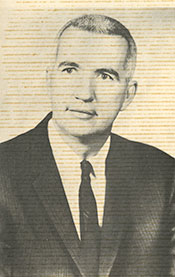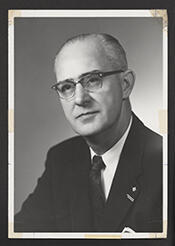
Durward Gorham Hall (September 14, 1910 – March 15, 2001) was a physician, educator, and six-term Republican member of the United States House of Representatives from Missouri’s 7th congressional district. Serving in Congress from 1961 to 1973, he represented southwest Missouri during a period of significant political and social change in the United States and became known on Capitol Hill for his fiscal conservatism and independent voting record.
Hall was born in Cassville, Barry County, Missouri, on September 14, 1910. He grew up in southwest Missouri and attended public schools before enrolling at the Greenwood Laboratory School at Southwest Missouri State Teacher’s College in Springfield, Missouri, from which he graduated in 1926. He continued his education in Springfield at Drury College (now Drury University), earning an A.B. degree in 1930. Demonstrating an early commitment to medicine, he then entered Rush Medical College in Chicago, Illinois, where he completed his medical degree (M.D.) in 1934, preparing for a career as a physician.
Following medical school, Hall entered the practice of medicine and later served his country in a military medical capacity. He served as a physician in the United States Army, Office of the Surgeon General, contributing his medical expertise to the armed forces. In 1955 he joined the United States Army Reserve, further formalizing his ongoing association with military medicine. His dual background in clinical practice and military medical service would later inform his legislative interests, particularly in health and defense-related issues.
Hall’s political career began in earnest with his election as a Republican to the 87th United States Congress in 1960, representing Missouri’s 7th congressional district. He took office on January 3, 1961, and was subsequently re-elected to five additional terms, serving continuously until January 3, 1973. Over these six terms in the House of Representatives, he participated actively in the legislative process and represented the interests of his southwest Missouri constituents during an era marked by the Cold War, the civil rights movement, and the escalation of U.S. involvement in Vietnam. In addition to his congressional duties, he was appointed as a delegate to the 1964 Republican National Convention, reflecting his standing within his party at both the state and national levels.
During his years in Congress, Hall developed a reputation as a staunch fiscal conservative and a social moderate. His frequent opposition to federal spending measures earned him the nickname “Dr. No” from his critics, a reference both to his medical title and his tendency to vote against appropriations and other spending bills he regarded as excessive. On civil rights legislation, his record was mixed: he voted against the Civil Rights Act of 1964 and the Voting Rights Act of 1965, but supported the Civil Rights Act of 1968. These votes placed him at the center of some of the most consequential debates of his time, illustrating the complex political alignments of the mid-20th century. After more than a decade in the House, Hall chose to retire from elective office and did not seek reelection to the 93rd Congress in 1972. He left Congress at the conclusion of his sixth term, and Gene Taylor, also a Republican, succeeded him as the representative from Missouri’s 7th District.
Following his departure from Congress, Hall remained active in public service and medical education. He was a co-founder and member of the board of trustees of the Uniformed Services University of the Health Sciences in Bethesda, Maryland, serving on its board from 1973 to 1981. In that role he helped shape the development of a federal health sciences university dedicated to training medical professionals for the uniformed services, drawing on his combined experience as a physician, military medical officer, and legislator. He also served on the faculty of Eckerd College in St. Petersburg, Florida, extending his commitment to education into the liberal arts and contributing to the academic life of the institution.
In his later years, Hall returned to Missouri and spent his retirement in Springfield with his wife, maintaining ties to the region where he had been educated and which he had represented in Congress. He continued to be remembered locally as both a physician and a public servant. Durward Gorham Hall died on March 15, 2001, in Albany, Oregon. In keeping with his lifelong dedication to medicine and education, he donated his body to medical science.
Congressional Record