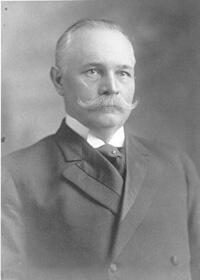
Duncan Upshaw Fletcher (January 6, 1859 – June 17, 1936) was an American lawyer and Democratic politician who became the longest-serving United States Senator in Florida’s history, serving from 1909 until his death in 1936. Over the course of five terms in the Senate, he played a prominent role in national legislative affairs, particularly in banking and securities regulation during the New Deal era, while also maintaining deep involvement in Florida’s legal, educational, and civic institutions. Before his long congressional service, he served two terms as mayor of Jacksonville, Florida, and held a seat in the Florida House of Representatives.
Fletcher was born near Americus, Sumter County, Georgia, on January 6, 1859. Raised in the post–Civil War South, he developed views strongly sympathetic to the Confederate cause, sentiments he would later express publicly. He pursued higher education in law at Vanderbilt University in Nashville, Tennessee, graduating in 1880. He was admitted to the bar in 1881 and soon thereafter moved to Florida, where he established a law practice in Jacksonville. Fletcher quickly became a leading figure in the city’s legal community, serving as a founding member of the Jacksonville Bar Association and becoming its first president in February 1897.
In his early legal career, Fletcher served as general counsel for several railroads, including the Florida East Coast Railroad operated by industrialist Henry Flagler, formerly president of Standard Oil. He also engaged in business ventures, notably as an early investor in approximately 1,300 acres in the area now known as Fort Lauderdale, specifically Wilton Manors, where he helped start Florida Fiber, a sisal hemp farming operation. In 1896, Fletcher was one of three white attorneys appointed to administer the bar examination to James Weldon Johnson, who became the first African American admitted to the Florida Bar by examination. Over the objection of another examiner, Fletcher moved that Johnson be admitted and personally congratulated him, an episode that marked a notable moment in Florida’s legal history.
Fletcher’s political career began at the municipal and state levels. He was elected to the Jacksonville city council in 1887 and subsequently elected mayor of Jacksonville, serving two nonconsecutive terms from 1893 to 1895 and from 1901 to 1903. During his second mayoral term, he played a central role in rebuilding Jacksonville after the devastating Great Fire of 1901, overseeing efforts to restore and modernize the city. In 1893, he was elected to the Florida House of Representatives, adding state legislative experience to his municipal leadership. From 1900 to 1907, he chaired the Board of Public Instruction of Duval County, reflecting his involvement in local educational governance. Beyond Florida, he developed an interest in regional infrastructure and waterways, serving in 1908 as president of the Gulf Coast Inland Waterways Association and later of the Mississippi to Atlantic Waterway Association.
In 1908, Fletcher secured the Democratic nomination for the United States Senate in a primary election held on June 16, and he was elected by the Florida Legislature at its next convening. He took his seat in the U.S. Senate in 1909 and was subsequently re-elected four times, serving continuously until 1936. His electoral record reflected his strong standing within the state’s dominant Democratic Party: in the 1914 Senate election he received approximately 99.5 percent of the vote; in 1920 he was re-elected with about 69.5 percent, defeating Republican John M. Cheney and several minor-party candidates; in 1926 he won another term with roughly 77.9 percent of the vote against independent John M. Lindsay; and in 1932 he was returned to office with about 99.8 percent of the vote. His long tenure in the Senate coincided with a transformative period in American history, spanning the Progressive Era, World War I, the Roaring Twenties, and the Great Depression, during which he consistently represented Florida’s interests and participated in the national legislative process.
During his Senate career, Fletcher held several influential assignments. He served on the United States Senate Committee on Commerce and chaired it from 1916 to 1919. As a member of the committee’s subcommittee investigating the Titanic disaster, he took part in the high-profile inquiry into maritime safety following the 1912 sinking of the RMS Titanic. In 1913, President Woodrow Wilson appointed him chairman of a United States commission to investigate European land-mortgage banks, cooperative rural credit unions, and methods for improving rural conditions, sending him abroad to study agricultural credit systems. Wilson also named him a delegate to the International High Commission, which sought to promote economic and legal cooperation in the Western Hemisphere. Fletcher later rose to national prominence as chairman of the Senate Committee on Banking and Currency in 1932, where he oversaw the investigation commonly known as the Pecora Commission, which examined the causes of the Wall Street Crash of 1929. The committee’s work led to major reforms of the American financial system, including the Securities Act of 1933 and the Securities Exchange Act of 1934, which established federal disclosure requirements for corporations seeking public financing and laid the groundwork for the creation of the U.S. Securities and Exchange Commission in 1935 to enforce these laws.
Fletcher also devoted considerable attention to Florida’s development and conservation. In 1928, he introduced legislation to create Everglades National Park, a measure that was ultimately signed into law by President Franklin D. Roosevelt in 1934, marking a significant federal commitment to preserving Florida’s unique ecosystem. He was instrumental in securing funding for Tampa’s Gandy Bridge, an important transportation link across Tampa Bay, and he played a role in founding property for what became MacDill Air Force Base in Tampa, reflecting his interest in both infrastructure and national defense. During the era of the Works Progress Administration and related New Deal programs, he was associated with a variety of public works projects that contributed to Florida’s economic and physical development.
Outside of elective office, Fletcher was active in civic, educational, and religious affairs. He served as a trustee of John B. Stetson University and of the St. Luke’s Hospital Association in Jacksonville, underscoring his interest in higher education and public health. He was vice president of the Children’s Home Society of Florida, supporting child welfare initiatives, and honorary president of the Southern Commercial Congress, an organization promoting economic development in the South. Professionally, he belonged to the American Bar Association and the Florida State Bar Association and served as president of the Florida Society. In 1907, he founded the First Unitarian Church in Jacksonville, Florida, reflecting his engagement with religious and community life. At the same time, he remained a staunch defender of the Confederate legacy; in a 1931 address to the United Daughters of the Confederacy, he asserted that the South had fought to preserve “race integrity” and “free white dominion,” arguing that what was termed the “Lost Cause” was “not so much ‘lost’ as is sometimes supposed,” a statement that illustrated his adherence to white supremacist and states’ rights doctrines prevalent among many Southern politicians of his era.
Duncan Upshaw Fletcher died of a heart attack in Washington, D.C., on June 17, 1936, while still serving in the United States Senate. He was interred in Evergreen Cemetery in Jacksonville, Florida. Following his death, his secretary destroyed his personal papers, leaving historians with limited access to his private correspondence and records. Fletcher’s legacy in Florida is reflected in numerous institutions and landmarks bearing his name, including Duncan U. Fletcher High School in Neptune Beach, Duncan U. Fletcher Middle School in Jacksonville Beach, Duncan U. Fletcher Hall at the University of Florida, and the Phi Alpha Delta Fletcher Chapter at the University of Florida College of Law. During World War II, the Liberty ship SS Duncan U. Fletcher was built in Panama City, Florida, in his honor, and Fletcher Avenue in Tampa also commemorates his long and influential public career.
Congressional Record