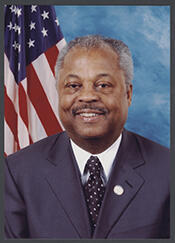
Donald Milford Payne Sr. (July 16, 1934 – March 6, 2012) was an American politician who served as a Representative from New Jersey in the United States Congress from 1989 to 2012. A member of the Democratic Party, he was the U.S. representative for New Jersey’s 10th congressional district from January 3, 1989, until his death, completing 12 terms in office. The district encompassed most of the city of Newark, parts of Jersey City and Elizabeth, and several suburban communities in Essex and Union counties. Payne was the first African American to represent New Jersey in Congress, and his service in the House of Representatives occurred during a significant period in American history, in which he consistently participated in the democratic process and represented the interests of his constituents.
Born in Newark, New Jersey, on July 16, 1934, Payne grew up in the city he would later represent in Congress. He attended local public schools in Newark and developed an early interest in public service and community affairs. His upbringing in an urban, working-class environment shaped his later legislative priorities, particularly his focus on education, civil rights, and economic opportunity for underserved communities. Newark remained the geographic and political center of his life and career.
Payne pursued higher education at Seton Hall University in South Orange, New Jersey, where he studied and prepared for a career that initially combined business, education, and civic engagement. Before entering national politics, he worked in the private sector and became active in local and regional organizations, gaining experience in leadership and governance. His early involvement with community-based groups and youth programs helped establish his reputation as a committed advocate for education and social advancement, and it laid the groundwork for his later roles on national boards and foundations.
Before his election to Congress, Payne built a substantial record of public and civic service that positioned him as a prominent figure in New Jersey politics. He became involved with organizations such as the Boys and Girls Clubs of Newark and the Newark YMCA, and he participated in initiatives aimed at improving opportunities for young people and families in urban neighborhoods. His work with these and other community institutions, including the Newark Day Center and the Fighting Back Initiative, reflected a long-standing commitment to addressing poverty, educational inequality, and community development. This combination of local engagement and emerging political leadership ultimately propelled him to seek and win a seat in the U.S. House of Representatives.
Elected to Congress in 1988, Payne took office on January 3, 1989, as the representative for New Jersey’s 10th congressional district and remained in that position until his death on March 6, 2012. Over the course of his 12 terms, he became known for having one of the most consistently progressive voting records among New Jersey’s congressional delegation. He was pro‑choice, opposed the death penalty, and was a strong supporter of policies designed to assist the middle class and low‑income communities. Payne received an “A” rating on the Drum Major Institute’s 2005 Congressional Scorecard on middle-class issues, underscoring his alignment with liberal and progressive economic and social policies. His electoral strength in the district was notable: in 1998 he won reelection with 84.16 percent of the vote against Republican Vanessa Williams, with minor-party candidates Harley Tyler and Toni Jackson receiving less than 1 percent each; in 2000 he was reelected with 87.5 percent of the vote against Republican Dirk B. Weber and independent Maurice Williams. In 2002 he was reelected with 84.5 percent of the vote, the highest margin in any New Jersey congressional race that year. In 2004 Republicans did not field a candidate, and Payne was reelected with 97 percent of the vote against Green Party candidate Toy‑Ling Washington and Socialist Workers Party candidate Sara J. Lobman. In 2006 he was unopposed in both the primary and general elections. In 2008 he won 99 percent of the vote against Green Party candidate Michael Taber, and in 2010 he defeated little-known candidate Micheal Alonso.
Within the House of Representatives, Payne emerged as a leading advocate for education and international human rights, particularly in Africa. Domestically, he was instrumental in the passage of key education-related legislation, including the Goals 2000 initiative to improve elementary and secondary schools, the School‑to‑Work Opportunities Act, and the National Service Act. He supported the establishment of the National Literacy Institute and consistently backed funding for Head Start, Pell Grants, summer jobs programs, and student loans, reflecting his belief that education and service were central to expanding opportunity. His legislative efforts in these areas contributed to national policy frameworks aimed at improving educational outcomes and workforce readiness for young Americans.
On foreign affairs, Payne played a prominent role as a member of the U.S. House Committee on Foreign Affairs. He served as chairman of the House Foreign Affairs Subcommittee on Africa and Global Health and sat on the Subcommittee on the Western Hemisphere and the Subcommittee on International Organizations, Human Rights, and Oversight. In these capacities, he was at the forefront of efforts to restore democracy and human rights in nations across the globe, with particular emphasis on Africa. He was deeply engaged in issues relating to the conflict in the Darfur region of Sudan and the Western Sahara conflict, and he became a leading congressional voice on humanitarian crises and conflict resolution on the African continent. On June 22, 2001, Payne was arrested while protesting against the Sudanese government at its embassy in Washington, D.C., underscoring the depth of his commitment to addressing genocide and mass atrocities. He supported and endorsed the Genocide Intervention Network and was recognized as having one of the most supportive records in Congress on issues involving the Northern Ireland peace process.
Payne’s international engagement extended beyond the legislative arena. He was one of five members of Congress chosen to accompany President Bill Clinton and First Lady Hillary Clinton on their historic six‑nation tour of Africa, reflecting his stature as a key voice on U.S.–Africa relations. He also headed a presidential mission to war‑torn Rwanda to help seek solutions to that country’s political and humanitarian crises in the aftermath of genocide. In 2003 President George W. Bush appointed Payne as one of two members of Congress to serve as a congressional delegate to the United Nations, and he was reappointed in 2005 to an unprecedented second term. In this role, he met with the U.N. Secretary‑General and the U.S. Ambassador to the United Nations and regularly attended sessions of the U.N. General Assembly and other high‑level meetings, further solidifying his influence on international policy. On April 13, 2009, while departing Mogadishu, Somalia, Payne’s plane came under mortar fire from Somali fighters at the airport; he was unhurt, as the aircraft was already en route to Kenya, and he later stated that his party did not know of the attack until after arriving in Kenya. The incident occurred one day after the rescue of Captain Richard Phillips from Somali pirates following the failed hijacking of the MV Maersk Alabama.
Within the Democratic Party, Payne held important leadership and advisory roles. He was a member, and former chair, of the Congressional Black Caucus, where he worked to advance civil rights, voting rights, and economic justice for African Americans and other marginalized communities. In 2002 House Minority Leader Nancy Pelosi selected him to serve on the Democratic Steering Committee, the body responsible for assigning Democratic members to House committees and helping shape the party’s legislative agenda. His influence within the caucus and the broader party was reflected in his role in internal debates and endorsements; during the 2008 presidential campaign, he initially supported Senator Hillary Clinton for the Democratic nomination but later shifted his support to Senator Barack Obama. Payne was also one of 31 House Democrats who voted in January 2005 not to count the 20 electoral votes from Ohio in the 2004 presidential election, a procedural challenge that, had it succeeded, would have sent the election to the House of Representatives under the Twelfth Amendment to the Constitution.
Beyond Congress, Payne served on the boards of numerous national and international organizations. He was a member of the board of directors of the National Endowment for Democracy, TransAfrica, the Discovery Channel Global Education Fund, the Congressional Award Foundation, the Boys and Girls Clubs of Newark, the Newark Day Center, the Fighting Back Initiative, and the Newark YMCA. His work with these organizations reflected his dual focus on democracy promotion abroad and youth development and education at home. He received numerous awards and honors from national, international, and community-based organizations, including the Visionaries Award bestowed by the Africa Society and the prestigious Democracy Service Medal from the National Endowment for Democracy, an honor previously awarded to figures such as former Polish President and Solidarity founder Lech Wałęsa. In recognition of his longstanding commitment to global development and education, the Donald M. Payne International Development Fellowship was established in his honor to encourage and support careers in international development and diplomacy.
Donald M. Payne died on March 6, 2012, while still serving in the U.S. House of Representatives, bringing to a close more than two decades of continuous congressional service. At the time of his death, he was widely regarded as one of New Jersey’s most progressive and internationally engaged lawmakers, with a record that combined vigorous advocacy for education and social justice at home with a sustained commitment to human rights, democracy, and conflict resolution abroad.
Congressional Record