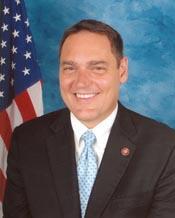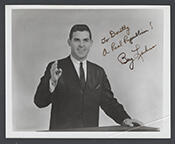
Donald Edgar “Buz” Lukens (February 11, 1931 – May 22, 2010) was a Republican politician from Ohio who served in the United States House of Representatives and the Ohio State Senate during a career that spanned more than two decades. A member of the Republican Party, he contributed to the legislative process during multiple terms in Congress, representing his constituents in the U.S. House of Representatives from 1967 to 1971 and again from 1987 until his resignation in 1990. His political career ended amid scandal when he was charged with contributing to the delinquency of a minor, and he was later convicted on federal bribery charges related to his time in Congress.
Lukens was born in Harveysburg, Warren County, Ohio, and attended local schools there before graduating from high school in nearby Waynesville, Ohio. He went on to attend Ohio State University in Columbus, where he earned a bachelor’s degree in 1954. Following his graduation, Lukens entered the United States Air Force. He served on active duty for six and a half years, attaining the rank of captain, and subsequently remained in the Air Force Reserve. His early professional and military experience helped introduce him to national politics and legislative procedure, and in 1961 he accepted a position in Washington, D.C., as minority counsel for the Republican staff of the House Committee on Rules.
During the early 1960s, Lukens became a prominent figure in Republican youth politics, serving as president of the national Young Republicans. This role raised his profile within the party and provided a platform for his entry into elective office. In 1966, capitalizing on his growing reputation, he ran for Congress from Ohio and won a seat in the U.S. House of Representatives by defeating Democrat James H. Pelley. He took office on January 3, 1967, in the 90th Congress. Lukens was reelected in 1968, defeating Democrat Lloyd D. Miller, and served through the 91st Congress. During this initial period in the House, he participated in the legislative process at a time of significant national debate over civil rights, the Vietnam War, and domestic policy, and he was an early supporter of California Governor Ronald Reagan’s campaign for the Republican presidential nomination in 1968.
Rather than seek reelection to the House in 1970, Lukens pursued higher office and entered the Republican primary for Governor of Ohio. He was defeated in that primary by Ohio House Speaker Roger Cloud, who subsequently lost the general election to Democrat John J. Gilligan. After this setback, Lukens returned to state-level politics. He was appointed to the Ohio State Senate in 1971 and went on to serve there until 1986. Over this fifteen-year tenure in the state legislature, he became a durable presence in Ohio Republican politics and maintained his ties to national party figures. In his personal life, Lukens married Toshiko Shirley Jane Davis, a model 21 years his junior, in Columbus, Ohio, in June 1973; the couple divorced in 1983.
In 1986, when Representative Tom Kindness, who then held Lukens’s former U.S. House seat, chose to run for the United States Senate against incumbent Senator John Glenn rather than seek reelection, Lukens sought to reclaim his old congressional district. He won the Republican nomination and defeated perennial Democratic candidate John W. Griffin in the general election. Lukens returned to Congress on January 3, 1987, for the 100th Congress and continued in the 101st Congress after winning reelection in 1988, again defeating Griffin. Across his combined service, he held office in the House of Representatives from 1967 to 1971 and from 1987 until 1990, for a total of four terms in Congress, during which he represented a heavily Republican district in southwestern Ohio and participated in the work of the House at both the state and national levels.
Lukens’s congressional career came to an abrupt and highly public end as a result of a sex scandal that emerged in 1989. On February 1 of that year, an Ohio television station filmed him at a McDonald’s restaurant in Columbus, Ohio, speaking with the mother of a teenage girl and openly discussing his sexual relationship with the girl. A Franklin County grand jury subsequently charged him with contributing to the delinquency of a minor based on allegations that he had paid the girl $40 and given her gifts in exchange for sex when she was 16 years old. Additional allegations suggested that the relationship had begun when she was 13, but the grand jury declined to pursue further charges beyond a single count of contributing to the delinquency of a minor. On June 30, 1989, a jury in Franklin County Juvenile Court convicted Lukens of the misdemeanor offenses of contributing to the delinquency of a minor and contributing to the unruliness of a minor for paying $40 to the girl for sex in his Columbus apartment on November 6, 1988; a 19-year-old friend of the girl accompanied her that day but was not directly involved. Although Ohio’s age of consent is 16, the conviction rested on a statute prohibiting any person from aiding, abetting, inducing, causing, encouraging, or contributing to a child or ward of the juvenile court becoming an unruly or delinquent child. The judge later set aside the conviction on the delinquency charge but upheld the unruliness conviction, imposing the maximum penalty of 180 days in jail and a $1,000 fine. All but 30 days of the jail term and half of the fine were suspended, and Lukens was ordered to attend sex offender programs and be tested for venereal diseases; bond was set at $100,000, which the judge characterized as “eminently reasonable for a man with no remorse whatsoever.”
Lukens appealed his conviction to the Franklin County Court of Appeals, arguing in part that the trial court had improperly excluded evidence of the girl’s juvenile record, which included curfew violations, running away, and petty theft, as well as a psychiatric report. The girl, who lived with her mother but was a ward of the Juvenile Court, had already been adjudicated a delinquent, and Lukens’s defense contended that her record would show she was already delinquent and an unreliable witness. The appellate court upheld the trial court’s rulings, despite acknowledged inconsistencies in the girl’s testimony, which even County Prosecutor Michael Miller conceded. Throughout the scandal, Lukens refused to resign from Congress despite pressure from Republican leaders. In the 1990 Republican primary, he was defeated by state representative John Boehner, marking the effective end of his electoral career in this strongly Republican district. On October 23, 1990, the House Committee on Standards of Official Conduct (Ethics Committee) voted to investigate additional allegations that Lukens had fondled and propositioned a Capitol elevator operator. Facing mounting ethical and political pressure and recognizing the untenable nature of his position, Lukens resigned from Congress on October 24, 1990. In January 1991, he served nine days of the 30-day jail sentence originally imposed in 1989. During the public furor over the scandal, Vice President Dan Quayle drew ridicule in the press when, in a speech on July 15, 1989, he mistakenly referred to “Neil Armstrong and Buz Lukens” walking on the moon, apparently confusing Lukens with astronaut Buzz Aldrin.
Lukens’s legal troubles continued after he left office. In the mid-1990s, in the wake of investigations related to the House banking scandal, a federal task force charged him with five counts of bribery and conspiracy arising from actions he had taken while serving in Congress. He was accused of accepting a $15,000 bribe in connection with his official duties. After an initial mistrial, Lukens was convicted in March 1996 following a second trial and was sentenced to 30 months in federal prison. His conviction placed him among the American federal politicians convicted of crimes and associated him with a broader series of federal political scandals in the United States.
In his later years, Lukens lived away from public life. He died of cancer in Dallas, Texas, on May 22, 2010, at the age of 79. His career, which began with military service, party activism, and legislative work in both the Ohio State Senate and the U.S. House of Representatives, ended under the shadow of criminal convictions and ethical controversy.
Congressional Record