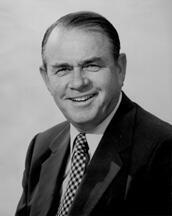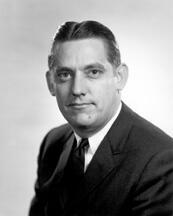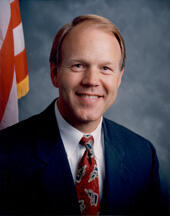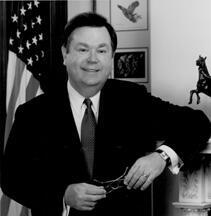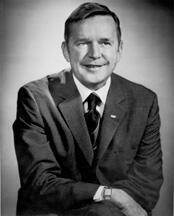
Dewey Follett Bartlett Sr. (March 28, 1919 – March 1, 1979) was an American politician who served as the 19th governor of Oklahoma from 1967 to 1971 and as a United States Senator from Oklahoma from 1973 to 1979. A member of the Republican Party, he was a prominent conservative voice who represented Oklahoma during a significant period in American political and economic history, particularly the energy crises of the 1970s. In 1966, he became the first Roman Catholic elected governor of Oklahoma, and in 1972 he was elected to the United States Senate, where he served one term.
Bartlett was born in Marietta, Ohio, to David A. and Jessie Bartlett. He attended schools in Marietta and later in Lawrenceville, New Jersey, where he prepared for college. He enrolled at Princeton University, from which he graduated in 1942 with an undergraduate degree in geological engineering. While at Princeton, he was president of his senior class and completed a senior thesis titled “Water-flooding an oil formation,” written under the supervision of Glenn L. Jepsen and Kenneth DePencier Watson. His academic work in geological engineering presaged his later professional involvement in the oil and gas industry.
Following his graduation from Princeton in 1942, Bartlett enlisted in the United States Navy and subsequently served in the United States Marine Corps during World War II. He was a dive bomber pilot in the Pacific theater, gaining combat experience that shaped his sense of duty and public service. After the war, he moved to Tulsa, Oklahoma, where he embarked on a career in agriculture and the petroleum industry. In Tulsa he held various positions in farming and ranching and became active in the oil business, ultimately inheriting ownership of the Tulsa-based Keener Oil and Gas Company from his father, David A. Bartlett. His business activities in oil and gas would later inform his legislative priorities, particularly during the national energy debates of the 1970s.
Bartlett’s formal political career began in the Oklahoma Legislature. He was elected to the Oklahoma Senate and served from 1962 to 1966. As a state senator, he built a reputation as a conservative Republican at a time when the party was still consolidating its position in Oklahoma politics. In 1966, he ran for governor and won, succeeding fellow Republican Henry Bellmon. In that election he defeated the Democratic nominee, Preston J. Moore of Oklahoma City, becoming the first Roman Catholic ever elected governor of Oklahoma. His victory marked a significant milestone in both the state’s partisan realignment and its religious and cultural history.
As governor of Oklahoma from 1967 to 1971, Bartlett pursued a program of governmental reform and fiscal conservatism. He implemented major changes to the Oklahoma Department of Corrections, seeking to modernize and reorganize the state’s penal system. He advocated school consolidation as a means of improving efficiency and educational standards and exercised his veto power on education legislation, including a school code bill he opposed. In 1970 he became the first Oklahoma governor eligible to seek a second consecutive term under revised state law. In the general election that year, he was challenged by Tulsa County Attorney David Hall. In what became the closest gubernatorial election in Oklahoma history, Hall defeated Bartlett by a vote of 338,338 (48.4 percent) to 336,157 (48.1 percent), ending Bartlett’s tenure in the governor’s office in January 1971.
After leaving the governorship, Bartlett turned to federal office. In 1972 he ran for the United States Senate seat held by Democrat Fred R. Harris, who did not seek reelection. Riding in part on President Richard Nixon’s strong performance in Oklahoma that year, Bartlett narrowly defeated Democratic U.S. Representative Ed Edmondson in the general election. He took office on January 3, 1973, and served one term in the Senate, leaving office on January 3, 1979. During his tenure in Congress, he maintained a generally conservative stance on most issues and was particularly active on matters affecting the oil and gas industry. Representing an energy-producing state during the energy crises of the 1970s, he championed the interests of oil and gas producers and advocated policies aimed at increasing domestic energy production and addressing national energy security.
Bartlett’s service in the Senate coincided with a turbulent era in American politics, encompassing the end of the Vietnam War, the Watergate scandal, and shifting national economic priorities. As a member of the Senate, Dewey Follett Bartlett contributed to the legislative process and represented the interests of his Oklahoma constituents in these debates. His work reflected both his business background and his earlier executive experience as governor. However, his congressional career was increasingly affected by health problems. In 1978 he was diagnosed with lung cancer. Facing a serious illness and anticipating a difficult reelection campaign against popular Democratic Governor David Boren, he chose not to seek a second term in the Senate in 1978.
In his personal life, Bartlett married Ann Smith, a native of Seattle, Washington, on April 2, 1945, at Mission San Juan Capistrano in San Juan Capistrano, California. The couple had three children: Dewey F. Bartlett Jr., Michael, and Joanie. Continuing the family’s involvement in public life and the energy sector, Dewey F. Bartlett Jr. later inherited the Keener Oil and Gas Company and entered local politics in Tulsa. The younger Bartlett served on the Tulsa City Council from 1990 to 1994 and as mayor of Tulsa from 2009 until he lost reelection to G. T. Bynum in 2016.
Two months after retiring from the Senate, Dewey Follett Bartlett died in Tulsa on March 1, 1979, from complications of lung cancer. He was buried in Calvary Cemetery in Tulsa. His public service continued to be recognized posthumously. In 1990 he was inducted into the Oklahoma CareerTech Hall of Fame, honoring his contributions to education and workforce development in the state. In March 2006, the United States Congress passed legislation renaming a U.S. Post Office in Tulsa in his honor, commemorating his years of service as governor and U.S. senator and his long association with the city and state he represented.
Congressional Record