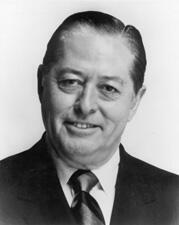
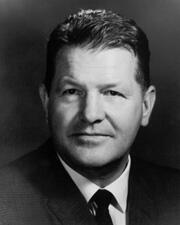
Dionisio “Dennis” Chávez (April 8, 1888 – November 18, 1962) was an American politician who served in the United States House of Representatives from 1931 to 1935 and in the United States Senate from 1935 until his death in 1962. A member of the Democratic Party, he was the first Hispanic person to be elected to a full term in the U.S. Senate, the first U.S. Senator to be born in New Mexico—then still a territory—and, according to contemporary accounts, became the first Latino lawyer in the United States in 1920. Over seven terms in Congress, he contributed significantly to the legislative process and represented the interests of his New Mexico constituents during a transformative period in American history.
Chávez was born in Los Chavez, in the New Mexico Territory, to David and Paz Chávez, whose families had lived in the area for generations. There was no school in Los Chavez, and in 1895 his father moved the family to the Barelas section of Albuquerque so he could work on the railroad and the children could attend school. Dennis attended school there until the seventh grade, when financial hardship required him to leave and work to help support the family. His early employment included delivering groceries for the Highland Grocery store. Despite limited formal schooling, he studied engineering and surveying at night and later worked as an engineer for the City of Albuquerque for several years. Public service ran in the family: his younger brother, David Chávez, would later serve as the 34th mayor of Santa Fe, as a judge of the United States District Court for the District of Puerto Rico, and as a member of the New Mexico Supreme Court.
In 1911, Chávez married Imelda Espinosa, a member of a prominent New Mexico family, and in 1914 the couple moved to Belen, New Mexico. They had three children: Dennis Jr., Gloria, and Ymelda. During these years, Chávez worked briefly as editor of a weekly newspaper in Belen, as a court interpreter, and as a private contractor. His fluency in Spanish and English led to temporary employment in 1916 as a Spanish interpreter for Senator Andrieus A. Jones’s election campaign. Impressed with his abilities, Senator Jones offered him a position in Washington, D.C., and in 1917 Chávez became assistant executive clerk of the United States Senate. While working full-time, he passed a special admission examination for Georgetown University Law Center, studied law at night, and graduated in 1920. He then returned to Albuquerque to establish a law practice, gaining prominence as counsel in high-profile murder cases and as an advocate for organized labor, successes that helped launch his political career.
Chávez’s formal political career began in state government. In 1922 he was elected to the New Mexico state legislature as a Democrat, serving a single term and choosing not to seek re-election. Building on his growing reputation, he ran for federal office in 1930 and was elected to New Mexico’s at-large seat in the United States House of Representatives. He was re-elected in 1932 and served in the House from March 4, 1931, to January 3, 1935. During his House service he chaired the Committee on Irrigation and Reclamation, a post of particular importance to a Western state dependent on water development and reclamation projects. His tenure in the House coincided with the early years of the New Deal, and he participated actively in the legislative process on issues affecting his state and region. He did not seek re-election to the House in 1934, instead becoming the Democratic nominee for the United States Senate from New Mexico.
In the 1934 Senate race, Chávez narrowly lost to the Republican incumbent, Bronson M. Cutting. On May 6, 1935, however, Cutting was killed in an airplane crash, and five days later Chávez was appointed to fill the vacancy pending a special election. In 1936 he won election to serve the remaining four years of Cutting’s term, and in 1940 he secured a full six-year term in his own right, thereby becoming the first person of Hispanic descent elected to a full term in the U.S. Senate. He was re-elected in 1946, 1952, and 1958, serving continuously in the Senate from January 3, 1935, until his death on November 18, 1962. Over these years he rose steadily in seniority, ultimately becoming the fourth-ranking member of the Senate. He chaired the Committee on Public Works from 1949 to 1953 and again from 1955 until his death, overseeing major federal infrastructure and development initiatives. His long tenure made him, by a wide margin, the longest-serving Hispanic U.S. senator of his era and only the second Hispanic ever to serve in the Senate. He was also the first person born in New Mexico to be elected by the state to the Senate.
Chávez’s Senate career was not without controversy. Following his 1952 re-election, Senate Republicans challenged the validity of the election, alleging irregularities and seeking to have him removed from his seat. A resolution was introduced asserting that no candidate had been duly elected in 1952 and that the Republican governor of New Mexico should appoint a new senator. After debate, the Senate rejected the resolution by a vote of 36 to 53, and Chávez retained his seat. Throughout his service, he was recognized as a steadfast Democrat and an influential voice on public works, Western development, and issues affecting Hispanic Americans, and he remained an active participant in the democratic process on behalf of his constituents.
Dennis Chávez died of cancer, attributed in contemporary accounts to his being a lifelong smoker, in Washington, D.C., on November 18, 1962. He was buried at Mount Calvary Cemetery in Albuquerque, New Mexico. Congress honored his memory with a minute of silence, and Vice President Lyndon B. Johnson delivered remarks at his funeral. His legacy extended through his family: his daughter Ymelda Chavez Dixon wrote a widely read women’s column, “Your Date with Ymelda,” for the Washington Evening Star from 1965 to 1981, and his granddaughter Gloria Tristani pursued public service as chair of the New Mexico State Corporation Commission in 1996, as a member of the Federal Communications Commission from 1997 to 2001, and as the Democratic nominee for New Mexico’s other U.S. Senate seat in 2002. In recognition of his national significance, the United States Postal Service honored him with a 35-cent stamp in its Great Americans series, issued between 1980 and 2000, and his career continues to be cited in lists of Hispanic and Latino Americans in the United States Congress and of members of Congress who died in office in the mid-twentieth century.
Congressional Record