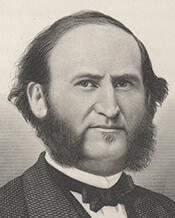
Demas Barnes (April 4, 1827 – May 1, 1888) was an American businessman, patent medicine manufacturer, newspaper editor, and politician who served as a Democratic United States Representative from New York for one term from 1867 to 1869. His congressional service took place during the tumultuous Reconstruction era following the Civil War, when he participated in the legislative process and represented the interests of his constituents in New York’s second congressional district.
Barnes was born on April 4, 1827, in Gorham Township, Ontario County, New York, the son of Demas Barnes. He attended the local public schools and, after completing his basic education, engaged in mercantile pursuits. These early experiences in trade and commerce laid the foundation for his later success in business and his eventual prominence in the patent medicine industry.
In 1849 Barnes moved to New York City, where he entered the drug business. He became involved in the development and marketing of proprietary remedies, including products associated with Charles Henry Fletcher’s Castoria, and quickly established himself in the expanding field of patent medicines. In the early 1850s he undertook an overland journey across the continent by wagon, traveling through Colorado, Nevada, and California. During this expedition he studied the mineral resources of these western territories, gaining first-hand knowledge of the economic and geographic conditions of the American West.
Upon his return to New York City, Barnes wrote articles and published accounts of his experiences in the United States, particularly his observations of the West and its resources. In 1853 he founded his own wholesale drug business in New York City, where he became highly prosperous as a manufacturer and distributor of patent medicines. His commercial success was accompanied by a notable role in the emerging system of revenue taxation on such products during the Civil War period. He was one of the first businessmen to request private die proprietary stamps after they were authorized by the federal government, and in September 1862 the Commissioner of Internal Revenue approved the first three “D. S. Barnes” stamps—denominations of 1 cent, 2 cents, and 4 cents in a vertical format, printed in black and in vermilion—used to indicate tax paid on his products.
Elected as a Democrat to the Fortieth Congress, Barnes served as a United States Representative from New York’s second district from March 4, 1867, to March 3, 1869. His single term in the House of Representatives coincided with a significant period in American history, as Congress grappled with Reconstruction policies, the reintegration of the former Confederate states, and the protection of newly emancipated African Americans. As a member of the House, Barnes contributed to the legislative process and participated in the democratic governance of the nation, representing the interests of his New York constituents. He chose not to be a candidate for renomination in 1868 and thus concluded his congressional service at the end of his term.
After leaving Congress, Barnes returned to his business and civic interests in New York, particularly in Brooklyn. In 1873 he established and edited the Brooklyn Argus, a newspaper that reflected his engagement with local affairs and public discourse. He was also active in the real estate business, further extending his influence in the economic development of Brooklyn. In addition to his commercial ventures, Barnes served on the board of education, contributing to the oversight and improvement of local schools, and he was one of the original trustees of the Brooklyn Bridge project, participating in the governance of what would become one of the most iconic infrastructure undertakings of the nineteenth century.
Demas Barnes died in New York City, New York, on May 1, 1888, at the age of 61 years and 27 days. He was interred in Green-Wood Cemetery in Brooklyn, New York, a resting place for many of the city’s notable figures. His career as a successful businessman, early patent medicine manufacturer, newspaper editor, and one-term Democratic member of Congress reflects the intertwined commercial and political life of a nineteenth-century urban entrepreneur during a transformative era in American history.
Congressional Record