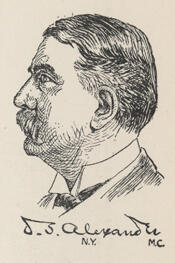
De Alva Stanwood Alexander (July 17, 1846 – January 30, 1925) was an American journalist, lawyer, historian, and Republican member of the United States House of Representatives, serving seven consecutive terms from 1897 to 1911 as a representative from New York. His congressional service spanned a significant period in American history at the turn of the twentieth century, during which he participated in the legislative process and represented the interests of his constituents while also establishing himself as an important commentator on political history and parliamentary procedure.
Alexander was born in Richmond, Sagadahoc County, Maine, on July 17, 1846, the son of Stanwood and Priscilla (Brown) Alexander. He was the grandson of Campbell and Margaret (Stanwood) Alexander and a descendant on his mother’s side of George Brown, who emigrated from England to Plymouth in 1635, giving him deep New England colonial roots. He attended local common schools in Maine and, following the death of his father, moved with his mother to Ohio in 1859. His early years were shaped by the upheaval of the Civil War, which interrupted his formal education but provided him with formative military experience.
During the American Civil War, Alexander served in the Union Army as a private from 1862 until the close of the conflict. He enlisted in the 128th Regiment, Ohio Volunteer Infantry, a unit that performed garrison and guard duties in the Western Theater. His wartime service, begun while he was still in his mid-teens, fostered a lifelong identification with Union veterans; in later years he would be active in the Grand Army of the Republic and eventually serve one term as commander of its Department of the Potomac. After the war, he returned to academic pursuits, attending the Edward Little Institute at Auburn, Maine, to prepare for college. He then enrolled at Bowdoin College in Brunswick, Maine, from which he graduated in 1870. He maintained a close relationship with his alma mater, serving for many years as a member and later president of the Bowdoin College board of overseers.
Immediately after his graduation in 1870, Alexander moved west to Fort Wayne, Indiana, where he embarked on a career in journalism and politics. He became one of the editors and proprietors of the Fort Wayne Daily Gazette, holding that position from 1871 to 1874. On September 21, 1871, he married Alice Colby. His work as an editor brought him into Republican Party circles, and in 1872 he served as a delegate to the Republican National Convention in Philadelphia, which renominated President Ulysses S. Grant. In 1874, Alexander relocated to Indianapolis, Indiana, where he continued his journalistic work as a correspondent for the Cincinnati Gazette. That same year he became secretary of the Indiana Republican State Committee, a position he held from 1874 to 1878, helping to organize and strengthen the party in a key Midwestern state.
While living in Indianapolis, Alexander studied law and developed important political connections. He formed a close friendship with Benjamin Harrison, then a rising Republican leader and later a United States senator and president. Alexander was admitted to the Indiana bar in 1877 and entered private practice in partnership with Stanton J. Peele, a prominent attorney who later became a federal judge. Their partnership continued until 1881, when Alexander was appointed Fifth Auditor of the United States Treasury Department in Washington, D.C. He served in that federal auditing post from 1881 to 1885, gaining administrative and fiscal experience in the national government. During this period he also remained active in veterans’ affairs through the Grand Army of the Republic, culminating in his service as commander of the Department of the Potomac for one term.
In 1885, after the end of the Republican administration in which he had served, Alexander moved to Buffalo, New York, where he established himself as a lawyer and public figure in his adopted state. He formed a law partnership with James A. Roberts, who would later serve as New York State Comptroller. When Benjamin Harrison was elected President of the United States in 1888, he rewarded his former associate by appointing Alexander United States Attorney for the Northern District of New York in May 1889. Alexander held that office until his resignation in December 1893, prosecuting federal cases and further enhancing his reputation in legal and political circles. Following the death of his first wife, he married Anne Gerlach Bliss on December 28, 1893, and then resumed the private practice of law in Buffalo.
Alexander entered national elective office in 1896, when he was chosen as a Republican to represent New York’s 33rd Congressional District in the Fifty-fifth Congress. He took his seat in the House of Representatives on March 4, 1897, and was subsequently reelected to six additional terms, serving continuously until March 3, 1911. Over the course of these seven terms, he participated actively in the legislative process during an era marked by the Spanish–American War, the rise of American imperial interests, and the Progressive movement. In the Sixty-first Congress, his final term, he served as chairman of the House Committee on Rivers and Harbors, a powerful committee responsible for legislation concerning the improvement of the nation’s waterways and port facilities. His long tenure reflected sustained support from his constituents, but in the 1910 election he was narrowly defeated for reelection by Democrat Charles Bennett Smith, who won the seat by a single vote.
Even while serving in Congress, Alexander cultivated a parallel career as a historian of American politics and legislative practice. He began work during his congressional years on what became his major scholarly undertaking, the four-volume “Political History of the State of New York,” which was completed and published in 1923. This comprehensive study examined the evolution of New York politics and profiled leading figures such as Grover Cleveland, Thomas C. Platt, and Theodore Roosevelt, drawing on Alexander’s firsthand knowledge of party organization and public life. He also authored “History and Procedure of the House of Representatives” (1916), a detailed account of the institutional development, rules, and operations of the House, reflecting both his legal training and his extensive legislative experience.
In his later years, after leaving Congress, Alexander resided in Buffalo, where he continued to practice law and devote himself to historical writing and civic affairs. His combined careers as soldier, journalist, party organizer, federal official, prosecutor, legislator, and author gave him a distinctive perspective on American political institutions at both the state and national levels. De Alva Stanwood Alexander died in Buffalo, New York, on January 30, 1925. He was buried in Forest Lawn Cemetery in Buffalo, closing a life that linked Civil War service, Gilded Age politics, and the early twentieth-century Congress with a substantial body of historical scholarship.
Congressional Record