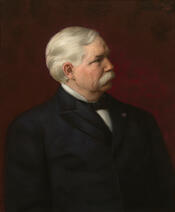
David Bremner Henderson (March 14, 1840 – February 25, 1906) was an American attorney, Civil War veteran, and Republican Party politician who served as the 34th Speaker of the United States House of Representatives from 1899 to 1903. He represented Iowa in the House from 1883 to 1903, serving ten consecutive terms, and was the first Speaker from west of the Mississippi River, the second foreign-born Speaker (after Charles Frederick Crisp), the only Speaker from Iowa, and the last Speaker who was a veteran of the Civil War. Over two decades in Congress, he participated actively in the legislative process and represented the interests of his Iowa constituents during a significant period in American political and economic development.
Henderson was born in Old Deer, Aberdeenshire, Scotland, on March 14, 1840. In 1846 he immigrated to the United States with his parents, who first settled in Winnebago County, Illinois. Three years later, in 1849, the family moved to a farm near Clermont in Fayette County, Iowa, where he was raised on the frontier of the growing Midwest. He attended the common schools and later pursued higher education at Upper Iowa University in Fayette, Iowa. While a student there he met Augusta Fox, a fellow student from Ohio who had moved to Iowa at an early age; the two pursued the same course of study and formed an attachment that would later lead to marriage.
With the outbreak of the American Civil War, Henderson left his studies and enlisted in the Union Army as a private. He served with distinction and saw heavy combat, being wounded at the Battle of Fort Donelson in Tennessee and again at the Second Battle of Corinth in Mississippi. His war service was marked by severe injury; he lost a leg as a result of his wounds. Despite this, he returned to active duty and accepted a colonelcy even before fully recovering, reflecting both his personal determination and the high regard in which he was held. He was mustered out of the service in 1864, having established a reputation as a courageous officer and committed Unionist.
After the war, Henderson read law and in 1865 began the practice of law in Dubuque, Iowa. His legal career advanced rapidly, and from 1869 to 1871 he served as Assistant United States Attorney for the Northern District of Iowa. During this period he married Augusta Fox, his former classmate from Upper Iowa University, with whom he had maintained a close relationship since their student days. The couple had two daughters and one son; their elder daughter married Samuel Peaslee, and their younger daughter, Isabelle, became known as an accomplished musician. Henderson’s growing prominence in the legal community and his Civil War record helped propel him into Republican politics in a state that strongly identified with the Union cause.
In 1882, Henderson was elected as a Republican to represent Iowa’s 3rd congressional district in the United States House of Representatives, taking his seat in March 1883. He would serve continuously until 1903, a span of ten terms, during which he became one of the most influential Republican leaders in the House. In 1889, he was a candidate for Speaker of the House but finished behind Thomas Brackett Reed and William McKinley in the internal party contest. From 1891 to 1895 he served as the ranking Republican member of the powerful House Committee on Appropriations, playing a central role in shaping federal spending during a period of industrial expansion and growing federal responsibilities. When Republicans regained control of the House in the 1894 elections, Reed, then Speaker, passed him over for the Appropriations chairmanship in favor of Joseph Gurney Cannon. Henderson was instead appointed chair of the House Committee on the Judiciary, a position he held from 1895 to 1899, where he oversaw important legislative and legal questions at the close of the nineteenth century.
Following Thomas Brackett Reed’s resignation from the House in 1899, Henderson, backed by fellow Republicans from the western states, was elected to succeed him as Speaker. He held the speakership during the 56th and 57th Congresses, from 1899 to 1903, and by longstanding tradition also served concurrently as chairman of the House Committee on Rules. As Speaker, he presided over the House during the administration of President William McKinley and the early years of President Theodore Roosevelt, a time marked by debates over imperial policy, economic regulation, and tariff issues. His tenure continued the strong speakership model associated with Reed, maintaining firm party control over the House agenda and procedures.
On September 16, 1902, with the next congressional election less than two months away, Henderson abruptly announced that he was withdrawing from his campaign for re-election to the House. In his public letter he attributed the decision in part to “a growing sentiment, among Republicans, that I do not truly represent their views on the tariff question,” suggesting a divergence between his positions and those of elements within his party. Contemporaries and later observers also speculated that the lingering effects of his Civil War injuries contributed to his decision to retire. Private correspondence among political figures of the time, including a letter from former House Clerk Henry H. Smith to Henderson’s successor Joseph G. Cannon, alluded to rumors involving Henderson’s personal conduct, including gambling and an alleged relationship with a lobbyist, though such claims remained unproven and circulated largely in private. Whatever the precise cause, his withdrawal cleared the way for Cannon to be elected Speaker in 1903, inaugurating Cannon’s long and powerful tenure in that office.
Henderson left Congress in March 1903, ending a twenty-year career in the House that had taken him from freshman representative to Speaker. In his later years he lived away from the political spotlight, his public legacy resting on his Civil War service, his long representation of Iowa, and his role in the evolution of the modern speakership. He died on February 25, 1906, closing a life that spanned immigration from Scotland, service in the Union Army, and leadership at the highest levels of the legislative branch of the United States government.
Congressional Record