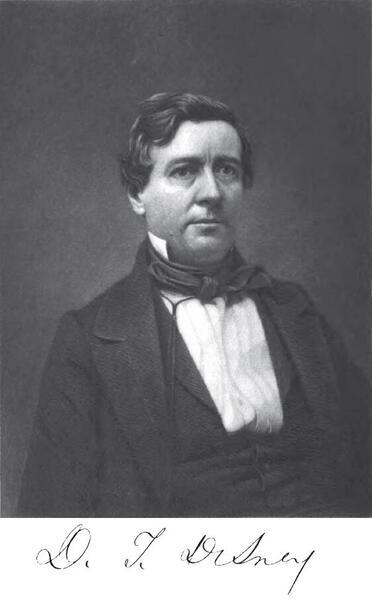
David Tiernan Disney (August 25, 1803 – March 14, 1857) was an American lawyer, state legislator, and Democratic politician who represented Ohio in the U.S. House of Representatives for three consecutive terms from 1849 to 1855. Over the course of a long public career, he rose to leadership positions in both chambers of the Ohio General Assembly, serving as speaker of the Ohio House of Representatives and as speaker of the Ohio State Senate, and later held important committee chairmanships in Congress during a pivotal period in the nation’s political history.
Disney was born on August 25, 1803, in Baltimore, Maryland. In 1807, when he was still a small child, he moved with his family to Ohio, where he spent most of his life and where his professional and political career would develop. He pursued legal studies, was admitted to the bar, and commenced the practice of law in Cincinnati, Ohio. His legal work in Cincinnati provided the foundation for his entry into public life and helped establish his reputation in the state’s growing political community.
Disney’s political career began in the Ohio House of Representatives, where he served as a member in 1829, 1831, and 1832. During his early legislative service he quickly emerged as a leader among his colleagues, and he was chosen speaker of the Ohio House for the 1832–1833 session. Following his service in the lower chamber, he moved to the Ohio State Senate. There he was immediately elected speaker of the Senate in 1833, a role that was the predecessor to the modern office of President of the Senate. He was reelected to the Senate for another term in 1834 and later returned to that body for additional terms in 1843 and 1844. Through these repeated leadership roles, Disney became one of the more prominent Democratic figures in Ohio state politics in the antebellum era.
As his influence within the Democratic Party grew, Disney participated in national party affairs. He served as a delegate to the Democratic National Convention in 1848, held in Baltimore, where the party nominated Lewis Cass of Michigan as its candidate for President. His selection as a delegate reflected his standing within Ohio’s Democratic organization and his alignment with the party’s national leadership during a time marked by sectional tensions and debates over the expansion of slavery and the future of newly acquired territories.
Disney was elected as a Democrat to the U.S. House of Representatives, winning a seat in the Thirty-first Congress and subsequently being reelected to the Thirty-second and Thirty-third Congresses, serving from 1849 to 1855. Representing Ohio in the national legislature, he contributed to the legislative process during a significant period in American history, participating in the democratic process and representing the interests of his constituents as the nation grappled with issues such as territorial expansion, the status of slavery in the territories, and the evolving balance of power between free and slave states. During the Thirty-second Congress he served as chairman of the Committee on Elections, and in the Thirty-third Congress he chaired the Committee on Public Lands, positions that placed him at the center of important questions concerning electoral disputes and the disposition and governance of federal lands. After three terms in office, he was an unsuccessful candidate for renomination in 1854, bringing his congressional career to a close.
In his later years, Disney remained associated with the Democratic Party and the public affairs of his time, though he did not return to Congress after his defeat for renomination. He died in Washington, D.C., on March 14, 1857. His remains were returned to Ohio, and he was interred in Spring Grove Cemetery in Cincinnati, reflecting the city’s central place in his professional and political life.
Congressional Record