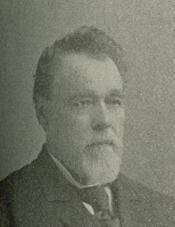
David Browning Culberson (September 29, 1830 – May 7, 1900) was a Confederate soldier, a Democratic U.S. Representative from Texas, and Chairman of the House Judiciary Committee. He served as a Representative from Texas in the United States Congress from 1875 to 1897, completing 11 consecutive terms in office during a significant period in American political and constitutional history. Over more than two decades in the House of Representatives, he participated actively in the legislative process, represented the interests of his Texas constituents, and became a prominent figure in national debates over federal power, economic policy, and legal reform.
Culberson was born in Troup County, Georgia, on September 29, 1830, the son of David B. and Lucy (Wilkerson) Culberson. He was educated at the Brownwood Institute in La Grange, Georgia, before pursuing legal studies. After leaving Brownwood Institute, he read law in Tuskegee, Alabama, under William P. Chilton, then Chief Justice of Alabama, receiving a rigorous grounding in the law through apprenticeship rather than formal law school. He was admitted to the bar in 1850 and began the practice of law in Dadeville, Alabama. On December 8, 1852, he married Eugenia Kimball; the couple had two sons, one of whom, Charles A. Culberson, would later become Governor of Texas and a United States Senator, extending the family’s influence in state and national politics. Culberson was also active in fraternal organizations, belonging to both the Masons and the Independent Order of Odd Fellows.
In 1856, Culberson moved west to Texas and settled in Upshur County, where he formed a law partnership with General Hinche P. Mabry. He practiced law there until 1861, when he moved to the nearby commercial center of Jefferson, Texas, which became his long-term home and the base of his legal and political career. His abilities as an advocate soon brought him into public life. He was elected to the Texas Legislature from Upshur County for the 1859–1860 session. Although he opposed secession, his district strongly favored it, and in deference to his constituents’ views and the mounting sectional crisis, he resigned his legislative seat. This early episode illustrated both his personal convictions and his sensitivity to the political will of his electorate.
Despite his opposition to secession, once Texas left the Union Culberson cast his lot with his state. He raised the 18th Texas Infantry for the Confederate Army and became its commander with the rank of lieutenant colonel. Under his command, the regiment saw combat, including service around Vicksburg in 1862–1863. During the war his health deteriorated, and he was reassigned to Austin as Adjutant General of Texas, where he oversaw military administrative duties. In 1864, while still a respected figure in state affairs, he was elected to the Texas Legislature from a multi-county district comprising Cass, Titus, and Bowie counties. He resigned his military position to take up this legislative role, returning to the civil sphere even before the end of the conflict.
After the Civil War, Culberson resumed his legal practice in Jefferson and quickly became one of the most prominent lawyers in East Texas. He served as one of the defense attorneys in the notable Stockade Case of 1869 and later helped defend Abe Rothschild, accused in the sensational “Diamond Bessie” murder trial, which drew wide public attention. He also worked to obtain the acquittal on treason charges of William Jesse McDonald, then a sixteen-year-old from Rusk County who would later gain fame as a Texas Ranger. Politically, Culberson remained active in the Democratic Party during Reconstruction. He attended the Democratic state convention in 1868 and served as a presidential elector in the 1872 presidential election, originally pledged to Liberal Republican and Democratic fusion candidate Horace Greeley. After Greeley’s death before the electoral votes were cast, Culberson ultimately cast his ballot for Benjamin Gratz Brown. In 1873, he was elected to the Texas State Senate representing Marion, Cass, and Bowie counties, further consolidating his influence in state politics. The following year he ran successfully for Congress from Texas’s 2nd Congressional District and resigned his state Senate seat to take his place in Washington.
Culberson’s congressional service extended from March 4, 1875, to March 3, 1897, spanning the 44th through the 54th Congresses. During these 11 terms, he represented first the 2nd District and later the 4th District of Texas as a member of the Democratic Party. He supported prohibition and was a consistent advocate of limiting federal interference in state government, reflecting a states’ rights orientation common among Southern Democrats of his era. In 1876, he favored repeal of the Specie Payment Resumption Act, aligning himself with those who opposed a rapid return to a strict gold-based currency and who sought more flexible monetary policies. In 1888, he introduced antitrust legislation in Congress, anticipating later federal efforts to regulate monopolies and corporate power. His legal expertise and long experience made him a natural leader on judicial and constitutional questions, and he eventually rose to become Chairman of the House Judiciary Committee, one of the most influential committees in the House of Representatives. Though he shared some concerns with agrarian and reform movements and could be described in certain respects as a populist, he campaigned vigorously against the Populist Party in Texas in the 1890s, viewing it as a divisive force that threatened Democratic unity and stability in state politics.
After leaving Congress in 1897, Culberson continued his public service at the national level. On June 21, 1897, President William McKinley appointed him as one of the commissioners to codify the laws of the United States, a position that drew on his deep knowledge of statutory and constitutional law and his long legislative experience. He served in this capacity until his death. Culberson died in Jefferson, Texas, on May 7, 1900, and was interred there. His career spanned the antebellum, Civil War, Reconstruction, and Gilded Age eras, and through his work as a lawyer, legislator, Confederate officer, and member of Congress, he left a lasting imprint on both Texas and national legal and political institutions.
Congressional Record