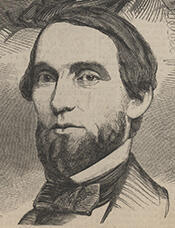
David Clopton (September 29, 1820 – February 5, 1892) was an American politician, lawyer, and jurist who served as a member of the United States House of Representatives from Alabama, a member of the Confederate States House of Representatives, a member of the Alabama Legislature, and an associate judge of the Alabama Supreme Court. A Democrat and a veteran of the Confederate Army, he participated in national and state politics during one of the most turbulent periods in American history.
Clopton was born on September 29, 1820, in what was then Georgia, and he spent his early years in the antebellum South, where the political and economic life of the region was dominated by questions of states’ rights and the expansion of slavery. He received a formal education appropriate to a young man of his background and era, studying in local schools before pursuing advanced studies. He read law in preparation for a legal career, a common path at the time, and was admitted to the bar, beginning the practice of law in Alabama. His early legal work helped establish his reputation and introduced him to the political networks that would later support his candidacies for public office.
By the 1850s, Clopton had become an active participant in Alabama’s Democratic Party, aligning himself with the dominant political current in the state. His legal practice and political engagement led to his election to the United States House of Representatives as a Democrat from Alabama. He served one term in Congress from 1859 to 1861, representing his constituents in the House of Representatives during the final years of the Union before the secession crisis. In this role, he contributed to the legislative process and participated in debates that were increasingly consumed by sectional tensions over slavery, federal authority, and the future of the Union.
Clopton’s service in the U.S. Congress coincided with a significant period in American history, as Southern states moved toward secession following the election of Abraham Lincoln in 1860. When Alabama seceded from the Union in January 1861, his tenure in the United States House of Representatives effectively came to an end. Like many Southern Democrats of his generation, he cast his lot with the Confederacy. He entered Confederate service and became a veteran of the Confederate Army, reflecting his commitment to the Southern cause during the Civil War.
In addition to his military service, Clopton continued his political career within the Confederate government. He served as a member of the Confederate States House of Representatives, where he represented Alabama in the legislative body of the Confederacy. In that capacity, he participated in shaping wartime policy and legislation for the breakaway government, working amid the severe strains of war, resource shortages, and the Confederacy’s ultimately unsuccessful struggle for independence. His dual experience in both the U.S. House of Representatives and the C.S. House of Representatives gave him a rare perspective on national governance from both sides of the Civil War divide.
After the collapse of the Confederacy in 1865, Clopton returned to Alabama and resumed his legal and political activities during the Reconstruction and post-Reconstruction eras. He served as a member of the Alabama Legislature, taking part in the effort to reestablish state government and redefine Alabama’s legal and political order in the aftermath of the war. His legislative work reflected the broader struggles of Southern states as they navigated federal oversight, the reintegration of former Confederates, and the transformation of social and economic relations following emancipation.
Clopton’s legal expertise and long experience in public life eventually led to his elevation to the judiciary. He became an associate judge of the Alabama Supreme Court, where he helped interpret state law in a period marked by ongoing disputes over civil rights, property, and the legacy of Reconstruction. As a justice, he brought to the bench the perspective of a former legislator and congressman who had witnessed the profound constitutional and political upheavals of mid-nineteenth-century America. He continued in public service until his later years, remaining a figure of influence in Alabama’s legal and political circles.
David Clopton died on February 5, 1892. Over the course of his life, he held positions at nearly every level of government—state legislator, U.S. Representative, Confederate congressman, and state supreme court judge—while also serving as a Confederate Army veteran. His career traced the trajectory of the Old South through secession, civil war, and the long, contested process of rebuilding political institutions in the postwar era.
Congressional Record