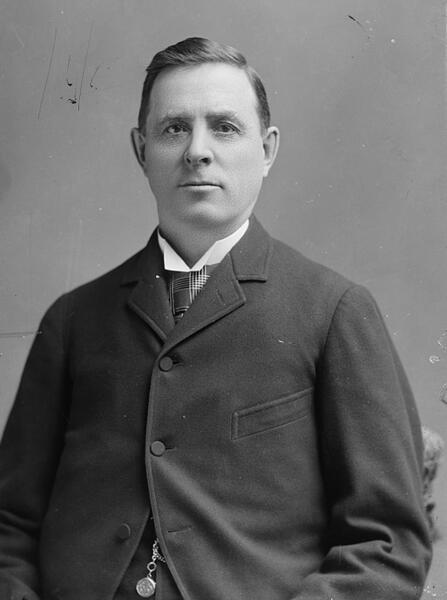
David Augustus Boody (August 13, 1837 – January 20, 1930) was an American lawyer, businessman, and Democratic politician who served as a United States Representative from New York and later as mayor of Brooklyn. His brief tenure in Congress and his longer career in municipal leadership and finance placed him at the intersection of law, politics, and commerce during a significant period in American urban and economic development.
Boody was born in a log cabin built by his father in Jackson, Waldo County, Maine, on August 13, 1837, the son of David and Lucretia Boody. He attended local common schools and then pursued further studies at Phillips Academy in Andover, Massachusetts. After completing his preparatory education, he studied law in Bangor, Maine, in the office of Charles M. Brown. Boody was admitted to the bar at Belfast, Maine, in 1860 and commenced the practice of law in Camden, Maine. During this early period of his professional life, he married Alice H. Treat.
In 1862 Boody moved to Brooklyn, New York, where he shifted his focus from law to finance, engaging in the banking and brokerage business. Establishing himself in New York’s financial community, he became a member of the New York Stock Exchange and built a substantial career in brokerage. His prominence in business was later reflected in his leadership roles as president of the Louisiana and Northwestern Railway and as vice president of the Sprague National Bank. Alongside his commercial pursuits, Boody became active in civic and educational affairs, serving as president of the Berkeley Institute in Brooklyn from 1886 to 1922, and demonstrating a long-standing interest in educational advancement.
Boody’s political career developed within the Democratic Party. He was an unsuccessful Democratic candidate for election to the Forty-eighth Congress in 1882 but remained engaged in party affairs, serving as a delegate to the Democratic National Conventions in 1884 and 1892. Elected as a Democrat to the Fifty-second Congress, he represented New York’s 2nd Congressional District in the United States House of Representatives. His service in Congress began on March 4, 1891, during a significant period in American history marked by industrial growth and political realignment. Although he contributed to the legislative process and represented the interests of his Brooklyn constituents, his tenure was brief; he resigned from the House on October 13, 1891, thus serving only part of a single term in office.
Following his resignation from Congress, Boody turned his attention to municipal leadership. He was elected Mayor of the City of Brooklyn and served in that office in 1892 and 1893. His mayoralty coincided with Brooklyn’s rapid expansion as a major urban center prior to its consolidation into Greater New York. After his term as mayor, Boody resumed his former banking and brokerage business, maintaining his position in New York’s financial community. His civic influence extended beyond elective office; beginning in 1897, he served as president of the board of trustees of the Brooklyn Public Library, a post he held until his death, guiding the development of one of the city’s principal cultural and educational institutions.
In addition to his formal offices, Boody’s prominence in Brooklyn was reflected in various honors and commemorations. Brooklyn named a fireboat after him in 1892; this vessel was operated by the Brooklyn Fire Department and, after consolidation, by the Fire Department of the City of New York (FDNY) until 1914. His long-standing membership in the New York Stock Exchange continued well into the twentieth century, and he remained active in financial circles until his retirement from the Exchange in 1926.
David Augustus Boody died in Brooklyn, Kings County, New York, on January 20, 1930, at the age of 92 years and 160 days. He was interred at Green-Wood Cemetery in Brooklyn. His name endures in the borough through David A. Boody Junior High School in Brooklyn, New York, and through the historical record of his contributions as a lawyer, financier, congressman, mayor, and civic leader.
Congressional Record