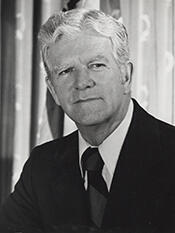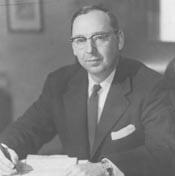
Daniel Sheffey (1770 – December 3, 1830) was a U.S. Representative from Virginia and a prominent Federalist politician and lawyer during the early national period of the United States. He was born in 1770 in Frederick, in the Province of Maryland, to Johann Adam Schieffe, a cobbler, and his wife Magdelena Loehr, who had emigrated from the Südwestpfalz region of Germany to Maryland around 1764. Largely self-educated, Sheffey pursued classical studies while growing up in modest circumstances. Apprenticed as a shoemaker in his father’s shop, he devoted his limited leisure time to observing nature and studying astronomy, cultivating the intellectual interests that would later support his legal and political career.
Upon attaining his majority, Sheffey left Maryland and walked to Winchester, Virginia, where he began working as a shoemaker and gradually accumulated the resources necessary to advance himself professionally. In 1791 he moved to Wytheville, Virginia, continuing to work at his trade while gaining a reputation locally for quick wit and considerable intellect. His abilities attracted the attention of leading figures in the region, and he was eventually received as a law student in the office of Alexander Smyth, an eminent attorney in that part of the state who would later serve as a general and commander of the northern army during the War of 1812. Under Smyth’s guidance, Sheffey read law and prepared for admission to the bar.
Sheffey was admitted to the bar on July 1, 1802, and commenced the practice of law in Wytheville. His legal career advanced rapidly, and he soon established himself as a capable advocate. Seeking broader opportunities, he later moved to Staunton, Virginia, where he continued the practice of law and became a leading member of the local bar. His professional success and growing prominence in the community led naturally into public service and political life at the state level.
Sheffey entered elective office as a member of the Virginia House of Delegates, in which he served from 1800 to 1804. He then advanced to the Virginia State Senate, serving there from 1804 to 1808. As a legislator in Richmond, he aligned with the Federalist Party, which favored a strong national government and a more commercially oriented economic policy. His performance in the state legislature, combined with his legal reputation, positioned him as a leading Federalist figure in western Virginia at a time when the Democratic-Republican Party dominated much of the state’s politics.
In 1809 Sheffey was elected as a Federalist to the U.S. House of Representatives, winning a seat in the Eleventh Congress with 66.56 percent of the vote and defeating Democratic-Republican candidate Francis Preston. He was subsequently re-elected to three succeeding Congresses, serving continuously from March 4, 1809, to March 3, 1817. In the 1811, 1813, and 1815 elections he was re-elected unopposed, reflecting his strong standing among his constituents. As a member of the Federalist Party representing Virginia, Sheffey contributed to the legislative process during four terms in office, participating in debates and votes during a significant period in American history that included the War of 1812. During his congressional service he took part in the democratic process and represented the interests of his district at a time of intense partisan division over issues such as war policy, commerce, and the scope of federal power.
On January 30, 1812, while serving in Congress, Sheffey married Maria Hanson, the daughter of Lieutenant Colonel Samuel Hanson of Mulberry Grove, Maryland, and a great-niece of John Hanson, who had served as President of the Continental Congress under the Articles of Confederation. This marriage linked Sheffey to a prominent Maryland family with deep roots in the Revolutionary era. His intellectual interests were also recognized beyond politics: in 1814 he was elected a member of the American Antiquarian Society, reflecting his engagement with historical and scholarly pursuits in addition to his legal and legislative work.
After leaving Congress in 1817, Sheffey returned to Virginia and resumed his legal practice, maintaining his residence in Staunton. He remained active in public affairs and again served in the Virginia House of Delegates in 1822 and 1823, continuing his long record of state-level service. In his later years he also held judicial responsibilities, including work associated with the Greenbrier Chancery Court, which required travel within western Virginia. His combined career as lawyer, state legislator, and congressman made him a notable Federalist voice from a region of the state where that party was relatively weak.
Daniel Sheffey died on December 3, 1830, at Warm Springs, Virginia, while traveling from a session of the Greenbrier Chancery Court back to his home in Staunton. He was buried in the churchyard of Trinity Episcopal Church in Staunton, Virginia. His life traced a path from immigrant artisan origins to influential lawyer and multi-term member of Congress, illustrating the opportunities for advancement in the early United States and marking him as a significant, if regionally focused, Federalist figure in Virginia’s political history.
Congressional Record