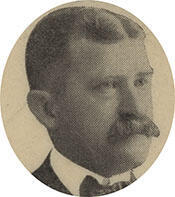
Daniel Franklin Lafean (February 7, 1861 – April 18, 1922) was an American politician and businessman who served as a Republican member of the U.S. House of Representatives from Pennsylvania from 1903 to 1913 and again from 1915 to 1917. Over the course of six terms in Congress, he contributed to the legislative process during a significant period in American history, representing the interests of his constituents in the House of Representatives.
Lafean was born in York, Pennsylvania, to German immigrants from the Province of Posen. Raised in a community with a strong German-American presence, he grew up in an environment that valued industry, thrift, and civic engagement. Although detailed records of his early formal education are limited, his later professional and civic activities suggest that he received a practical education suited to business and public life in late nineteenth-century Pennsylvania.
Before entering national politics, Lafean established himself as a prominent businessman in York. He became engaged in candy manufacturing and banking, activities that placed him at the center of the region’s growing industrial and financial life. He was the first president of the American Caramel Company, a leading confectionery firm that became well known in its era, and he later co-founded and served as president of the Keystone Color Works. His business leadership extended into civic and educational affairs: he served as a director of Gettysburg College and as a trustee of the Gettysburg Theological Seminary in Gettysburg, Pennsylvania, reflecting his interest in higher education and religious institutions. He was also active in Freemasonry and served as Worshipful Master of Zeredatha Lodge No. 451 in York in 1895.
Lafean’s prominence in business and community affairs helped pave the way for his political career. A member of the Republican Party, he was elected to the Fifty-eighth Congress and to the four succeeding Congresses, serving continuously from March 4, 1903, to March 3, 1913. During these years, he participated in the democratic process at the federal level, contributing to debates and legislation during a transformative era marked by industrial expansion, progressive reforms, and growing federal involvement in economic and social policy. He represented Pennsylvania’s interests in the House of Representatives, aligning with Republican priorities of the period, including support for business development and protective tariffs, while responding to the needs of his constituents.
In 1912, Lafean was an unsuccessful candidate for reelection to the Sixty-third Congress, temporarily interrupting his congressional service. He returned to the national legislature after winning election to the Sixty-fourth Congress, serving from March 4, 1915, to March 3, 1917. During this final term, he again took part in the legislative work of the House as the United States moved closer to involvement in World War I. He chose not to be a candidate for renomination in 1916, concluding his service in Congress after a total of six terms.
Following his departure from Congress, Lafean continued his public service at the state level. In 1917 he was appointed commissioner of banking of the Commonwealth of Pennsylvania, a position of considerable responsibility during a period of financial and economic adjustment associated with the war effort. In this capacity he oversaw aspects of the state’s banking system and regulation, drawing on his long experience in business and finance. After his tenure as banking commissioner, he again engaged in manufacturing pursuits, maintaining his ties to the industrial and commercial life of Pennsylvania.
Daniel Franklin Lafean died in Philadelphia, Pennsylvania, on April 18, 1922. He was interred in Prospect Hill Cemetery in his native York, Pennsylvania, returning in death to the community where his life in business, civic affairs, and politics had begun.
Congressional Record