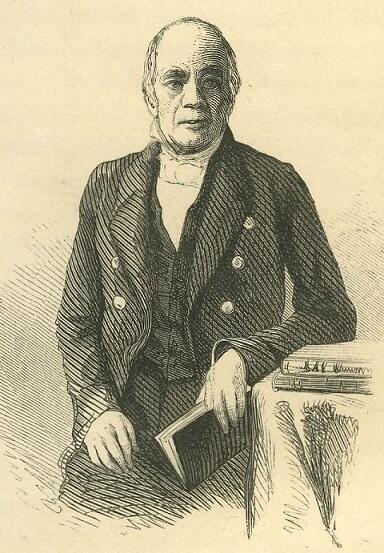
Daniel Chipman (October 22, 1765 – April 23, 1850) was an American politician, lawyer, educator, and author who served as a United States Representative from Vermont. A member of the Federalist Party, he represented Vermont for one term in Congress during a formative period in the nation’s early political history, participating in the federal legislative process and representing the interests of his constituents.
Chipman was born on October 22, 1765, in Salisbury in the Connecticut Colony, the son of Samuel Chipman and Hannah (Austin) Chipman. He was part of a prominent New England family that would produce several notable public figures, including his brothers Nathaniel Chipman, later a United States senator from Vermont and the first federal judge in Vermont, and Lemuel Chipman, who served in the New York State Assembly and the New York State Senate. Daniel Chipman pursued a classical education and graduated from Dartmouth College in 1788, an achievement that prepared him for a career in law and public service.
After completing his studies at Dartmouth, Chipman read law, was admitted to the bar, and began the practice of law in Rutland, Vermont, in 1790. He practiced in Rutland until 1794, when he moved to Middlebury, Vermont, which became the principal center of his professional and political life. In addition to his active legal practice, he trained a number of aspiring lawyers; among his law students was Charles Davis, who later served as a justice on the Vermont Supreme Court. Chipman’s legal expertise and growing reputation led to his participation in several Vermont state constitutional conventions, in which he served as a delegate in 1793, 1814, 1836, 1843, and 1850, contributing to the shaping and revision of the state’s fundamental law over more than half a century.
Chipman’s state-level political career was extensive and influential. He served multiple terms in the Vermont House of Representatives, sitting in that body from 1798 to 1808, from 1812 to 1814, again in 1818, and once more in 1821. During the sessions of 1813 and 1814 he was elected Speaker of the Vermont House of Representatives, presiding over the chamber at a time of national tension during the War of 1812. He was also a member of the Governor’s Council in 1808, further entrenching his role in Vermont’s executive and legislative affairs. Beyond elective office, he was closely associated with Middlebury College, where he was named a Charter Trustee and served in that capacity until his resignation in 1844. From 1806 until 1818 he was a professor of law at Middlebury College, one of the early law instructors in the region, and in recognition of his contributions the college awarded him an honorary LL.D. in 1848. In 1812 he was elected a Fellow of the American Academy of Arts and Sciences, reflecting his standing in the broader intellectual community.
On the national stage, Chipman was aligned with the Federalist Party and sought a seat in the United States House of Representatives multiple times. Before his eventual success, he ran unsuccessfully for Congress in 1796, 1798, 1800, 1802, and 1812. He was finally elected as a Federalist to the Fourteenth Congress and served as a United States Representative from Vermont from March 4, 1815, until his resignation on May 5, 1816. His term in Congress coincided with the closing phase of the War of 1812 and the early postwar period, a significant era in American political and economic development. During this single term in office, he contributed to the legislative process as part of the Federalist minority, participating in debates and votes that reflected both national concerns and the interests of his Vermont constituents.
After leaving Congress, Chipman continued to play an important role in Vermont’s legal and civic life. In 1824 he was appointed reporter of the superior court, responsible for compiling and publishing judicial decisions, an important function in the development of Vermont’s jurisprudence. He remained engaged in legal practice and public affairs while also devoting increasing attention to writing and scholarship. In 1828 he moved from Middlebury to Ripton, Vermont, where he continued the practice of law and pursued literary and historical work.
Chipman’s later years were marked by significant contributions to legal and historical literature. He authored a biography of his brother, titled “Life of Nathaniel Chipman,” documenting the career of the United States senator, federal judge, and former Chief Justice of Vermont during its years as an independent republic. He also wrote “Memoirs of Thomas Chittenden, First Governor of Vermont,” preserving the history of Vermont’s founding executive; “Memoirs of Col. Seth Warner,” recounting the life of the Revolutionary War officer; and an “Essay on the Law of Contracts,” reflecting his legal scholarship. In addition, his “Speech of Hon. Daniel Chipman,” published by E. R. Jewett in 1837, further illustrates his engagement with public questions of his time. Through these works he helped shape the historical record and legal understanding in Vermont and beyond.
In his personal life, Chipman married Eleutheria Hedge in 1796. The couple had four children: Austin Chipman, Sarah White Chipman, Susan Hedge Chipman, and Mary Chipman. His family maintained connections with other prominent Vermonters; his daughter Sarah White Chipman married Charles Linsley, who became a notable lawyer and public official in Vermont. These familial ties, combined with the public careers of his brothers, placed Daniel Chipman within a wider network of regional political and legal influence.
Daniel Chipman died on April 23, 1850, in Ripton, Vermont. He was interred at West Cemetery in Middlebury, Vermont, a town closely associated with his legal, educational, and political work. His legacy is reflected not only in his legislative and judicial contributions and his published writings, but also in the geography of the region; Chipman Hill in Middlebury is named in his honor, commemorating his long and varied service to Vermont and the early United States.
Congressional Record