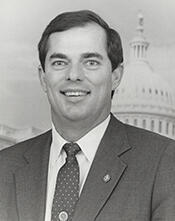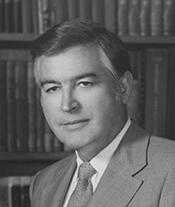
Dale Milford (February 18, 1926 – December 26, 1997) was a Democratic U.S. Representative from Texas who served three terms in the United States House of Representatives from 1973 to 1979. He was born in the small community of Bug Tussle, Fannin County, Texas, where he attended the local public schools. Growing up in rural northeast Texas during the Great Depression and World War II era, Milford’s early life was shaped by the agricultural and small-town environment of his birthplace, which later informed his understanding of the needs and concerns of his constituents.
After completing his early schooling, Milford entered the United States Army in 1944 during the final phase of World War II. He served on active duty until 1953, a period that spanned both the closing years of the war and the early Cold War era. During his nearly decade-long military career he attained the rank of captain, gaining leadership experience and exposure to emerging technologies that would later influence his professional focus on aviation and meteorology. Following his discharge from the Army, Milford pursued higher education at Baylor University in Waco, Texas, attending from 1953 to 1957. His time at Baylor coincided with the beginning of his parallel career in broadcasting and weather analysis.
Milford developed a dual professional path in aviation and meteorology in the 1950s and 1960s. He became a consultant in aviation and meteorology and operated a commercial flight service until 1958, reflecting his expertise in both piloting and weather science. At the same time, from 1953 to 1958, he served as a staff meteorologist for KWTX-TV in Waco, one of the region’s early television stations, where he helped introduce televised weather forecasting to central Texas audiences. In 1958 he moved into a larger media market when he joined WFAA-TV in Dallas as a meteorologist, a position he held until 1971. His work at WFAA-TV brought him significant public visibility across North Texas and established him as a recognizable figure in the Dallas–Fort Worth area, combining scientific knowledge with public communication skills.
Milford’s growing prominence and interest in public affairs led him into formal political activity within the Democratic Party. By the early 1970s he had become active in state party politics, serving as a delegate to the Texas State Democratic convention in 1972. This role reflected his increasing engagement with policy issues and party organization at a time when Texas politics was undergoing significant transition from one-party Democratic dominance toward a more competitive two-party system. His background in the military, aviation, and broadcasting, along with his familiarity with regional issues, positioned him as a viable candidate for national office.
In 1972 Milford was elected as a Democrat to the U.S. House of Representatives, winning a seat in the 93rd Congress and taking office on January 3, 1973. He was subsequently reelected to the 94th and 95th Congresses, serving continuously until January 3, 1979. His tenure in Congress thus spanned a significant period in American history, including the end of the Vietnam War, the Watergate scandal and the resignation of President Richard Nixon, the administration of President Gerald Ford, and the early years of the Carter administration. As a member of the House of Representatives from Texas, Milford participated in the legislative process during these turbulent years, representing the interests of his constituents and contributing to debates on national policy. His service in Congress occurred as Texas was gaining population and political influence, and he was part of the broader Democratic delegation that sought to balance regional concerns with national priorities.
During his three terms in office, Milford took part in the work of the House through committee assignments and floor activity, engaging in the democratic process on issues that affected both Texas and the nation. While specific committee assignments and legislative initiatives are documented in congressional records and his archival papers, his overall service reflected the concerns of a Sun Belt district experiencing growth, economic change, and evolving attitudes toward federal programs. He sought renomination to a fourth term in 1978 but was an unsuccessful candidate for renomination to the 96th Congress, bringing his congressional career to a close at the start of 1979.
After leaving Congress, Milford returned to private life in Texas. He remained a resident of Howe, a community in Grayson County, north of Dallas, where he lived until his death. His post-congressional years were spent outside elective office, and his career and public service are documented in the Dale Milford Papers, preserved in the Special Collections of the University of Texas at Arlington Libraries. Dale Milford died in Howe, Texas, on December 26, 1997. He was interred at Dial Cemetery in Honey Grove, Texas, not far from his birthplace in Bug Tussle, thus closing a life and career that had remained closely tied to the communities of northeast and north-central Texas.
Congressional Record