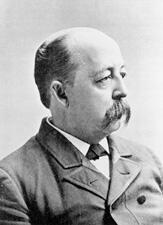
Cushman Kellogg Davis (June 16, 1838 – November 27, 1900) was an American Republican politician who served as the seventh governor of Minnesota and as a United States senator from Minnesota. Over the course of his public career he held a series of important legal and political offices at the state and federal levels, and his service in Congress from 1887 to 1901 coincided with a significant period in American history marked by industrial expansion, debates over corporate power, and the nation’s emergence as an international power.
Davis was born in Henderson, Jefferson County, New York, to Horatio N. Davis and Clarissa Cushman. Before he was a year old, his family moved west to the Wisconsin Territory, where his father later served several terms in the Wisconsin State Senate. Raised on the frontier, Davis received his early education in the Midwest and went on to attend Carroll College (now Carroll University) in Wisconsin. He later enrolled at the University of Michigan, from which he graduated in 1857. After reading law, he was admitted to the bar in 1860, beginning a legal career that would be closely intertwined with his later political life.
With the outbreak of the American Civil War, Davis entered military service in the Union Army. He served in the 28th Wisconsin Volunteer Infantry Regiment, initially as a lieutenant in charge of Company B. He saw action in the western campaigns and, in 1864, served as an aide to General Willis A. Gorman. His wartime service was cut short when he was compelled to return home in 1864 due to poor health. Seeking a more favorable climate and the restorative reputation of the city, he relocated to St. Paul, Minnesota, where he resumed the practice of law and began to build his political career.
In Minnesota, Davis quickly emerged as a prominent figure in Republican politics. He was elected to the Minnesota House of Representatives, serving from 1867 to 1868. In 1868 he was appointed United States District Attorney for Minnesota, a position he held until 1873. He resigned that federal post to run as the Republican candidate for governor of Minnesota and was elected the state’s seventh governor. Serving a single term from 1874 to 1876, he declined renomination for a second term. As governor he continued the reformist policies of his predecessor Horace Austin in attempting to curb corporate power in the state, a phenomenon he termed “Modern Feudalism.” During his administration he established a state board of railway commissioners to regulate railroads, oversaw revisions to the state constitution that allowed women to vote on school matters and hold certain elected offices, and directed state assistance to farmers suffering from a devastating locust plague.
After leaving the governorship, Davis returned to private legal practice in St. Paul and remained a leading figure at the bar. He successfully defended Judge Sherman Page in his 1878 impeachment trial before the Minnesota Senate, a high-profile case that further enhanced his reputation. Davis also entered into a notable law partnership with Frank B. Kellogg, who would later become a U.S. senator and secretary of state, and Cordenio Severance, another prominent attorney. This partnership placed Davis at the center of important legal and commercial affairs in Minnesota during the late nineteenth century.
Davis’s national political career began with his election to the United States Senate from Minnesota in 1887 as a member of the Republican Party. He served in the 50th, 51st, 52nd, 53rd, 54th, 55th, and 56th Congresses, from 1887 until his death in 1900, thus completing three full terms and part of a fourth. During his years in the Senate he contributed actively to the legislative process and represented the interests of his Minnesota constituents during a period of rapid economic and social change. He was involved in legislation concerning veterans’ pensions and supported measures related to the construction and improvement of the Soo Locks, a key infrastructure project facilitating Great Lakes commerce. Beginning in 1897, Davis served as chair of the Senate Committee on Foreign Relations, a position that placed him at the forefront of American foreign policy at the close of the nineteenth century. In that capacity he played a central role in the sequence of events leading to the Spanish–American War and participated in the negotiations in Paris that produced the Treaty of Paris of 1898, which formally ended the conflict and significantly expanded the United States’ overseas possessions.
Beyond his formal offices, Davis was active in learned and patriotic societies. He was elected a member of the American Antiquarian Society in 1894, reflecting his interest in history and letters. In 1895 he was chosen as a vice-president general of the National Society of the Sons of the American Revolution, underscoring his engagement with organizations that promoted the commemoration of the nation’s founding and the preservation of its historical legacy. His public prominence also extended into national politics more broadly, and contemporary observers took note of his influence within the Republican Party during the 1890s.
Davis’s personal life included two marriages. He married Laura Bowman in 1862, during the early years of his legal and military career. After her death, he remarried in the 1880s, taking as his wife Anna Malcom Agnew Fox. Throughout his later years he continued to reside in St. Paul, which remained his home base during his Senate service and where he was regarded as one of the city’s leading citizens.
Cushman Kellogg Davis died in office in St. Paul, Minnesota, on November 27, 1900, while still serving as a United States senator. His death brought to a close more than three decades of public service at the state and national levels. He was interred at Arlington National Cemetery in Virginia, a burial that signified national recognition of his military service in the Civil War and his long tenure in public life.
Congressional Record