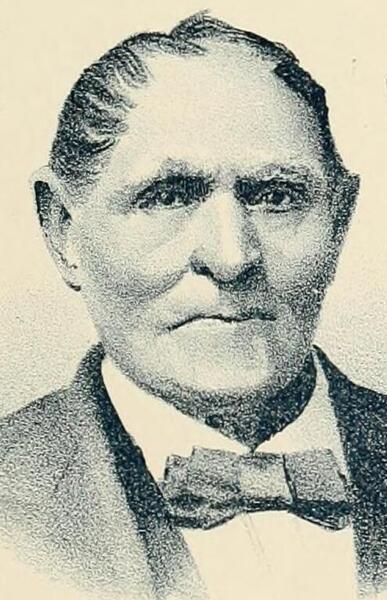
Columbia Lancaster (August 26, 1803 – September 15, 1893) was an American lawyer and Democratic politician who served as the first Delegate from the Territory of Washington to the United States House of Representatives. He was born in New Milford, Connecticut, on August 26, 1803. In 1817 he moved with his family to Canfield, Ohio, where he attended the common schools. During his years in Canfield he met and married Roseanne Jones, establishing the family ties that would accompany him through his subsequent moves across the developing American frontier.
In 1824 Lancaster moved to Detroit in the Michigan Territory, where he undertook the study of law. He was admitted to the bar in 1830 and commenced legal practice in Centreville, Michigan. His abilities as a lawyer brought him to the attention of territorial authorities, and he was appointed prosecuting attorney of Michigan Territory by Governor Lewis Cass. Lancaster also entered elective office in Michigan, serving in the Michigan House of Representatives in 1838, a period that coincided with the transition of Michigan from territorial status to statehood and gave him early experience in legislative affairs.
Seeking new opportunities in the West, Lancaster settled in the Willamette Valley in the Oregon Country in 1847. Almost immediately he became involved in the region’s provisional government, serving as Supreme Judge of the Provisional Government of Oregon from 1847 until the end of that government in 1849, when formal territorial status under the United States superseded the provisional regime. After Oregon became a U.S. territory, he took up residence near the mouth of the Lewis River in the Oregon Territory, in an area that would later become part of the present-day State of Washington. He was an unsuccessful candidate for Delegate to the Thirty-first Congress from Oregon Territory before the separation of the Territories of Washington and Oregon.
Lancaster continued his territorial political career as a member of the Oregon Territorial Council (Senate) from 1850 to 1852. During the contentious 1851–1852 session of the Oregon Territorial Legislature, he aligned himself with a minority faction consisting of four members of the House who refused to sit with the Democratic Party majority meeting at Salem. Lancaster was the sole member of the Council who joined this rump group in an effort to establish it as the legitimate Oregon Territorial Legislature in a rival session held at the Territorial Library in Oregon City. For two weeks the minority assembly met in Oregon City, producing the unusual spectacle of Lancaster making and seconding his own motions in the “Council” as its only member. He resigned his Council seat in the fall of 1852 and was replaced following a special election held on December 7 of that year.
When the newly created Washington Territory was admitted to representation in Congress, Lancaster emerged as a leading Democratic figure. He was elected as a Democrat to the Thirty-third Congress as the first Delegate from the Territory of Washington and served from April 12, 1854, to March 3, 1855. In this capacity he represented the interests of a vast and sparsely settled region during a significant period in American history, participating in the legislative process and helping to articulate the concerns of his frontier constituents in the national forum. After one term in office he was an unsuccessful candidate for renomination, ending his brief but notable congressional service.
Following his tenure in Congress, Lancaster remained active in the civic and developmental affairs of the Pacific Northwest. In 1862 he served as a regent of the University of Washington in Seattle, contributing to the early governance of the institution that would become the state’s flagship public university. That same year he was connected with the Puget Sound & Columbia River Railroad project, reflecting his interest in internal improvements and transportation links that were critical to the economic growth of Washington Territory and the broader region.
Columbia Lancaster spent his later years in what had become the State of Washington, continuing to be identified with the community he had helped to shape. He died in Vancouver, Washington, on September 15, 1893, and was interred in the City Cemetery there. His legacy is commemorated in several local landmarks: Lancaster Lake, just north of Ridgefield, Washington, bears his name, and his house in Ridgefield survives and is listed on the National Register of Historic Places, serving as a tangible reminder of his role in the legal and political development of the Pacific Northwest.
Congressional Record