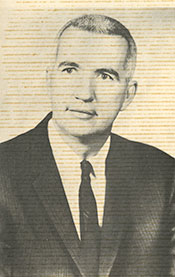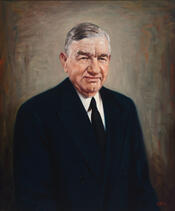
Clarence Andrew Cannon (April 11, 1879 – May 12, 1964) was a Democratic congressman from Missouri who served in the United States House of Representatives from 1923 until his death in Washington, D.C., in 1964. Over the course of 21 consecutive terms, he became the longest-serving member of the House from the state of Missouri and emerged as one of the chamber’s most influential figures in matters of procedure and federal spending. His congressional career spanned more than four decades, encompassing major events in American history from the post–World War I era through the Great Depression, World War II, the early Cold War, and the dawn of the civil rights movement.
Cannon was born on April 11, 1879, near Elsberry in Lincoln County, Missouri, into a rural community that shaped his early outlook and political sensibilities. Raised in an agricultural region along the Mississippi River, he was exposed from an early age to the concerns of small farmers and local merchants, experiences that later informed his advocacy for his largely rural constituency. His formative years in Missouri coincided with the closing of the American frontier and the rise of the Progressive Era, developments that influenced his views on government’s role in regulating the economy and providing public services.
Educated in Missouri’s public schools, Cannon pursued higher education and teacher training before entering public life. He attended La Grange College (later known as LaGrange College) in Missouri and became a schoolteacher, a profession that honed his skills in communication, organization, and leadership. His interest in law and public affairs led him to study legal principles and parliamentary practice, and he was admitted to the bar, beginning a legal career in his home state. This combination of teaching and legal work provided the foundation for his later reputation as a meticulous parliamentarian and legislative craftsman.
Cannon’s early career in public service developed through local and state roles in Missouri, where he gained experience in governance and legislative procedure. He became known for his mastery of parliamentary rules and his ability to interpret and apply them in complex situations. This expertise brought him to the attention of national Democratic leaders and helped pave the way for his election to Congress. By the early 1920s, he had established himself as a capable advocate for his region and as a Democrat aligned with the party’s national agenda during a period of Republican dominance at the federal level.
Elected as a Democrat to the United States House of Representatives in 1922, Cannon took his seat in the 68th Congress on March 4, 1923, representing a Missouri district that included many of the rural communities in which he had lived and worked. He remained in the House continuously from 1923 to 1965, serving 21 terms and contributing steadily to the legislative process. As a member of the House of Representatives, Clarence Andrew Cannon participated in the democratic process and represented the interests of his constituents through periods of profound economic and social change. He supported New Deal initiatives during the Great Depression, engaged in debates over wartime mobilization and postwar reconstruction, and took part in shaping early Cold War policy, all while maintaining a focus on the needs of his Missouri district.
Within the House, Cannon became best known as a notable parliamentarian and as one of the chamber’s leading authorities on rules and procedure. He compiled and authored influential reference works on House practice, including a widely used manual of parliamentary law that guided members in interpreting the rules of the House. His command of legislative procedure allowed him to influence the flow of business on the floor and to help his party navigate complex debates. Colleagues from both parties often relied on his interpretations in resolving procedural disputes, and his writings on parliamentary practice remained standard references for years.
Cannon’s influence reached its peak through his long association with the House Committee on Appropriations, which he eventually chaired. As chairman of this powerful committee, he played a central role in drafting and overseeing federal spending bills, shaping the allocation of funds for domestic programs, defense, and foreign aid. His tenure on Appropriations coincided with the expansion of the federal government’s role in economic management and social welfare, and he was deeply involved in the annual negotiations that determined how federal resources would be distributed. Through this position, he was able both to direct resources to Missouri and to assert broader views about fiscal policy, budget discipline, and the priorities of the federal government.
Clarence Andrew Cannon remained in active service in Congress until his death in Washington, D.C., on May 12, 1964. His more than four decades in the House made him a central participant in many of the twentieth century’s most consequential legislative struggles, and his reputation as a parliamentarian and appropriations leader left a lasting imprint on the institution. Serving from 1923 until his death in 1964, he stands as the longest-serving member of the United States House of Representatives from Missouri, remembered for his sustained engagement in the legislative process and his dedication to representing the interests of his constituents over an exceptionally long congressional career.
Congressional Record