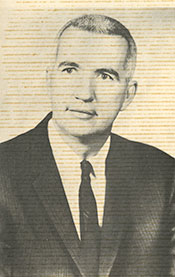
Clare Magee (March 31, 1899 – August 7, 1969) was an American lawyer and Democratic politician from Missouri who served as a member of the United States House of Representatives from 1949 to 1953. Born on a farm in Putnam County near Livonia, Missouri, he spent his early years in a rural setting that would shape his understanding of agricultural and small-town concerns. He graduated from Unionville High School in Unionville, Missouri, and went on to attend Kirksville State Teachers College and the University of Missouri. He subsequently studied law at the University of Missouri School of Law, preparing for a legal career that would run parallel to his later political service.
Magee’s early adulthood was marked by military service and frontier experience. During World War I, he served in the United States Navy as a seaman first class and small arms instructor, contributing to the war effort through training and technical expertise. After the war, he moved west and homesteaded in the Bighorn Basin region, working as a laborer for the United States Reclamation Service in Deaver, Wyoming. This period exposed him to federal land and water projects and the challenges of western development, broadening his perspective beyond his Missouri roots.
Returning to Missouri, Magee was admitted to the bar in 1922 and commenced the practice of law in Unionville. In addition to his legal work, he maintained close ties to agriculture, taking over the operation of his family’s farm in 1932. His involvement in local affairs deepened when he was appointed postmaster of Unionville, a position he held from 1935 to 1941. As postmaster, he played a central role in the community’s communications and public life during the latter years of the Great Depression, gaining administrative experience and local visibility that would later support his political career.
Magee’s life took a dramatic turn in 1941 when he was charged in the fatal shooting of his cousin, Charles Magee. The incident occurred while Charles was in police custody and reportedly distraught after having stabbed Clare’s brother, Dr. E. H. Magee. At trial, evidence indicated that Clare shot Charles under these highly charged circumstances. Magee was acquitted on a plea of temporary insanity, and he subsequently resumed his professional and public activities. The episode, though controversial, did not prevent his later military and congressional service.
With the onset of World War II, Magee again entered military service, this time in the United States Army. He initially served as a private in the Field Artillery Branch and was later commissioned as a captain in the United States Army Air Corps. He served in this capacity until the end of the war, adding to his earlier World War I naval experience and reinforcing his identification with veterans and military affairs. His dual background as a lawyer and veteran would become a defining feature of his later legislative work.
In 1948, Magee was elected as a Democrat to the Eighty-first Congress, representing Missouri in the United States House of Representatives. He was reelected in 1950 to the Eighty-second Congress and served two consecutive terms from January 3, 1949, to January 3, 1953. As a member of the Democratic Party representing Missouri, he contributed to the legislative process during a significant period in American history, participating in the democratic process and representing the interests of his constituents in the early years of the Cold War and the beginning of the Korean conflict. During his congressional career, he earned recognition for his efforts to extend G.I. Bill benefits to veterans of the Korean War, reflecting his long-standing concern for servicemembers and their reintegration into civilian life. Magee chose not to be a candidate for renomination in 1952, thus concluding his service in Congress after two terms.
After leaving Congress, Magee returned to Unionville and resumed the practice of law, continuing his involvement in the civic and professional life of his hometown while also maintaining his agricultural interests. He lived in Unionville for the remainder of his life, remaining identified with the community where he had been educated, practiced law, operated his family farm, and held federal office as postmaster and later as a member of Congress. Clare Magee died in Unionville, Missouri, on August 7, 1969, and was buried in Unionville Cemetery, closing a life that spanned rural farm origins, two world wars, legal practice, and service in the United States House of Representatives.
Congressional Record