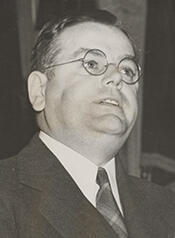
Clare Gerald Fenerty (July 25, 1895 – July 1, 1952) was a Republican member of the United States House of Representatives from Pennsylvania who served one term in Congress from 1935 to 1937. He was born in Philadelphia, Pennsylvania, where all four of his grandparents were Irish immigrants, a background that placed him within the city’s substantial Irish American community and shaped his early life in an urban, immigrant-influenced environment.
Fenerty pursued his education in Philadelphia, graduating from St. Joseph’s College in 1916. He continued his studies in law at the University of Pennsylvania, earning his degree from the law department in 1921. His legal training in one of the nation’s leading law schools prepared him for a career that combined legal practice, public service, and academic work, and anchored him firmly in the civic and professional life of his native city.
During the First World War, Fenerty served in the United States Navy in 1917 and 1918, contributing to the nation’s war effort as a young man. He later reentered naval service in 1933 as a lieutenant, senior grade, reflecting an ongoing commitment to national service during a period of global instability between the world wars. His military experience complemented his emerging legal and political career and added to his credentials as a public servant.
After completing his legal education, Fenerty embarked on a multifaceted legal career in Philadelphia. From 1924 to 1929, he served on the law faculty of the Wharton School of the University of Pennsylvania, where he helped train future lawyers and business leaders. He was a member of the Philadelphia Board of Law Examiners from 1928 to 1940, playing a role in overseeing admission to the bar. At the same time, he served as an assistant district attorney in Philadelphia from 1928 to 1935, participating in the prosecution of criminal cases and gaining substantial courtroom and public-sector experience.
Fenerty’s legal and civic work led to his election as a Republican to the 74th Congress, where he represented Pennsylvania in the United States House of Representatives from 1935 to 1937. His service in Congress occurred during a significant period in American history, in the midst of the New Deal era and the continuing challenges of the Great Depression. As a member of the House of Representatives, he participated in the legislative process, contributed to national debates, and represented the interests of his Pennsylvania constituents. A member of the Republican Party, he served one term in office and was an unsuccessful candidate for reelection in 1936.
Following his congressional service, Fenerty returned to the law and soon moved into the judiciary. In November 1939, he was appointed judge of Common Pleas Court No. 5 of Philadelphia, an important trial court in the Pennsylvania state judicial system. He was subsequently elected to a full ten-year term on that court in November 1941, confirming public support for his judicial role. In November 1951, he was reelected to another term, underscoring his standing in the legal community and his reputation as a jurist.
Clare Gerald Fenerty continued to serve on the Court of Common Pleas until his death in Philadelphia on July 1, 1952. He was interred at Holy Sepulchre Cemetery in Cheltenham Township, Pennsylvania. His career spanned military service, legal practice, academic teaching, prosecutorial work, legislative service in the U.S. Congress, and a lengthy tenure on the bench, reflecting a lifelong engagement with public service at the local, state, and national levels.
Congressional Record