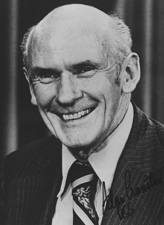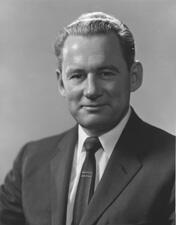
Clair Engle (September 21, 1911 – July 30, 1964) was an American politician who served as a United States senator from California from 1959 until his death in 1964. A member of the Democratic Party, he is best remembered for participating in the vote breaking the filibuster of the Civil Rights Act of 1964 in the U.S. Senate while partially paralyzed and unable to speak, shortly before his death from a brain tumor. Over the course of nine terms in the United States Congress, he contributed significantly to the legislative process during a pivotal period in American history, representing the interests of his California constituents in both the House of Representatives and the Senate.
Engle was born in Bakersfield, California, and grew up in Shasta County in northern California. He attended public schools and worked on farms and in local enterprises during his youth, gaining familiarity with the rural communities he would later represent. His early experiences in the largely agricultural and resource-based economy of northern California helped shape his later legislative focus on water development, reclamation, and infrastructure projects that would benefit similar regions throughout the state.
Engle pursued higher education at Chico State College (now California State University, Chico) and later studied law at the University of California, Hastings College of the Law in San Francisco. He was admitted to the bar in 1933 and began practicing law in Corning, California. Alongside his legal career, he became active in local civic affairs and Democratic Party politics, building a reputation as an energetic and ambitious young attorney. His early legal practice and community involvement laid the groundwork for his rapid rise in public office.
Engle’s formal political career began in the California State Senate, where he served from January to August 1943. That same year, a vacancy arose in California’s 2nd congressional district following the death of Representative Harry Lane Englebright. On August 31, 1943, Engle was elected as a Democrat to the 78th Congress to fill the vacancy, representing a district that had more Republican than Democratic voters. His victory was aided by a split in the Republican vote between Englebright’s widow and another Republican candidate. He was elected to a full term in 1944 and re-elected to the following six Congresses, serving in the U.S. House of Representatives from August 1943 until January 3, 1959. At that time, the 2nd district encompassed 18 counties in northern California and was one of the largest in the nation by area, second in size only to a district in Nevada.
The vast size of his district led Engle to obtain and use a pilot’s license so he could travel quickly among far-flung communities. He became known as the “flying congressman” and on one notable occasion flew solo from the Hybla Valley Airport in Alexandria, Virginia, back to his home in California. His energetic style, colorful language, and the presence of the geologically active Mount Lassen in his district, combined with the ever-present clouds of smoke from his cigars, earned him the nickname “Congressman Fireball.” In the House, he rose to positions of influence, serving as chairman of the U.S. House Committee on War Claims in the 79th Congress and as chairman of the U.S. House Committee on Interior and Insular Affairs in the 84th and 85th Congresses. He sponsored major expansions of the California Central Valley Project, promoted the Saline Water Conversion Research Program, and advanced a low-interest loan program for small irrigation projects, reflecting his long-standing commitment to water development and reclamation. He also became known as a key supporter of the Taft–Hartley Act, a stance that did not prevent him from being nominated by both major parties when he sought re-election.
In 1958, Engle was elected to the United States Senate from California and took office on January 3, 1959. As a senator, he continued to focus on western water issues, natural resources, and infrastructure, while also engaging in the broader national debates of the late 1950s and early 1960s. His Senate service coincided with the Eisenhower and Kennedy administrations and the early years of the Johnson administration, a period marked by the Cold War, the burgeoning civil rights movement, and significant domestic policy initiatives. Engle’s legislative work in the Senate extended his long-standing advocacy for California’s development, particularly in the areas of water supply, power generation, and regional economic growth.
Engle’s most enduring national legacy came during the Senate’s consideration of the Civil Rights Act of 1964. Stricken with a brain tumor, he had become partially paralyzed and lost the ability to speak, yet he remained determined to participate in the historic cloture vote to end the southern filibuster against the bill. On June 10, 1964, when his name was called, Engle, unable to voice his vote, pointed to his eye to signify “aye,” helping to secure the two-thirds majority needed to invoke cloture. This dramatic gesture, made while he was gravely ill, symbolized his support for civil rights legislation and became one of the most memorable moments of his career.
Clair Engle’s health continued to decline following his participation in the civil rights vote, and he remained in office until his death in Washington, D.C., on July 30, 1964. His Senate service, from 1959 until his death, capped more than two decades in public office, including his earlier tenure in the California State Senate and his long service in the U.S. House of Representatives from 1943 to 1959. Engle’s career spanned a transformative era in American politics, and he is remembered both for his vigorous representation of northern California and for his courageous role in advancing landmark civil rights legislation at the end of his life.
Congressional Record