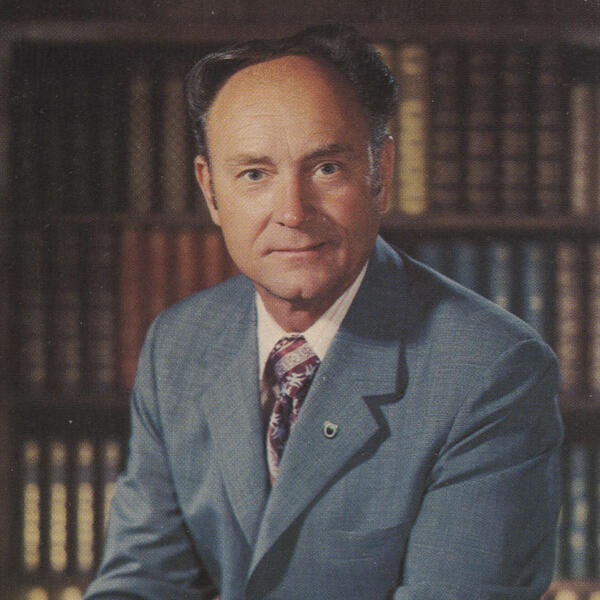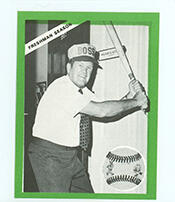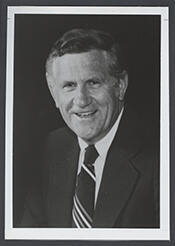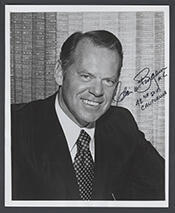
Clair Walter Burgener (December 5, 1921 – September 9, 2006) was an American World War II veteran and Republican politician who served as a member of the U.S. House of Representatives from California from 1973 to 1983. Over the course of five terms in Congress, he contributed to the legislative process during a significant period in American history, representing the interests of his constituents while maintaining a generally conservative voting record and a reputation for bipartisan cooperation on regional issues.
Burgener was born in Vernal, Utah, and spent his childhood in Vernal and Salt Lake City. Raised in the Church of Jesus Christ of Latter-day Saints, he carried his Latter-day Saint faith and values with him throughout his life and public service. After his early years in Utah, he eventually moved to California, where he would establish his professional career and enter public life.
During World War II, Burgener served in the United States Army Air Corps in the Pacific theater as a navigator. He attained the rank of second lieutenant and was awarded the Air Medal in 1945 for his service. Following the war, he returned to civilian life but was later recalled to duty during the Korean War, this time serving in the United States Air Force. His military experience, spanning two major conflicts, informed his later perspectives on national defense and veterans’ issues.
After his wartime service, Burgener pursued higher education in California. He graduated from San Diego State College (now San Diego State University) with a Bachelor of Arts degree in liberal arts. In the early 1950s, he worked as a realtor in partnership with his brother, establishing himself in the San Diego area. He also briefly pursued an interest in the performing arts; in 1951 he appeared on the stage of the Old Globe Theatre in Balboa Park, playing Elwood P. Dowd in a 33-day run of the play “Harvey.” An oft-related anecdote from this period describes how, after an oilman at a cocktail party offered him a $5,000 check to support a future political campaign, Burgener later returned the check when he decided to run for office, explaining that he believed it would be improper to accept so large a contribution from a single out-of-state donor.
Burgener’s formal political career began at the local level. He was elected to the San Diego City Council in 1953 and served until 1957. On the council, he advocated for the development of Mission Bay Park, helping to shape one of San Diego’s major recreational and tourism assets, though he later recalled that the city council post was “the job I enjoyed the least.” After several years in private life, he was elected to the California State Assembly, serving from 1963 to 1967, and then to the California State Senate, where he served from 1967 to 1973. He later described his years in the State Capitol as his most productive and rewarding in public office. Among the state legislation of which he was most proud was a 1963 measure he championed that mandated classroom training for intellectually disabled students, reflecting a lifelong concern for individuals with developmental disabilities.
In 1972, Burgener was elected to the U.S. House of Representatives as a Republican from California and took office on January 3, 1973. He served five consecutive terms, remaining in Congress until January 3, 1983. His tenure coincided with a transformative decade in American politics, spanning the end of the Vietnam War, the Watergate era, and shifting economic and social policies. While he maintained a mostly conservative voting record, he frequently crossed party lines to work with Democratic colleagues, notably fellow San Diego-area Representative Lionel Van Deerlin, to advance the interests of the San Diego region. In 1980, his district—then the most populous congressional district in the country—drew national attention when Ku Klux Klan leader Tom Metzger won the Democratic primary. State and national Democratic leaders, including Governor Jerry Brown, publicly disavowed Metzger and endorsed Burgener. Burgener’s campaign highlighted and publicized Metzger’s extremist and inflammatory statements, and he went on to win reelection with 86 percent of the vote, breaking a 40-year-old record for votes received in a House race. He chose not to seek reelection in 1982 and retired from Congress at the conclusion of his fifth term.
Following his retirement from Congress, Burgener remained active in civic and educational affairs. He was appointed a Regent of the University of California, serving on the Board of Regents from 1988 to 1997, where he participated in the governance of the state’s public research university system. His longstanding advocacy for individuals with developmental disabilities was deeply personal; after his son Rod was diagnosed as developmentally disabled, Burgener became a prominent champion of mentally and intellectually disabled children. He led and supported various associations and committees dedicated to their welfare and education, including the Clair Burgener Foundation for the Developmentally Disabled. His work in this area complemented the legislative initiatives he had advanced earlier in his career at the state level.
In his later years, Burgener lived with his wife, Marvia, in Rancho Santa Fe, California. He was diagnosed with Alzheimer’s disease, which gradually limited his public activities. Clair Walter Burgener died on September 9, 2006, in Encinitas, California. He was survived by his wife and two sons, John and Greg. His legacy in public service and advocacy is reflected in institutions that bear his name, including the Clair Burgener Academy in Oceanside, California, and the Clair Burgener Clinical Research Diagnostic Unit at the University of California, San Diego, both of which continue his commitment to education, research, and support for individuals with developmental disabilities.
Congressional Record