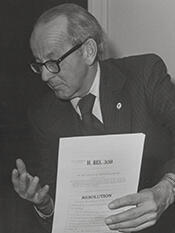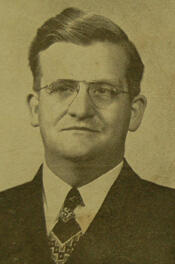
Chester Earl Merrow (November 15, 1906 – February 10, 1974) was a Republican member of the United States House of Representatives from New Hampshire who served ten consecutive terms in Congress from 1943 to 1963. His congressional career spanned World War II, the early Cold War, and the beginnings of the modern civil rights era, during which he represented the interests of his New Hampshire constituents while participating in major national legislative debates.
Merrow was born in Center Ossipee, Carroll County, New Hampshire, on November 15, 1906. He attended the public schools of his hometown and then Brewster Free Academy in Wolfeboro, New Hampshire, from 1921 to 1925. Pursuing higher education in New England, he enrolled at Colby College in Waterville, Maine, from which he graduated in 1929. He continued his academic training in education by attending Teachers College of Columbia University in New York City during the summers, completing his studies there in 1937. This combination of liberal arts and professional training in education shaped his early career and informed his later interest in international educational and cultural affairs.
Following his graduation from Colby College, Merrow embarked on a career in secondary and postsecondary education. He served as an instructor of science at Kents Hill School in Kents Hill, Maine, in 1929 and 1930. In 1930 he joined Montpelier Seminary in Montpelier, Vermont, as a science instructor, remaining there until 1937. While at Montpelier Seminary he advanced to the position of assistant headmaster, serving in that administrative role from 1935 to 1938. During this period he also broadened his teaching portfolio, becoming an instructor of political science and history at Vermont Junior College in Montpelier in 1937 and 1938. His work as a teacher and administrator reflected a sustained commitment to education that would later be evident in his international assignments.
Merrow entered public life in New Hampshire at the close of the 1930s. He was elected to the New Hampshire House of Representatives, serving as a state legislator in 1939 and 1940. Around this time he also became active as a radio news commentator and lecturer, roles that increased his public visibility and allowed him to comment on national and international affairs during a period marked by global conflict and the approach of World War II. His interest in education and international relations led to his selection as a delegate to an international conference on education and cultural relations of the United Nations held in London in 1945, as the postwar international order was being formed.
In 1942 Merrow was elected as a Republican to the Seventy-eighth Congress, and he took his seat in the U.S. House of Representatives on January 3, 1943. He was subsequently reelected to the nine succeeding Congresses, serving continuously until January 3, 1963. During his twenty years in the House, he participated in the legislative process through a period that included the end of World War II, the onset of the Cold War, and the domestic transformations of the 1950s and early 1960s. He was involved in representing New Hampshire’s interests on a wide range of issues and took part in deliberations on civil rights, foreign policy, and federal domestic programs. Reflecting his engagement with international educational and cultural policy, he served as a congressional adviser to the first conference of the United Nations Educational, Scientific, and Cultural Organization (UNESCO) held in Paris in 1946, and he was a member of the United States delegation to UNESCO from 1946 to 1949.
Merrow’s voting record in Congress included support for key early civil rights legislation. He voted in favor of the Civil Rights Act of 1957 and the Civil Rights Act of 1960, measures that sought to strengthen federal protection of voting rights and enforcement of civil rights in the states. When the proposed Twenty-fourth Amendment to the United States Constitution, which would ultimately prohibit the use of poll taxes in federal elections, came before the House, he voted “present,” neither supporting nor opposing the measure on the record. After ten terms in the House, he chose not to be a candidate for reelection in 1962 to the Eighty-eighth Congress, instead seeking the Republican nomination for the United States Senate from New Hampshire. His bid for the Senate nomination was unsuccessful, bringing his continuous congressional service to a close in January 1963.
Following his departure from Congress, Merrow continued his involvement in public service at the federal level. From 1963 to 1968 he served in the Department of State as Special Adviser on Community Relations, a position that placed him at the intersection of domestic community concerns and the department’s broader public and international outreach during a period marked by social change and the expansion of federal civil rights and community programs. He remained active in electoral politics as well, seeking a return to Congress from New Hampshire. He was an unsuccessful candidate for election in 1970 to the Ninety-second Congress and again in 1972 to the Ninety-third Congress.
In his later years, Merrow resided in his native Center Ossipee, New Hampshire, maintaining his ties to the community where he had been born and educated. He died there on February 10, 1974. Chester Earl Merrow was interred in Chickville Cemetery in Center Ossipee, closing a life that combined careers in education, state and national politics, and international cultural and educational affairs.
Congressional Record