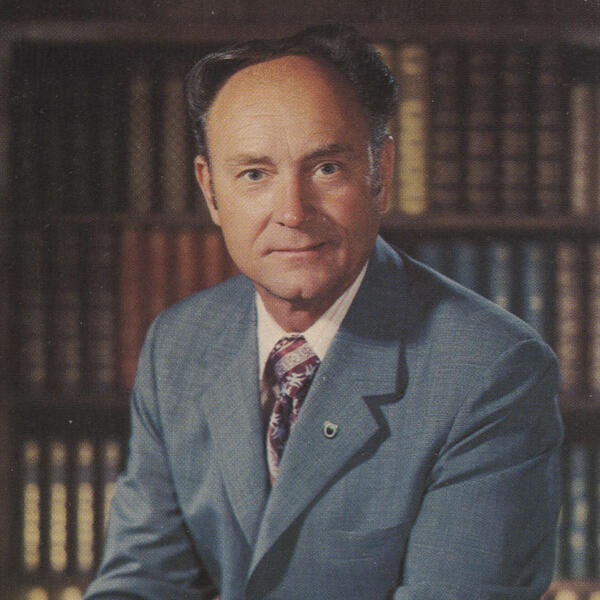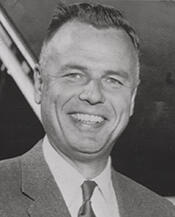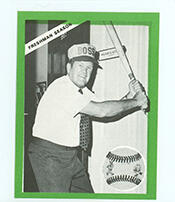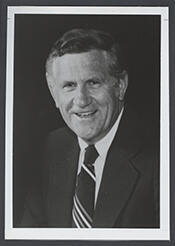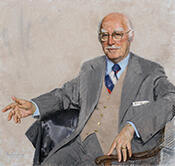
Chester Earl Holifield (December 3, 1903 – February 6, 1995) was a 20th‑century American businessman and Democratic politician who served as a United States Representative from California from 1943 to 1975. Representing California’s 19th congressional district for 16 consecutive terms, he became nationally known as “Mr. Atomic Energy” for his central role in shaping federal policy on nuclear power and atomic energy.
Holifield was born in Mayfield, Kentucky, and moved with his family to Springdale, Arkansas, in 1912. He attended the public schools there before relocating in 1920 to Montebello, California, a growing community in Los Angeles County. In Montebello he entered the private sector, working in the manufacture and selling of men’s apparel, a line of business he pursued from 1920 to 1943. In 1922 he married Vernice Caneer; the couple had four daughters. His early experience as a small businessman in Southern California helped shape his understanding of economic and labor issues that would later inform his legislative work.
Holifield’s involvement in Democratic Party politics began at the local and regional levels in California during the 1930s. He served as chair of the Los Angeles County Democratic Central Committee of the 51st District from 1934 to 1938, and then as chair of the California State Central Committee of the 12th congressional district from 1938 to 1940. His growing prominence within the party led to his selection as a delegate to every Democratic National Convention from 1940 through 1964, placing him in the midst of national party deliberations during the New Deal, World War II, and the early Cold War eras. His political work during this period laid the foundation for his successful bid for Congress.
In 1942 Holifield was elected as a Democrat to the U.S. House of Representatives from California’s 19th congressional district and took his seat on January 3, 1943. He served continuously from that date until his resignation on December 31, 1974, choosing not to be a candidate for reelection to the 94th Congress in 1974. His 16 terms in office spanned World War II, the Cold War, the Korean and Vietnam conflicts, and major domestic transformations in American society. During World War II, he was one of the relatively few members of the California congressional delegation to object to the internment of Japanese Americans, marking an early and notable stance on civil liberties during a period of intense wartime pressure.
Over the course of his congressional career, Holifield became a key figure in oversight of the federal government and in the development of atomic energy policy. He served as chair of the U.S. House Committee on Government Operations during the 91st through 93rd Congresses, where he exercised broad jurisdiction over the efficiency and accountability of federal agencies. Even more prominently, he chaired the Joint Committee on Atomic Energy in the 87th, 89th, and 91st Congresses. In this capacity he was deeply involved in legislation and oversight concerning nuclear weapons, civilian nuclear power, and the Atomic Energy Commission, and he emerged as one of the most influential congressional voices on atomic affairs. His expertise and advocacy earned him the sobriquet “Mr. Atomic Energy,” reflecting his strong support for the expansion and technological development of nuclear power.
Holifield’s engagement with atomic energy extended beyond the halls of Congress into national and international forums. In 1946 he served as a member of the President’s Special Evaluation Commission on Atomic Bomb Tests at Bikini Atoll, which assessed some of the earliest postwar nuclear weapons tests. In the late 1950s and early 1960s, as a member of the House Military Operations Subcommittee, he became a prominent advocate of civil defense measures, including fallout shelters, arguing that the United States should “build a nationwide system of underground shelters” to protect the civilian population in the event of nuclear war. He also served as a congressional adviser to a series of international conferences on the peaceful uses of atomic energy, nuclear weapons testing, water desalinization, and disarmament, helping to shape U.S. positions in emerging global nuclear policy. His strong commitment to nuclear development sometimes brought him into conflict with advocates of more stringent safety measures; nuclear scientist Alvin M. Weinberg later recounted a 1972 exchange in which Holifield told him, “if you are concerned about the safety of reactors, then I think it may be time for you to leave nuclear energy.”
Holifield’s long tenure in Congress coincided with a period of rapid growth and change in California, and he consistently participated in the legislative process on behalf of his constituents while engaging in broader national policy debates. As a member of the House of Representatives, he contributed to the democratic process through his committee leadership, floor work, and involvement in major legislative initiatives, particularly those touching on government operations and the nation’s nuclear infrastructure. His service in Congress thus occurred during a significant period in American history, and he played a notable role in shaping federal policy in the mid‑20th century.
After resigning from Congress on December 31, 1974, Holifield returned to private life and resumed the manufacture and selling of men’s apparel, reconnecting with the business career that had preceded his decades in public office. He continued to reside in Southern California, and in retirement he lived in a beach house in Balboa, California. His contributions were recognized by academic and public honors: in 1966 he was awarded an honorary Doctor of Laws (LL.D.) degree from Whittier College. The Chet Holifield Library in Montebello, California, named in his honor, opened in 1969, and the Chet Holifield Federal Building in Laguna Niguel, California, was renamed for him in 1978, reflecting his lasting impact on the region and on federal service.
Holifield’s personal life remained closely tied to his family. He and his wife, Vernice Caneer Holifield, were married for nearly seven decades until her death in 1991. Chester Earl Holifield died of pneumonia on February 6, 1995, in Redlands, California. His career and influence on atomic energy policy have been the subject of scholarly study, including works such as Richard Wayne Dyke’s “Mr. Atomic Energy: Congressman Chet Holifield and Atomic Energy Affairs from 1945 to 1974” and Dyke and Francis X. Gannon’s “Chet Holifield: Master Legislator and Nuclear Statesman,” which underscore his reputation as a master legislator and a central figure in the history of U.S. nuclear policy.
Congressional Record