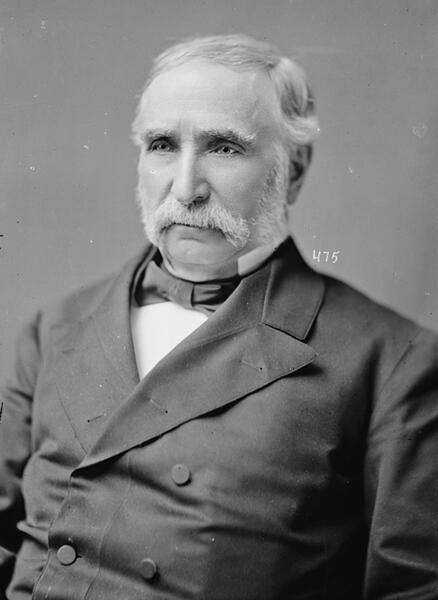
Chester William Chapin (December 16, 1798 – June 10, 1883) was an American businessman, railroad executive, and Democratic Representative from Massachusetts who played a notable role in the economic and political life of New England in the nineteenth century. Born in the closing years of the eighteenth century, he rose from modest beginnings to become a multimillionaire and one of the region’s leading transportation magnates, ultimately controlling one of New England’s most important rail lines. His career culminated in national office as a member of the United States House of Representatives, where he served a single term during a transformative period in American history.
Chapin’s early life unfolded against the backdrop of a young and rapidly developing United States, and he came of age as New England’s commercial and industrial economy was expanding. Entering business at a time when improvements in transportation were reshaping regional and national markets, he developed an aptitude for enterprise that would define his later career. Through persistence and an ability to recognize emerging opportunities in infrastructure and commerce, he steadily advanced from local business ventures into larger-scale operations that connected communities and facilitated trade.
By the mid-nineteenth century, Chapin had become deeply involved in the transportation sector, particularly in railroads, which were then revolutionizing travel and commerce. His most prominent business role was as president of the Boston and Albany Railroad, a key trunk line linking the Atlantic seaboard with the interior. He held this position from 1868 to 1878, a decade in which the railroad industry was central to the economic growth of New England and the nation. Under his leadership, the Boston and Albany Railroad solidified its status as one of the region’s most important rail lines, and his control over this enterprise contributed significantly to the fortune that made him a multimillionaire by the time of his death in 1883.
Chapin’s prominence in business and his standing in Massachusetts society led naturally to involvement in public affairs and politics. A member of the Democratic Party, he entered national politics during the post–Civil War era, when questions of reconstruction, industrialization, and regional development dominated the national agenda. Drawing on his experience in commerce and transportation, he was well positioned to represent the interests of a state whose prosperity was closely tied to trade, manufacturing, and infrastructure.
Chester William Chapin served as a Representative from Massachusetts in the United States Congress from 1875 to 1877. Elected as a Democrat to the House of Representatives, he served one term in the Forty-fourth Congress. During this period, he participated in the legislative process at a time when the nation was grappling with the aftermath of the Civil War, the end of Reconstruction, and the rapid expansion of industry and railroads. In Congress, he represented the interests of his constituents and contributed to debates shaped by economic modernization and shifting political alignments, bringing to bear his extensive experience as a railroad executive and businessman.
In addition to his business and political activities, Chapin also engaged in cultural and commemorative projects that reflected both family pride and the civic culture of New England. In 1881, he commissioned the noted sculptor Augustus Saint-Gaudens to produce a sculpture of his forefather, Deacon Samuel Chapin, an early settler of Springfield, Massachusetts. The resulting work, titled The Puritan, became one of Saint-Gaudens’s most famous sculptures. Although Chapin did not live to see its public unveiling—the piece was not released until 1887, four years after his death—it stands as a lasting testament to his interest in memorializing his family’s role in the region’s history.
Chester William Chapin died on June 10, 1883, having lived through and helped shape a period of profound economic and social transformation in the United States. At the time of his death he was widely recognized as a leading figure in New England’s railroad industry and as a man whose wealth and influence had grown in tandem with the rise of modern transportation. His legacy encompassed not only his decade-long presidency of the Boston and Albany Railroad and his term in Congress, but also his contributions to the civic and cultural life of Massachusetts, symbolized in part by the posthumous unveiling of The Puritan in honor of his ancestor.
Congressional Record