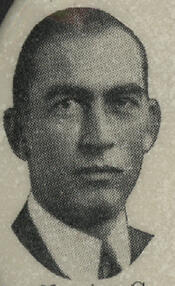
Chester Castle Bolton (September 5, 1882 – October 29, 1939) was a Republican U.S. Representative from Ohio who served in the United States Congress from 1929 to 1937 and again from 1939 until his death in 1939. Over the course of five terms in office, he represented Ohio’s 22nd congressional district and contributed to the legislative process during a significant period in American history, spanning the onset of the Great Depression and the prelude to World War II. He was the husband of Frances Payne Bingham Bolton, who succeeded him in Congress, and the father of Oliver P. Bolton; Frances and Oliver Bolton would later become the first mother and son to serve simultaneously in Congress.
Bolton was born in Cleveland, Ohio, on September 5, 1882, and was educated in the city’s public schools. He graduated from the University School in Cleveland in 1901 and went on to attend Harvard University, from which he graduated in 1905. While at Harvard he was a member of the Delphic Club, reflecting his early engagement in collegiate social and professional networks that would later support his business and political career.
Following his graduation from Harvard, Bolton returned to Cleveland and entered the steel industry, becoming a business industrialist in that sector from 1905 to 1917. During this same period, he began a parallel career in military service, joining the Ohio National Guard in 1905 and serving until 1915. In 1907 he married Frances Payne Bingham, a member of a prominent Cleveland family who would later have a distinguished congressional career of her own. The couple had four children: Charles B. Bolton, Oliver Payne Bolton, Kenyon C. Bolton, and Elizabeth Bolton.
With the entry of the United States into World War I, Bolton’s military responsibilities expanded. He was commissioned as a captain in the Reserve Corps and was ordered into active service in March 1917. Initially detailed to the War Industries Board, he then served as aide to the Assistant Secretary of War. Later in 1917 he was transferred to the General Staff, where he was promoted to the rank of lieutenant colonel. He was detailed to the 101st Division as Assistant Chief of Staff and served in that capacity until his discharge in December 1918. His wartime assignments placed him at the intersection of military planning and industrial mobilization during a critical phase of the conflict.
After his discharge, Bolton returned to Cleveland and resumed his business activities, serving as a director of several large corporations. He also developed a notable agricultural enterprise, raising and breeding a renowned Guernsey cattle herd at Franchester Farms on the Bolton family’s 65-acre estate, “Franchester Place,” in Lyndhurst, Ohio. His interest in local affairs led him into public service at the municipal level, and he served as a member of the Lyndhurst Village Council from 1918 to 1921, marking his formal entry into elective office.
Bolton’s political career advanced to the state level when he was elected to the Ohio State Senate, where he served from 1923 to 1928. During his tenure in the Senate he rose to a leadership position, serving as president pro tempore in 1927 and 1928. In 1928 he further solidified his standing within the Republican Party by serving as a delegate to the Republican National Convention. These roles positioned him for national office and established his reputation as a capable party leader and legislator.
In 1928 Bolton was elected as a Republican to the Seventy-first Congress from Ohio’s 22nd congressional district and took office on March 4, 1929. He was subsequently reelected to the three succeeding Congresses, serving continuously from 1929 until January 3, 1937. His service in the House of Representatives coincided with the stock market crash of 1929, the Great Depression, and the early years of the New Deal, during which he participated in the democratic process and represented the interests of his constituents in northeastern Ohio. Within the party organization, he held a key strategic role as chairman of the Republican Congressional Campaign Committee in 1934 and 1936, helping to direct Republican electoral efforts during a period of Democratic dominance. He was an unsuccessful candidate for reelection in 1936 to the Seventy-fifth Congress, temporarily interrupting his congressional service.
Bolton returned to the House after winning election to the Seventy-sixth Congress in 1938, again representing Ohio’s 22nd district. He began this new term on January 3, 1939, and served until his death on October 29, 1939, in Cleveland, Ohio, thus completing part of his fifth term in Congress. His service in Congress, spanning five terms between 1929 and 1941 as recorded in contemporary accounts, reflected a sustained engagement with national legislative affairs during a transformative era in American political and economic life. Following his death, his wife, Frances P. Bolton, was elected to serve out the remainder of his term and was repeatedly reelected by the 22nd District through the late 1960s, ultimately serving for 29 years in the House of Representatives. Their son, Oliver P. Bolton, would also serve in Congress, and together Frances and Oliver became the first mother-and-son pair to serve simultaneously in the United States Congress.
Chester C. Bolton was interred in Lake View Cemetery in Cleveland, a resting place for many of the city’s prominent figures. His son Oliver P. Bolton was interred there in 1972, and his wife, Frances P. Bolton, was interred there in 1977, underscoring the family’s enduring association with Cleveland and its civic life.
Congressional Record