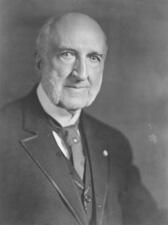
Chauncey Mitchell Depew (April 23, 1834 – April 5, 1928) was an American attorney, businessman, and Republican politician, best remembered for his two terms as United States Senator from New York and for his long association with Cornelius Vanderbilt and the New York Central Railroad System, where he rose to the presidency and later chairmanship of the board. He was born in Peekskill, New York, on April 23, 1834, to Isaac Depew (1800–1869), a merchant and farmer who pioneered river transportation between Peekskill and New York City, and Martha Minot (Mitchell) Depew (1810–1885). His paternal line traced back to François DuPuy, a French Huguenot who purchased land from Native Americans at the present site of Peekskill. Through his mother, he was descended from Rev. Josiah Sherman, a Revolutionary War chaplain with the rank of captain and brother of founding father Roger Sherman, and from Rev. Charles Chauncy, the second president of Harvard College.
Depew received his early education at the Peekskill Military Academy, where he studied for twelve years before entering Yale College in 1852. At Yale he was an active and distinguished student, joining numerous clubs and societies and earning several academic honors. He received second dispute appointments in both his junior and senior years and was chosen as an honored speaker at the Junior Exhibition and at Commencement. Depew was a member of the Thulia Boat Club, Kappa Sigma Epsilon, Kappa Sigma Theta, Psi Upsilon, and the secret society Skull and Bones, and he served as the third president of the Linonian Society. Among his classmates were future United States Supreme Court Justices David Josiah Brewer and Henry Billings Brown. He graduated from Yale in 1856, after which he returned to Peekskill to prepare for a legal career.
Following his graduation, Depew read law in the office of Edward Wells in Peekskill and continued his legal studies with William Nelson. He was admitted to the New York State bar in March 1858 and opened a law office in Peekskill, where he practiced until 1861. For a brief period he engaged in the brokerage business in New York City as a member of the firm Depew & Potter, but soon resumed his law practice in Peekskill and later moved permanently to New York City. During the American Civil War, he served in the New York National Guard as adjutant of the 18th Regiment and later as colonel and judge advocate of the 5th Division on the staff of Major General James W. Husted of the New York Guard. In 1865 he was appointed and confirmed as United States Minister to Japan, but he declined the diplomatic post in order to pursue his growing career as a railroad and business lawyer. As a young lawyer and political activist, he campaigned across New York State for John C. Frémont in the 1856 presidential election and for Abraham Lincoln in 1860.
Depew’s formal political career began in state and local office. He represented Westchester County in the New York State Assembly in 1862 and 1863, and during the latter year he occasionally acted as Speaker pro tempore while Speaker Theophilus C. Callicot was under investigation. In 1863 he was elected Secretary of State of New York on the Union ticket, serving from 1864 to 1865. He briefly held the post of clerk of Westchester County in 1867 before resigning, and in 1870 the New York Legislature named him Immigration Commissioner, a position he declined. Over the years he also served as commissioner of quarantine, president of the Court of Claims of New York City, and commissioner of taxes and assessments for the city and county of New York. He was appointed one of the commissioners to build the New York State Capitol in 1874 and served on the state boundary commission in 1875. In 1872 he ran unsuccessfully for Lieutenant Governor of New York on the Liberal Republican–Democratic ticket. His oratorical gifts brought him national prominence; in 1886 he delivered the principal oration at the unveiling of the Statue of Liberty, and on October 7, 1897, he inaugurated the New York pneumatic tube mail system with a widely quoted address extolling speed and modern communication in the growing metropolis.
Depew’s most significant business career was in the railroad industry, particularly within the Vanderbilt interests. In 1866 he became attorney for the New York & Harlem Railroad, owned by Cornelius Vanderbilt. Three years later he assumed the same role for Vanderbilt’s New York Central and Hudson River Railroad. His effective work with these and other subsidiary companies led to his appointment in 1876 as general counsel and director of the entire “Vanderbilt System.” He joined the executive board of the New York Central & Hudson River Railroad in 1882 and was elected its second vice president. In 1885 he became president of the railroad, a position he held until 1898, when he was succeeded by Samuel R. Callaway. Thereafter he served as chairman of the board of directors of the New York Central Railroad Company, a post he retained until his death in 1928. While primarily associated with the Vanderbilt railroads, Depew simultaneously held numerous other corporate positions. He was president of the West Shore Railroad and sat on the boards of the New York and Harlem Railroad, the Chicago and North Western Railway, the Chicago, St. Paul, Minneapolis and Omaha Railway, the Cleveland, Cincinnati, Chicago and St. Louis Railroad, the Delaware and Hudson Railroad, the New Jersey Junction Railroad, the St. Lawrence and Adirondack Railroad, the Wallkill Valley Railroad, and the Canada Southern Railroad. Outside the railroad sector, he served as a director of Western Union, the Hudson River Bridge Company, the Niagara River Bridge Company, the New York State Realty & Terminal Company, the Union Trust Company, Equitable Life Assurance Company, and the Kensico Cemetery Association. In 1904 he was among several prominent investors who backed the Intercontinental Correspondence University, an educational venture that ultimately failed and folded by 1915.
On the national political stage, Depew became a leading Republican figure and convention orator. He served as a delegate-at-large to each Republican National Convention from 1888 to 1904 and was elected a delegate to all subsequent conventions, including that of 1928, to which he was chosen the day before his death. At the 1888 convention he received 99 votes for the Republican presidential nomination. He delivered nominating speeches for Benjamin Harrison in 1892 and for former Vice President Levi P. Morton in 1896, and in 1904 he gave the renomination speech for Vice President Charles W. Fairbanks. Depew was a candidate for the United States Senate in a special election in 1881 but withdrew his name after the forty-first ballot, and he declined another opportunity for a Senate nomination in 1885. In 1898 he placed Theodore Roosevelt’s name in nomination for Governor of New York at the Republican state convention, further cementing his role as a party elder and influential spokesman.
Depew’s long-sought service in the United States Senate began at the close of the nineteenth century. A member of the Republican Party, he was elected from New York and served two terms in the United States Senate from March 4, 1899, to March 3, 1911. He was re-elected in 1905 and represented New York during a significant period in American history marked by rapid industrialization, the Progressive Era, and expanding federal power. As a senator, Depew participated in the legislative process and the broader democratic life of the nation, representing the interests of his New York constituents while maintaining his close ties to the railroad and business communities. His prominence and corporate connections also made him a target of reformers. In 1906, journalist David Graham Phillips launched a muckraking series in William Randolph Hearst’s Cosmopolitan magazine titled “The Treason of the Senate,” in which Depew was the first senator attacked. Phillips accused him of being a “boodler” owned “mentally and morally” by railroad magnates Cornelius and William Vanderbilt. The article provoked strong reactions, including outrage from President Theodore Roosevelt, the New York Sun, and Senator Henry Cabot Lodge, and it became part of the larger Progressive critique of corporate influence in the Senate.
In his personal life, Depew married twice. On November 9, 1871, he wed Elise Ann Hegeman (1848–1893) in New York City, the daughter of William and Eliza Jane (Nevin) Hegeman. The couple had one son, Chauncey Mitchell Depew Jr. (1879–1931), who never married. Elise Depew died on May 7, 1893. On December 27, 1901, Depew married May Eugenie Palmer (1866–1940) in Nice, France; she was the daughter of Henry and Alice (Hermann) Palmer. Depew was an Episcopalian and attended Saint Thomas Episcopal Church in New York. His social and civic life in New York City reflected his status as a leading lawyer, railroad executive, and political figure in the Gilded Age and Progressive Era.
In the spring of 1928, while returning from Florida to Manhattan, Depew became ill and developed bronchial pneumonia. He died in Manhattan on April 5, 1928, just weeks short of his ninety-fourth birthday and shortly after his election as a delegate to the 1928 Republican National Convention. He was buried in the family mausoleum in Hillside Cemetery in his native Peekskill, New York. In recognition of his long service to the New York Central Railroad and his prominence in public life, the great concourse of Grand Central Terminal in New York City was draped in mourning in his honor.
Congressional Record