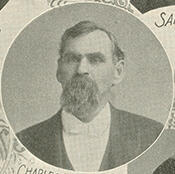
Charles Henderson Yoakum (July 10, 1849 – January 1, 1909) was a Democratic U.S. Representative from Texas who served one term in the United States Congress from 1895 to 1897. Born near Tehuacana in Lincoln County, Texas—an area that later became part of Limestone County—he grew up in a period of rapid change in Texas during the post–Civil War era. He was a member of a prominent family; his brothers included Benjamin Franklin Yoakum, a noted railroad executive, and Finis E. Yoakum, a faith healer and social reformer.
Yoakum pursued his early education in Texas, attending Larissa College in Cherokee County and later Cumberland College. After completing his studies, he read law and prepared for a legal career in a state still developing its judicial and political institutions. He was admitted to the bar in 1874 and began the practice of law in Emory, the county seat of Rains County, Texas, marking the start of a professional life that would combine legal practice with public service.
Soon after entering the legal profession, Yoakum moved into public office. In 1876 he was appointed or elected prosecuting attorney for Rains County, where he gained experience in criminal law and local governance. Seeking broader opportunities, he relocated in 1883 to Hunt County and established himself in Greenville, Texas. There he continued his legal practice and became increasingly involved in regional affairs, positioning himself for higher office within the state’s judicial system.
Yoakum’s growing reputation led to his service as district attorney for the eighth judicial district of Texas from 1886 to 1890. In this capacity he oversaw prosecutions across a multi-county district, reinforcing his standing as a capable lawyer and public official. Building on this record, he entered state-level politics and served as a member of the Texas Senate from 1892 to 1896. His tenure in the state legislature coincided with significant debates over economic development, railroads, and agrarian interests in Texas, and it provided him with legislative experience that would inform his later work in Congress.
In national politics, Yoakum was elected as a Democrat to the Fifty-fourth Congress and served in the U.S. House of Representatives from March 4, 1895, to March 3, 1897. Representing Texas during a significant period in American history marked by economic realignment and the aftermath of the Panic of 1893, he participated in the legislative process and represented the interests of his constituents in the House of Representatives. His single term in Congress reflected both the competitive nature of Texas politics in the late nineteenth century and the shifting priorities of the Democratic Party during that era.
After leaving Congress, Yoakum returned to Greenville, Texas, where he resumed the practice of law. He continued his legal career there until 1900, when he moved to Los Angeles, California. His relocation to California was part of a broader westward movement of many Americans at the turn of the century, though he maintained his ties to Texas. In 1904 he returned to his home state, closing the California chapter of his life and reestablishing himself in Texas.
Charles Henderson Yoakum died in Fort Worth, Texas, on January 1, 1909. He was interred in Myrtle Cemetery in Ennis, Texas. His career, spanning local prosecutorial work, service as a district attorney, membership in the Texas Senate, and a term in the U.S. House of Representatives, reflected the trajectory of a nineteenth-century Texas lawyer who rose through successive levels of public office while remaining closely connected to the legal profession and to the evolving political life of his state.
Congressional Record