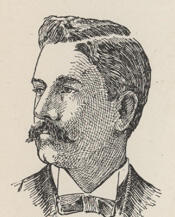
Charles Kennedy Wheeler (April 18, 1863 – June 15, 1933) was a Democratic U.S. Representative from Kentucky who served three consecutive terms in the United States Congress from 1897 to 1903. His congressional career spanned a significant period in American history marked by overseas conflict, debates over imperial expansion, and shifting U.S. foreign policy, during which he represented Kentucky’s First Congressional District and participated actively in the legislative process on behalf of his constituents.
Wheeler was born on April 18, 1863, near Hopkinsville in Christian County, Kentucky. He was the youngest of twelve children born to Dr. James Wheeler and Elizabeth (Watkins) Wheeler. His father, a physician, had immigrated from England around 1830, and the family’s professional and immigrant background helped shape Wheeler’s outlook and opportunities. Raised in rural western Kentucky, he received his early education from a private tutor, an arrangement that allowed him to advance rapidly in his studies and prepare for higher education at an unusually young age.
At seventeen, Wheeler graduated from Southwestern University in Clarksville, Tennessee, an institution that later became part of what is now Rhodes College in Memphis, Tennessee. He then pursued legal training at Cumberland University in Lebanon, Tennessee, a prominent Southern law school of the era, from which he graduated in 1880. That same year, through the enactment of a special grant by the Kentucky state legislature, he was admitted to the bar despite his youth and promptly commenced the practice of law in Paducah, McCracken County, Kentucky. On October 10, 1888, he married Mary Kirkpatrick Guthrie; the couple had four children: James Guthrie Wheeler, Mary Wheeler, Charlotte Wheeler, and Margaret Wheeler.
Wheeler quickly gained prominence in Paducah as a lawyer and public speaker. Known as an outstanding orator, he frequently campaigned on behalf of Democratic candidates for office, building a reputation as an effective advocate for his party. He served as an assistant presidential elector for the Democratic Party in the presidential elections of 1884 and 1888 and was the presidential elector for Kentucky’s First District in 1892. That same year, he was elected city solicitor of Paducah, a position he held until 1896. In this role he honed his skills in municipal law and public administration, further elevating his profile within both local and state Democratic circles.
In 1896, Wheeler was elected as a Democrat to represent Kentucky’s First District in the U.S. House of Representatives. He served in the Fifty-fifth, Fifty-sixth, and Fifty-seventh Congresses from March 4, 1897, to March 3, 1903. During his three terms in office, he contributed to the legislative process at a time when the United States was grappling with the aftermath of the Spanish–American War, the question of colonial acquisitions, and an expanding role on the world stage. He secured significant federal appropriations for projects in his district, including the expansion of a federal courthouse in Paducah and measures for the protection of a local ice harbor, reflecting his attention to infrastructure and economic development at home. As a member of the House Naval Affairs Committee, he used his influence to secure the naming of the gunboat USS Paducah in honor of his home city. He was later chosen to deliver the presentation address when the city of Paducah presented a silver service for use on the ship, and in recognition of his service, the Paducah Company of the Kentucky State Guard adopted the name “The Wheeler Guard” in his honor.
Wheeler’s congressional tenure was also marked by outspoken positions on foreign policy and American involvement abroad. He criticized what he viewed as British interference in American affairs, particularly British efforts to discourage U.S. involvement in the Cuban War of Independence and to enlist American citizens for service in the Second Boer War. He directed sharp criticism at the administration of Republican President Theodore Roosevelt, and especially Secretary of State John Hay, accusing them of bringing the country to “this humiliating condition.” A vigorous opponent of American imperial expansion, he vehemently opposed U.S. efforts to purchase the Philippines from Spain for $20 million following the Spanish–American War. In 1902, he achieved national prominence when he denounced an official reception for Prince Henry of Prussia and the planned attendance of Alice Roosevelt at the coronation of King Edward VII, characterizing such displays as “flunkeyism” and “toadyism.” His remarks drew mixed reactions in the press, but they were widely reported, and President Roosevelt ultimately cancelled his daughter’s trip to the coronation, underscoring the impact of Wheeler’s criticism.
Wheeler did not seek renomination to Congress in 1902. He aspired instead to a seat in the United States Senate, but despite his prominence and oratorical gifts, he was never seriously considered as a candidate by the Kentucky state legislature, which at that time still elected U.S. Senators. After leaving Congress in March 1903, he returned to Paducah and resumed the practice of law, forming a firm with D. H. Hughes and W. A. Berry. His firm became a training ground for younger lawyers, among them Alben W. Barkley, who would later serve as a U.S. Representative, U.S. Senator from Kentucky, and Vice President of the United States under President Harry S. Truman. Wheeler supported Barkley’s political rise and campaigned on his behalf when Barkley sought election to Wheeler’s former congressional seat in 1912, thereby extending his influence into the next generation of Kentucky political leadership.
In his later years, Wheeler remained an active figure in the civic and social life of Paducah. In 1913, he became a charter member and the first president of the Paducah Country Club, reflecting his standing in the community’s professional and social circles. He participated in various civic organizations and was a member of Grace Episcopal Church in Paducah, demonstrating an ongoing engagement with local institutions beyond the realm of partisan politics. Charles Kennedy Wheeler died in Paducah on June 15, 1933, and was interred in Oak Grove Cemetery. His papers, spanning the years 1879 to 1933, are preserved in the University of Kentucky Libraries Special Collections Research Center, providing a documentary record of his legal career, political service, and role in Kentucky and national affairs.
Congressional Record