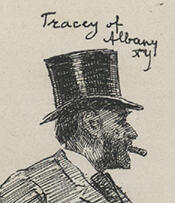
Charles Tracey (May 27, 1847 – March 24, 1905) was a Democratic member of the United States House of Representatives from New York who served four consecutive terms in Congress from 1887 to 1895. He was born in Albany, New York, the son of John Tracey and Maria McCarthy Tracey. His father, born in Ireland, emigrated to Canada at the age of fourteen with his older brother Daniel and sister Ann, who later married Charles Wilson, and subsequently moved to Albany after the Patriot War of 1837. His mother was born on the Isle of Wight, the daughter of an officer in the British Army. Charles Tracey grew up in a family that would become notable in public service and the law, with his brothers achieving distinction in military, legal, and judicial careers.
Tracey’s family environment was marked by a strong emphasis on education and civic engagement. His older brother, John Tracey Jr. (November 30, 1842 – May 17, 1897), graduated from Mount St. Mary’s School in Maryland in 1859 and from Albany Law School in 1862. John Jr. served in the Union Army during the Civil War, rising from lieutenant to lieutenant colonel in the 18th New York Volunteer Cavalry and later receiving a brevet as colonel from New York Governor Reuben Fenton for his service under Colonel James J. Byrne and Colonel Oliver P. Gooding during the Red River campaign. In 1893 he was appointed superintendent of charities for the District of Columbia by President Grover Cleveland. Charles’s younger brother, James Francis Tracey (May 30, 1854 – September 19, 1925), attended the Albany Academy, earned an A.B. degree from Georgetown College in Washington, D.C. in 1874, and an LL.B. from Albany Law School in 1875. James practiced law in Albany, taught at Albany Law School, and, after appointment by President Theodore Roosevelt, served as an associate justice of the Supreme Court of the Philippines from 1905 to 1909; Georgetown University conferred upon him an honorary LL.D. in 1910.
Within this accomplished family, Charles Tracey’s own education and early professional formation took place in Albany, where he was raised and where he would later center much of his business and political life. On June 14, 1883, he married Marie-Anne Marguerite-Hermine Juchereau “Hermine” Duchesnay in Montreal, Quebec, Canada. The marriage linked him to a prominent French Canadian family and they had a daughter and four sons. By the time of his entry into national politics, Tracey had established himself as a figure of some standing in New York’s civic and business circles, particularly in Albany and Rochester, which provided a base of support for his later congressional career.
A member of the Democratic Party, Tracey was elected to the United States House of Representatives from New York and served from 1887 to 1895, encompassing four terms in office. His tenure in Congress coincided with a significant period in American history marked by rapid industrialization, labor unrest, and debates over tariffs, monetary policy, and federal regulation. As a member of the House of Representatives, he participated in the legislative process and represented the interests of his New York constituents, contributing to the deliberations and decisions that shaped federal policy in the late nineteenth century. During these years, he was part of the Democratic contingent in the House as the party alternated in national power and grappled with issues central to the Gilded Age, including economic development and the role of government in addressing emerging social and economic challenges.
Tracey’s congressional service placed him among the Democratic lawmakers who navigated the shifting political landscape of the 1880s and 1890s, including the administrations of Presidents Grover Cleveland and Benjamin Harrison. In this capacity, he participated in the democratic process at the national level, helping to articulate and advance the concerns of urban and upstate New York communities. His four-term tenure reflected sustained electoral support and suggested a reputation for reliability and effectiveness among his constituents during a time of intense partisan competition and regional realignment.
After leaving Congress in 1895, Tracey returned to Albany, where he resumed his business activities, maintaining interests in both Albany and Rochester, New York. That same year he was reappointed to the Board of Managers of the House of Refuge by Governor Levi P. Morton, underscoring his continued involvement in public affairs and institutional oversight. His work on the Board of Managers reflected an ongoing concern with charitable and corrective institutions, consistent with broader late nineteenth-century efforts to reform and professionalize public welfare and correctional systems.
In his later years, Tracey continued to reside in Albany, remaining connected to the civic and social life of the city. In late December 1904, suffering from a liver ailment, he traveled to Watkins Glen, New York, seeking treatment. His health did not improve sufficiently, and he returned to his home in Albany, where he died on March 24, 1905, at the age of 57. Charles Tracey was interred in St. Agnes Cemetery in Menands, New York, a burial place for many of the region’s prominent Catholic families. His life and career, framed by his family’s immigrant origins and their collective ascent into public service, left a record of sustained engagement in lawmaking, institutional governance, and civic leadership in New York and the broader United States.
Congressional Record