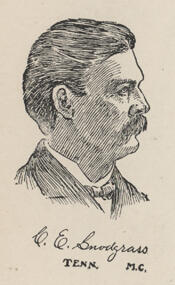
Charles Edward Snodgrass (December 28, 1866 – August 9, 1936) was an American politician, lawyer, and jurist who served as a Democratic Representative from Tennessee in the United States Congress from 1899 to 1903. He represented Tennessee’s 4th congressional district in the Fifty-sixth and Fifty-seventh Congresses and later became a prominent judge in the Tennessee state judiciary.
Snodgrass was born on December 28, 1866, near Sparta, in White County, Tennessee, the son of Thomas Snodgrass and Eliza Jane Evans Snodgrass. He was a nephew of Henry C. Snodgrass, who also represented Tennessee in the United States House of Representatives. Raised in rural Middle Tennessee, he attended the common schools of the area, receiving a basic formal education that prepared him for the study of law. On June 30, 1889, he married Lola Adel Webb, and the couple had nine children, establishing deep family and professional roots in the region.
After completing his early schooling, Snodgrass studied law and was admitted to the bar. In 1888 he commenced the practice of law in Crossville, Tennessee, in Cumberland County. His legal practice quickly became the foundation of a public career that would span several decades. Practicing in a small but growing community on the Cumberland Plateau, he gained recognition as an able attorney and civic figure, and he later practiced law in partnership with his son in a building on the courthouse square in Crossville, a structure that would eventually be renamed in his honor.
Elected as a Democrat, Snodgrass won a seat in the United States House of Representatives from Tennessee’s 4th congressional district and served two consecutive terms. He took his seat in the Fifty-sixth Congress on March 4, 1899, and was re-elected to the Fifty-seventh Congress, serving until March 3, 1903. His tenure in Congress coincided with a significant period in American history, marked by the aftermath of the Spanish–American War, the nation’s growing international presence, and domestic debates over economic and social policy. As a member of the House of Representatives, Charles Edward Snodgrass participated in the legislative process, contributed to deliberations on national issues, and represented the interests of his constituents in Tennessee’s 4th district. He was an unsuccessful candidate for re-election in 1902, bringing his congressional service to a close after two terms in office.
Following his departure from Congress, Snodgrass returned to Tennessee and resumed his legal career, which soon led him into judicial service. He became a judge of the fifth judicial circuit of Tennessee, presiding over trial courts and gaining a reputation for his knowledge of the law and his judicial temperament. When the Tennessee court system was reorganized, he was appointed and subsequently elected as a judge of the Tennessee Court of Appeals. He served on that appellate court from 1925 until 1934, when he retired from the bench and returned to private life in Crossville. His long judicial career extended his influence on Tennessee law well beyond his years in elective legislative office.
In his later years, Snodgrass remained a respected figure in Crossville and throughout the region. The building on the courthouse square in Crossville where he and his son had practiced law was renamed in his honor, reflecting his enduring impact on the local legal community. His family connections to public service and military distinction were notable: in addition to being the nephew of Congressman Henry C. Snodgrass, he was the father-in-law of Milo Lemert, a World War I Medal of Honor recipient.
Charles Edward Snodgrass died in Crossville, Tennessee, on August 9, 1936, at the age of 69 years, 219 days. He was interred at Crossville City Cemetery. His career as a lawyer, congressman, and judge, together with his family’s continued public service, secured his place in the civic and political history of Tennessee.
Congressional Record